
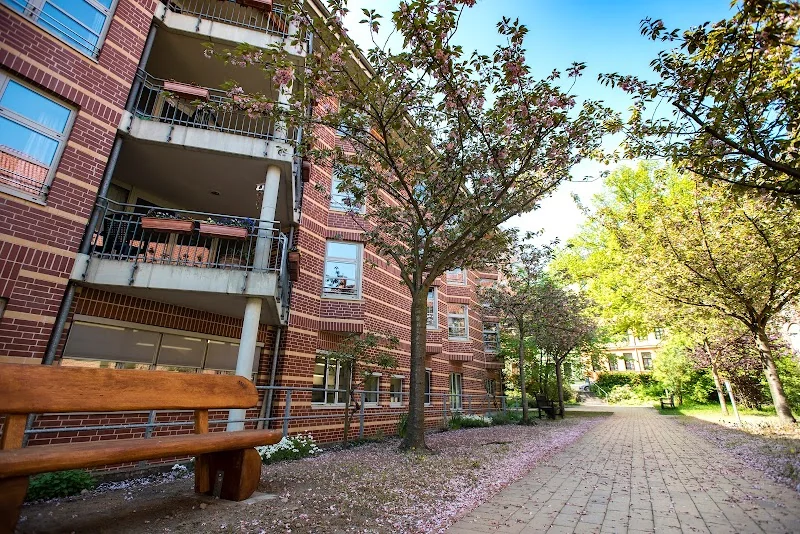
Schäferstraße 17, Schwerin
Schäferstraße 17, 19053 Schwerin, Germany
Augustenstift zu Schwerin | Photos & Nursing Home
Those looking for photos, impressions, and reliable information about the Augustenstift zu Schwerin usually want to first understand what this institution actually is and why it plays such a special role in Schwerin. The Augustenstift is not a classic event venue, but a church-influenced network for living and caring that has existed since 1855 and today unites several services under one roof or within the same network. The main location is at Schäferstraße 17 in the Schwerin Feldstadt, near the old town and in a historic environment that gives the house a calm yet urban atmosphere. Those who want to orient themselves visually can find images, interior views, and contact paths for relatives, residents, and interested parties on the website. ([augustenstift.de](https://www.augustenstift.de/))
Photos, first impressions, and why the Augustenstift is so often sought
The search term photos usually indicates not only interest in images but also in orientation. People want to know how the house feels, whether it is bright and friendly, whether it looks more like a clinic or a residential building, and what atmosphere visitors can expect. This is exactly where the Augustenstift zu Schwerin reveals its special character: The institution is historically rooted, clearly oriented towards modern care and living forms, and embedded in an environment that does not feel anonymous. The site of today's nursing and care home was built in 1995 on the former house garden, and the website describes the house as a senior facility in a historic convent garden near the Schwerin old town. This mix of history, greenery, and urban location makes the first visual impression particularly striking. ([augustenstift.de](https://www.augustenstift.de/stationaere-pflege.html))
For the visual language of the institution, it is important that not just a single house is shown, but a whole network with different living and care situations. The website mentions a cafeteria with terrace, large hall, hair salon, church hall, devotions, services, exhibitions, concerts, senior sports, excursions, and celebrations. This creates not a sterile impression but the image of a house where everyday life, community, and care are closely intertwined. Those looking for photos usually want to see exactly this mix: private retreats, friendly common rooms, and a place where not only care is provided but also life is lived. The imprint also points to various image sources, confirming that the website works visually and does not only provide dry text information. ([augustenstift.de](https://www.augustenstift.de/stationaere-pflege.html))
Particularly relevant is the location in the Schwerin Feldstadt. The district is central enough for relatives and visitors to plan their routes well, and at the same time quiet enough to create a homely environment. The proximity to the old town and the historical development of the house ensure that photos here do not only show a building but a piece of Schwerin's social history. Those who want to get an impression before a visit should therefore not only search for exterior views but also for interior spaces, garden motifs, and community situations. This helps in deciding whether the institution meets one's expectations, care needs, and desired living feeling. ([augustenstift.de](https://www.augustenstift.de/stationaere-pflege.html))
Inpatient care in the historic Augustenstift
The inpatient care is the heart of the Augustenstift zu Schwerin. The official site describes the house as an evangelical nursing and care home with 105 places in 77 single and 14 double rooms. These numbers give a good impression of the size: The house is large enough for a diverse range of services but remains manageable enough to enable personal care and reliable structures. Residents should feel comfortable regardless of their denomination, and they can furnish their rooms with their own furniture. This is an important point, as familiarity plays a significant role in care. Those who bring familiar furniture, pictures, or small everyday objects often experience the move less as a break and more as a new focal point. ([augustenstift.de](https://www.augustenstift.de/stationaere-pflege.html))
The room furnishings are also clearly described. Under the roof of the Augustenstift, there are bright single and double rooms with a view of the garden. Each room has a small hallway, a shower room, a nursing bed, a built-in wardrobe, a call system, and television and telephone connections. This is important for everyday safety, but also for independence and the private feeling in the room. Those looking for a nursing home in Schwerin usually pay attention to this mix of functionality and homeliness. The Augustenstift does not focus solely on a medical character but on a house that combines care, safety, and privacy. ([augustenstift.de](https://www.augustenstift.de/stationaere-pflege.html))
The care itself is, according to the website, individually and activating oriented. The focus is on the self-determination of the care recipients, and in special care situations, a professional, tailored care is offered. Additionally, further services are available in the house when prescribed by a doctor, including occupational therapy, physiotherapy, speech therapy, and podiatry. There are also active life and leisure activities as well as various senior sports options. This combination makes inpatient care in the Augustenstift interesting: It is not just about care but about activity, maintaining abilities, and a lively everyday life. ([augustenstift.de](https://www.augustenstift.de/stationaere-pflege.html))
Social and spiritual life also plays a significant role. On the ground floor, there is a cafeteria with a terrace, a large hall, and a hair salon. Daily devotions take place, and every Sunday a service is celebrated in the church hall. The house also organizes exhibitions, concerts, senior sports, excursions, and celebrations. These offerings are an important quality feature for many relatives because they show that residents do not live in isolation but remain part of an active house. The Augustenstift thus combines traditional diaconal influence with a modern understanding of living and care. ([augustenstift.de](https://www.augustenstift.de/stationaere-pflege.html))
The history of the house reinforces this impression. The Augustenstift has been accompanying seniors in Schwerin since 1855. The name goes back to Grand Duchess Auguste of Mecklenburg-Schwerin, who founded the Augustenstift as a poorhouse and hospital for needy people at the current location. The current home was built in 1995 and thus stands for a connection between historical tradition and modern care architecture. Those researching inpatient care in Schwerin therefore receive not only an institution but a house with a long social memory that has developed over many decades. ([augustenstift.de](https://www.augustenstift.de/))
Assisted living and shared apartments in the Feldstadt
The Augustenstift offers not only inpatient care but also various living forms for people who want to remain as independent as possible in old age. According to the website, assisted living is aimed at older people aged 60 and above who want to manage their everyday lives independently and self-determined but desire additional services and community. In assisted living, each resident rents their own complete apartment with kitchen and bathroom. This form is particularly attractive for people who appreciate safety and support but do not want to give up their private everyday life. The range of offerings shows that the Augustenstift covers very different life situations and focuses not only on care but also on quality of living. ([augustenstift.de](https://www.augustenstift.de/betreutes-wohnen.html))
In the Old Augustenstift, there are 25 two-room apartments. The renovated house is listed as a historic monument and is centrally located in the Schwerin Feldstadt. The apartments can accommodate up to two residents but are also suitable for individuals. Those living there can access a wide range of additional services, such as lunch in the neighboring Augustenstift, a hairdresser, a cafeteria, or a kiosk. There are also cultural offerings and a service every Sunday in the church hall. These facts are particularly relevant for search terms like Assisted Living Schwerin or Senior Apartment Schwerin because they show that the house offers more than just living space. It is an organizationally embedded, socially supported living environment. ([augustenstift.de](https://www.augustenstift.de/betreutes-wohnen.html))
Another living option is assisted living on Gartenstraße. There are ten two-room apartments in a quiet but centrally located house in the middle of the Feldstadt. Four apartments are wheelchair accessible, six barrier-free, and each apartment has a loggia or balcony. On the ground floor, there are common rooms available, and the house is easily accessible by car, bus, and train. This living form is interesting for people who value having their own apartment but want to benefit from short distances, barrier-free access, and community. The proximity to other offerings of the Augustenstift creates additional security in everyday life. ([augustenstift.de](https://www.augustenstift.de/betreutes-wohnen.html))
Particularly exciting is the assisted senior shared apartment in Gartenhöhe. There, residents live in six rooms of about 20 square meters each with their own bathroom. A communal area of about 100 square meters with a living kitchen and living room creates space for joint activities. The concept combines privacy with community and is thus suitable for seniors who desire social closeness without wanting to give up their own room. Additionally, there are hairdressers, cultural events, sports offerings, and pastoral care in the neighboring Augustenstift. This makes Gartenhöhe an important building block in the network for people. ([augustenstift.de](https://www.augustenstift.de/betreutes-wohnen.html))
Even more specialized is the outpatient-supported shared apartment for people with dementia in Gartenhöhe 6c. There, eight residents can live largely self-determined in bright, modern apartments with their own bathroom. Presence staff support with everyday tasks and accompany the daily routine, while additional care services can be provided by a freely chosen care service. A large living area and a shared kitchen complement the private retreat spaces. This offering is particularly important because it responds to a sensitive care field: people with dementia need structure, security, and orientation, but also as much independence as possible. The Augustenstift clearly describes this middle ground. ([augustenstift.de](https://www.augustenstift.de/demenz-wg.html))
Short-term care, day care, and outpatient nursing service
In addition to permanent living forms, the Augustenstift also offers flexible solutions for transitional phases and relief. The short-term care in Gartenhöhe has 24 places in 8 single and 8 double rooms. According to the website, it is easily accessible and suitable for people who need temporary support after a hospital stay or whose relatives need relief. Particularly important is that cultural, creative, and communicative offerings can be utilized directly on site as well as in the neighboring Augustenstift. This way, the stay is not limited to pure care but retains a practical and social framework. ([augustenstift.de](https://www.augustenstift.de/kurzzeitpflege.html))
The second short-term care is named Friedensberg and was opened in August 2019. It is located in the premises of the former Station M4 of the Helios Kliniken Schwerin and is thus optimally connected to the hospital. The facility has 24 places in 2 single and 11 double rooms. Many rooms offer a view over the Ziegelsee, in summer there is a sun terrace, and in winter a fireplace room. These details are particularly interesting for search queries like short-term care Schwerin or vacation with care level because they show that the facility is not only functional but also pleasantly designed. Additionally, the Augustenstift explicitly focuses on the topic of vacation and respite care in its offerings. ([augustenstift.de](https://www.augustenstift.de/kurzzeitpflege.html))
The day care in the Wittrock House is aimed at people who wish for care during the day and return to their own four walls in the evening. The facility cares for up to 18 day guests daily from 8 a.m. to 4 p.m. During the stay, breakfast, lunch, coffee, cake, and fruit meals are offered. Additional offerings include bowling, sports, newspaper rounds, bingo, memory training, singing, game afternoons, excursions to the surrounding area, as well as pastoral offerings and church festivals. The Wittrock House is located in the heart of Schwerin's Paulsstadt, just a few minutes' walk from the main train station and directly connected to bus and tram. For relatives, this form is particularly attractive because it combines relief and structure. ([augustenstift.de](https://www.augustenstift.de/tagespflege.html))
The outpatient nursing service complements the network with home care. It supports people in Schwerin seven days a week and 365 days a year. Services range from personal care, assistance with meals and movement to accompaniment on walks and care in the home. In addition, the service offers additional services such as emergency call phones, meals on wheels, courier services, accompaniment to pharmacies, doctors, authorities, or post offices, as well as to events and walks if needed. For people who want to stay in their own home but rely on secure support, this is a very important complement to the inpatient and part-inpatient offerings. ([augustenstift.de](https://www.augustenstift.de/ambulanter-pflegedienst.html))
Directions, contact, and advice in the network for people
The main location of the Augustenstift is at Schäferstraße 17, 19053 Schwerin. The central administration is located at Wismarsche Straße 298, 19055 Schwerin, and is easily accessible via tram lines 1 and 4 at the Lewenberg stop. There are also parking spaces available. For relatives and interested parties, the advisory center for living and care is the central point of contact when it comes to suitable offerings, financing, care insurance, or orientation in the network. This structure is a great advantage because it brings together not just a single location but several suitable solutions for different life situations. ([augustenstift.de](https://www.augustenstift.de/kontakt.html))
The network for people unites, according to its own statement, 14 facilities for elderly care in the Schwerin urban area. These include outpatient, pre-stationary, and stationary offerings. This networking is particularly important because care needs can change over time. Those living in their own apartment today may need day care tomorrow, short-term care later, and finally inpatient care. The Augustenstift can accompany such transitions within a network. Additionally, there is pastoral care, medically safe structures, and a close connection to diaconal and social services. For users, this creates not just a house but a coordinated care system. ([augustenstift.de](https://www.augustenstift.de/))
Especially when searching for photos and first impressions, this connection of location, contact, and offering is crucial. Those visiting the house quickly notice that not only care is organized here but a daily life with advice, community, and support. The combination of traditional history, central location in Schwerin, barrier-free living forms, short-term care, day care, and outpatient support makes the Augustenstift a versatile address for older people and their families. Those who want to orient themselves in advance should read the pages on inpatient care, assisted living, short-term care, day care, and outpatient services in context because they together provide the complete picture of the institution. ([augustenstift.de](https://www.augustenstift.de/stationaere-pflege.html))
Sources:
- Augustenstift zu Schwerin - History and Network
- Augustenstift zu Schwerin - Inpatient Care
- Augustenstift zu Schwerin - Assisted Living
- Augustenstift zu Schwerin - Short-Term Care
- Augustenstift zu Schwerin - Day Care
- Augustenstift zu Schwerin - Outpatient Nursing Service
- Augustenstift zu Schwerin - Dementia WG
- Augustenstift zu Schwerin - Contact
Show moreShow less
Augustenstift zu Schwerin | Photos & Nursing Home
Those looking for photos, impressions, and reliable information about the Augustenstift zu Schwerin usually want to first understand what this institution actually is and why it plays such a special role in Schwerin. The Augustenstift is not a classic event venue, but a church-influenced network for living and caring that has existed since 1855 and today unites several services under one roof or within the same network. The main location is at Schäferstraße 17 in the Schwerin Feldstadt, near the old town and in a historic environment that gives the house a calm yet urban atmosphere. Those who want to orient themselves visually can find images, interior views, and contact paths for relatives, residents, and interested parties on the website. ([augustenstift.de](https://www.augustenstift.de/))
Photos, first impressions, and why the Augustenstift is so often sought
The search term photos usually indicates not only interest in images but also in orientation. People want to know how the house feels, whether it is bright and friendly, whether it looks more like a clinic or a residential building, and what atmosphere visitors can expect. This is exactly where the Augustenstift zu Schwerin reveals its special character: The institution is historically rooted, clearly oriented towards modern care and living forms, and embedded in an environment that does not feel anonymous. The site of today's nursing and care home was built in 1995 on the former house garden, and the website describes the house as a senior facility in a historic convent garden near the Schwerin old town. This mix of history, greenery, and urban location makes the first visual impression particularly striking. ([augustenstift.de](https://www.augustenstift.de/stationaere-pflege.html))
For the visual language of the institution, it is important that not just a single house is shown, but a whole network with different living and care situations. The website mentions a cafeteria with terrace, large hall, hair salon, church hall, devotions, services, exhibitions, concerts, senior sports, excursions, and celebrations. This creates not a sterile impression but the image of a house where everyday life, community, and care are closely intertwined. Those looking for photos usually want to see exactly this mix: private retreats, friendly common rooms, and a place where not only care is provided but also life is lived. The imprint also points to various image sources, confirming that the website works visually and does not only provide dry text information. ([augustenstift.de](https://www.augustenstift.de/stationaere-pflege.html))
Particularly relevant is the location in the Schwerin Feldstadt. The district is central enough for relatives and visitors to plan their routes well, and at the same time quiet enough to create a homely environment. The proximity to the old town and the historical development of the house ensure that photos here do not only show a building but a piece of Schwerin's social history. Those who want to get an impression before a visit should therefore not only search for exterior views but also for interior spaces, garden motifs, and community situations. This helps in deciding whether the institution meets one's expectations, care needs, and desired living feeling. ([augustenstift.de](https://www.augustenstift.de/stationaere-pflege.html))
Inpatient care in the historic Augustenstift
The inpatient care is the heart of the Augustenstift zu Schwerin. The official site describes the house as an evangelical nursing and care home with 105 places in 77 single and 14 double rooms. These numbers give a good impression of the size: The house is large enough for a diverse range of services but remains manageable enough to enable personal care and reliable structures. Residents should feel comfortable regardless of their denomination, and they can furnish their rooms with their own furniture. This is an important point, as familiarity plays a significant role in care. Those who bring familiar furniture, pictures, or small everyday objects often experience the move less as a break and more as a new focal point. ([augustenstift.de](https://www.augustenstift.de/stationaere-pflege.html))
The room furnishings are also clearly described. Under the roof of the Augustenstift, there are bright single and double rooms with a view of the garden. Each room has a small hallway, a shower room, a nursing bed, a built-in wardrobe, a call system, and television and telephone connections. This is important for everyday safety, but also for independence and the private feeling in the room. Those looking for a nursing home in Schwerin usually pay attention to this mix of functionality and homeliness. The Augustenstift does not focus solely on a medical character but on a house that combines care, safety, and privacy. ([augustenstift.de](https://www.augustenstift.de/stationaere-pflege.html))
The care itself is, according to the website, individually and activating oriented. The focus is on the self-determination of the care recipients, and in special care situations, a professional, tailored care is offered. Additionally, further services are available in the house when prescribed by a doctor, including occupational therapy, physiotherapy, speech therapy, and podiatry. There are also active life and leisure activities as well as various senior sports options. This combination makes inpatient care in the Augustenstift interesting: It is not just about care but about activity, maintaining abilities, and a lively everyday life. ([augustenstift.de](https://www.augustenstift.de/stationaere-pflege.html))
Social and spiritual life also plays a significant role. On the ground floor, there is a cafeteria with a terrace, a large hall, and a hair salon. Daily devotions take place, and every Sunday a service is celebrated in the church hall. The house also organizes exhibitions, concerts, senior sports, excursions, and celebrations. These offerings are an important quality feature for many relatives because they show that residents do not live in isolation but remain part of an active house. The Augustenstift thus combines traditional diaconal influence with a modern understanding of living and care. ([augustenstift.de](https://www.augustenstift.de/stationaere-pflege.html))
The history of the house reinforces this impression. The Augustenstift has been accompanying seniors in Schwerin since 1855. The name goes back to Grand Duchess Auguste of Mecklenburg-Schwerin, who founded the Augustenstift as a poorhouse and hospital for needy people at the current location. The current home was built in 1995 and thus stands for a connection between historical tradition and modern care architecture. Those researching inpatient care in Schwerin therefore receive not only an institution but a house with a long social memory that has developed over many decades. ([augustenstift.de](https://www.augustenstift.de/))
Assisted living and shared apartments in the Feldstadt
The Augustenstift offers not only inpatient care but also various living forms for people who want to remain as independent as possible in old age. According to the website, assisted living is aimed at older people aged 60 and above who want to manage their everyday lives independently and self-determined but desire additional services and community. In assisted living, each resident rents their own complete apartment with kitchen and bathroom. This form is particularly attractive for people who appreciate safety and support but do not want to give up their private everyday life. The range of offerings shows that the Augustenstift covers very different life situations and focuses not only on care but also on quality of living. ([augustenstift.de](https://www.augustenstift.de/betreutes-wohnen.html))
In the Old Augustenstift, there are 25 two-room apartments. The renovated house is listed as a historic monument and is centrally located in the Schwerin Feldstadt. The apartments can accommodate up to two residents but are also suitable for individuals. Those living there can access a wide range of additional services, such as lunch in the neighboring Augustenstift, a hairdresser, a cafeteria, or a kiosk. There are also cultural offerings and a service every Sunday in the church hall. These facts are particularly relevant for search terms like Assisted Living Schwerin or Senior Apartment Schwerin because they show that the house offers more than just living space. It is an organizationally embedded, socially supported living environment. ([augustenstift.de](https://www.augustenstift.de/betreutes-wohnen.html))
Another living option is assisted living on Gartenstraße. There are ten two-room apartments in a quiet but centrally located house in the middle of the Feldstadt. Four apartments are wheelchair accessible, six barrier-free, and each apartment has a loggia or balcony. On the ground floor, there are common rooms available, and the house is easily accessible by car, bus, and train. This living form is interesting for people who value having their own apartment but want to benefit from short distances, barrier-free access, and community. The proximity to other offerings of the Augustenstift creates additional security in everyday life. ([augustenstift.de](https://www.augustenstift.de/betreutes-wohnen.html))
Particularly exciting is the assisted senior shared apartment in Gartenhöhe. There, residents live in six rooms of about 20 square meters each with their own bathroom. A communal area of about 100 square meters with a living kitchen and living room creates space for joint activities. The concept combines privacy with community and is thus suitable for seniors who desire social closeness without wanting to give up their own room. Additionally, there are hairdressers, cultural events, sports offerings, and pastoral care in the neighboring Augustenstift. This makes Gartenhöhe an important building block in the network for people. ([augustenstift.de](https://www.augustenstift.de/betreutes-wohnen.html))
Even more specialized is the outpatient-supported shared apartment for people with dementia in Gartenhöhe 6c. There, eight residents can live largely self-determined in bright, modern apartments with their own bathroom. Presence staff support with everyday tasks and accompany the daily routine, while additional care services can be provided by a freely chosen care service. A large living area and a shared kitchen complement the private retreat spaces. This offering is particularly important because it responds to a sensitive care field: people with dementia need structure, security, and orientation, but also as much independence as possible. The Augustenstift clearly describes this middle ground. ([augustenstift.de](https://www.augustenstift.de/demenz-wg.html))
Short-term care, day care, and outpatient nursing service
In addition to permanent living forms, the Augustenstift also offers flexible solutions for transitional phases and relief. The short-term care in Gartenhöhe has 24 places in 8 single and 8 double rooms. According to the website, it is easily accessible and suitable for people who need temporary support after a hospital stay or whose relatives need relief. Particularly important is that cultural, creative, and communicative offerings can be utilized directly on site as well as in the neighboring Augustenstift. This way, the stay is not limited to pure care but retains a practical and social framework. ([augustenstift.de](https://www.augustenstift.de/kurzzeitpflege.html))
The second short-term care is named Friedensberg and was opened in August 2019. It is located in the premises of the former Station M4 of the Helios Kliniken Schwerin and is thus optimally connected to the hospital. The facility has 24 places in 2 single and 11 double rooms. Many rooms offer a view over the Ziegelsee, in summer there is a sun terrace, and in winter a fireplace room. These details are particularly interesting for search queries like short-term care Schwerin or vacation with care level because they show that the facility is not only functional but also pleasantly designed. Additionally, the Augustenstift explicitly focuses on the topic of vacation and respite care in its offerings. ([augustenstift.de](https://www.augustenstift.de/kurzzeitpflege.html))
The day care in the Wittrock House is aimed at people who wish for care during the day and return to their own four walls in the evening. The facility cares for up to 18 day guests daily from 8 a.m. to 4 p.m. During the stay, breakfast, lunch, coffee, cake, and fruit meals are offered. Additional offerings include bowling, sports, newspaper rounds, bingo, memory training, singing, game afternoons, excursions to the surrounding area, as well as pastoral offerings and church festivals. The Wittrock House is located in the heart of Schwerin's Paulsstadt, just a few minutes' walk from the main train station and directly connected to bus and tram. For relatives, this form is particularly attractive because it combines relief and structure. ([augustenstift.de](https://www.augustenstift.de/tagespflege.html))
The outpatient nursing service complements the network with home care. It supports people in Schwerin seven days a week and 365 days a year. Services range from personal care, assistance with meals and movement to accompaniment on walks and care in the home. In addition, the service offers additional services such as emergency call phones, meals on wheels, courier services, accompaniment to pharmacies, doctors, authorities, or post offices, as well as to events and walks if needed. For people who want to stay in their own home but rely on secure support, this is a very important complement to the inpatient and part-inpatient offerings. ([augustenstift.de](https://www.augustenstift.de/ambulanter-pflegedienst.html))
Directions, contact, and advice in the network for people
The main location of the Augustenstift is at Schäferstraße 17, 19053 Schwerin. The central administration is located at Wismarsche Straße 298, 19055 Schwerin, and is easily accessible via tram lines 1 and 4 at the Lewenberg stop. There are also parking spaces available. For relatives and interested parties, the advisory center for living and care is the central point of contact when it comes to suitable offerings, financing, care insurance, or orientation in the network. This structure is a great advantage because it brings together not just a single location but several suitable solutions for different life situations. ([augustenstift.de](https://www.augustenstift.de/kontakt.html))
The network for people unites, according to its own statement, 14 facilities for elderly care in the Schwerin urban area. These include outpatient, pre-stationary, and stationary offerings. This networking is particularly important because care needs can change over time. Those living in their own apartment today may need day care tomorrow, short-term care later, and finally inpatient care. The Augustenstift can accompany such transitions within a network. Additionally, there is pastoral care, medically safe structures, and a close connection to diaconal and social services. For users, this creates not just a house but a coordinated care system. ([augustenstift.de](https://www.augustenstift.de/))
Especially when searching for photos and first impressions, this connection of location, contact, and offering is crucial. Those visiting the house quickly notice that not only care is organized here but a daily life with advice, community, and support. The combination of traditional history, central location in Schwerin, barrier-free living forms, short-term care, day care, and outpatient support makes the Augustenstift a versatile address for older people and their families. Those who want to orient themselves in advance should read the pages on inpatient care, assisted living, short-term care, day care, and outpatient services in context because they together provide the complete picture of the institution. ([augustenstift.de](https://www.augustenstift.de/stationaere-pflege.html))
Sources:
- Augustenstift zu Schwerin - History and Network
- Augustenstift zu Schwerin - Inpatient Care
- Augustenstift zu Schwerin - Assisted Living
- Augustenstift zu Schwerin - Short-Term Care
- Augustenstift zu Schwerin - Day Care
- Augustenstift zu Schwerin - Outpatient Nursing Service
- Augustenstift zu Schwerin - Dementia WG
- Augustenstift zu Schwerin - Contact
Augustenstift zu Schwerin | Photos & Nursing Home
Those looking for photos, impressions, and reliable information about the Augustenstift zu Schwerin usually want to first understand what this institution actually is and why it plays such a special role in Schwerin. The Augustenstift is not a classic event venue, but a church-influenced network for living and caring that has existed since 1855 and today unites several services under one roof or within the same network. The main location is at Schäferstraße 17 in the Schwerin Feldstadt, near the old town and in a historic environment that gives the house a calm yet urban atmosphere. Those who want to orient themselves visually can find images, interior views, and contact paths for relatives, residents, and interested parties on the website. ([augustenstift.de](https://www.augustenstift.de/))
Photos, first impressions, and why the Augustenstift is so often sought
The search term photos usually indicates not only interest in images but also in orientation. People want to know how the house feels, whether it is bright and friendly, whether it looks more like a clinic or a residential building, and what atmosphere visitors can expect. This is exactly where the Augustenstift zu Schwerin reveals its special character: The institution is historically rooted, clearly oriented towards modern care and living forms, and embedded in an environment that does not feel anonymous. The site of today's nursing and care home was built in 1995 on the former house garden, and the website describes the house as a senior facility in a historic convent garden near the Schwerin old town. This mix of history, greenery, and urban location makes the first visual impression particularly striking. ([augustenstift.de](https://www.augustenstift.de/stationaere-pflege.html))
For the visual language of the institution, it is important that not just a single house is shown, but a whole network with different living and care situations. The website mentions a cafeteria with terrace, large hall, hair salon, church hall, devotions, services, exhibitions, concerts, senior sports, excursions, and celebrations. This creates not a sterile impression but the image of a house where everyday life, community, and care are closely intertwined. Those looking for photos usually want to see exactly this mix: private retreats, friendly common rooms, and a place where not only care is provided but also life is lived. The imprint also points to various image sources, confirming that the website works visually and does not only provide dry text information. ([augustenstift.de](https://www.augustenstift.de/stationaere-pflege.html))
Particularly relevant is the location in the Schwerin Feldstadt. The district is central enough for relatives and visitors to plan their routes well, and at the same time quiet enough to create a homely environment. The proximity to the old town and the historical development of the house ensure that photos here do not only show a building but a piece of Schwerin's social history. Those who want to get an impression before a visit should therefore not only search for exterior views but also for interior spaces, garden motifs, and community situations. This helps in deciding whether the institution meets one's expectations, care needs, and desired living feeling. ([augustenstift.de](https://www.augustenstift.de/stationaere-pflege.html))
Inpatient care in the historic Augustenstift
The inpatient care is the heart of the Augustenstift zu Schwerin. The official site describes the house as an evangelical nursing and care home with 105 places in 77 single and 14 double rooms. These numbers give a good impression of the size: The house is large enough for a diverse range of services but remains manageable enough to enable personal care and reliable structures. Residents should feel comfortable regardless of their denomination, and they can furnish their rooms with their own furniture. This is an important point, as familiarity plays a significant role in care. Those who bring familiar furniture, pictures, or small everyday objects often experience the move less as a break and more as a new focal point. ([augustenstift.de](https://www.augustenstift.de/stationaere-pflege.html))
The room furnishings are also clearly described. Under the roof of the Augustenstift, there are bright single and double rooms with a view of the garden. Each room has a small hallway, a shower room, a nursing bed, a built-in wardrobe, a call system, and television and telephone connections. This is important for everyday safety, but also for independence and the private feeling in the room. Those looking for a nursing home in Schwerin usually pay attention to this mix of functionality and homeliness. The Augustenstift does not focus solely on a medical character but on a house that combines care, safety, and privacy. ([augustenstift.de](https://www.augustenstift.de/stationaere-pflege.html))
The care itself is, according to the website, individually and activating oriented. The focus is on the self-determination of the care recipients, and in special care situations, a professional, tailored care is offered. Additionally, further services are available in the house when prescribed by a doctor, including occupational therapy, physiotherapy, speech therapy, and podiatry. There are also active life and leisure activities as well as various senior sports options. This combination makes inpatient care in the Augustenstift interesting: It is not just about care but about activity, maintaining abilities, and a lively everyday life. ([augustenstift.de](https://www.augustenstift.de/stationaere-pflege.html))
Social and spiritual life also plays a significant role. On the ground floor, there is a cafeteria with a terrace, a large hall, and a hair salon. Daily devotions take place, and every Sunday a service is celebrated in the church hall. The house also organizes exhibitions, concerts, senior sports, excursions, and celebrations. These offerings are an important quality feature for many relatives because they show that residents do not live in isolation but remain part of an active house. The Augustenstift thus combines traditional diaconal influence with a modern understanding of living and care. ([augustenstift.de](https://www.augustenstift.de/stationaere-pflege.html))
The history of the house reinforces this impression. The Augustenstift has been accompanying seniors in Schwerin since 1855. The name goes back to Grand Duchess Auguste of Mecklenburg-Schwerin, who founded the Augustenstift as a poorhouse and hospital for needy people at the current location. The current home was built in 1995 and thus stands for a connection between historical tradition and modern care architecture. Those researching inpatient care in Schwerin therefore receive not only an institution but a house with a long social memory that has developed over many decades. ([augustenstift.de](https://www.augustenstift.de/))
Assisted living and shared apartments in the Feldstadt
The Augustenstift offers not only inpatient care but also various living forms for people who want to remain as independent as possible in old age. According to the website, assisted living is aimed at older people aged 60 and above who want to manage their everyday lives independently and self-determined but desire additional services and community. In assisted living, each resident rents their own complete apartment with kitchen and bathroom. This form is particularly attractive for people who appreciate safety and support but do not want to give up their private everyday life. The range of offerings shows that the Augustenstift covers very different life situations and focuses not only on care but also on quality of living. ([augustenstift.de](https://www.augustenstift.de/betreutes-wohnen.html))
In the Old Augustenstift, there are 25 two-room apartments. The renovated house is listed as a historic monument and is centrally located in the Schwerin Feldstadt. The apartments can accommodate up to two residents but are also suitable for individuals. Those living there can access a wide range of additional services, such as lunch in the neighboring Augustenstift, a hairdresser, a cafeteria, or a kiosk. There are also cultural offerings and a service every Sunday in the church hall. These facts are particularly relevant for search terms like Assisted Living Schwerin or Senior Apartment Schwerin because they show that the house offers more than just living space. It is an organizationally embedded, socially supported living environment. ([augustenstift.de](https://www.augustenstift.de/betreutes-wohnen.html))
Another living option is assisted living on Gartenstraße. There are ten two-room apartments in a quiet but centrally located house in the middle of the Feldstadt. Four apartments are wheelchair accessible, six barrier-free, and each apartment has a loggia or balcony. On the ground floor, there are common rooms available, and the house is easily accessible by car, bus, and train. This living form is interesting for people who value having their own apartment but want to benefit from short distances, barrier-free access, and community. The proximity to other offerings of the Augustenstift creates additional security in everyday life. ([augustenstift.de](https://www.augustenstift.de/betreutes-wohnen.html))
Particularly exciting is the assisted senior shared apartment in Gartenhöhe. There, residents live in six rooms of about 20 square meters each with their own bathroom. A communal area of about 100 square meters with a living kitchen and living room creates space for joint activities. The concept combines privacy with community and is thus suitable for seniors who desire social closeness without wanting to give up their own room. Additionally, there are hairdressers, cultural events, sports offerings, and pastoral care in the neighboring Augustenstift. This makes Gartenhöhe an important building block in the network for people. ([augustenstift.de](https://www.augustenstift.de/betreutes-wohnen.html))
Even more specialized is the outpatient-supported shared apartment for people with dementia in Gartenhöhe 6c. There, eight residents can live largely self-determined in bright, modern apartments with their own bathroom. Presence staff support with everyday tasks and accompany the daily routine, while additional care services can be provided by a freely chosen care service. A large living area and a shared kitchen complement the private retreat spaces. This offering is particularly important because it responds to a sensitive care field: people with dementia need structure, security, and orientation, but also as much independence as possible. The Augustenstift clearly describes this middle ground. ([augustenstift.de](https://www.augustenstift.de/demenz-wg.html))
Short-term care, day care, and outpatient nursing service
In addition to permanent living forms, the Augustenstift also offers flexible solutions for transitional phases and relief. The short-term care in Gartenhöhe has 24 places in 8 single and 8 double rooms. According to the website, it is easily accessible and suitable for people who need temporary support after a hospital stay or whose relatives need relief. Particularly important is that cultural, creative, and communicative offerings can be utilized directly on site as well as in the neighboring Augustenstift. This way, the stay is not limited to pure care but retains a practical and social framework. ([augustenstift.de](https://www.augustenstift.de/kurzzeitpflege.html))
The second short-term care is named Friedensberg and was opened in August 2019. It is located in the premises of the former Station M4 of the Helios Kliniken Schwerin and is thus optimally connected to the hospital. The facility has 24 places in 2 single and 11 double rooms. Many rooms offer a view over the Ziegelsee, in summer there is a sun terrace, and in winter a fireplace room. These details are particularly interesting for search queries like short-term care Schwerin or vacation with care level because they show that the facility is not only functional but also pleasantly designed. Additionally, the Augustenstift explicitly focuses on the topic of vacation and respite care in its offerings. ([augustenstift.de](https://www.augustenstift.de/kurzzeitpflege.html))
The day care in the Wittrock House is aimed at people who wish for care during the day and return to their own four walls in the evening. The facility cares for up to 18 day guests daily from 8 a.m. to 4 p.m. During the stay, breakfast, lunch, coffee, cake, and fruit meals are offered. Additional offerings include bowling, sports, newspaper rounds, bingo, memory training, singing, game afternoons, excursions to the surrounding area, as well as pastoral offerings and church festivals. The Wittrock House is located in the heart of Schwerin's Paulsstadt, just a few minutes' walk from the main train station and directly connected to bus and tram. For relatives, this form is particularly attractive because it combines relief and structure. ([augustenstift.de](https://www.augustenstift.de/tagespflege.html))
The outpatient nursing service complements the network with home care. It supports people in Schwerin seven days a week and 365 days a year. Services range from personal care, assistance with meals and movement to accompaniment on walks and care in the home. In addition, the service offers additional services such as emergency call phones, meals on wheels, courier services, accompaniment to pharmacies, doctors, authorities, or post offices, as well as to events and walks if needed. For people who want to stay in their own home but rely on secure support, this is a very important complement to the inpatient and part-inpatient offerings. ([augustenstift.de](https://www.augustenstift.de/ambulanter-pflegedienst.html))
Directions, contact, and advice in the network for people
The main location of the Augustenstift is at Schäferstraße 17, 19053 Schwerin. The central administration is located at Wismarsche Straße 298, 19055 Schwerin, and is easily accessible via tram lines 1 and 4 at the Lewenberg stop. There are also parking spaces available. For relatives and interested parties, the advisory center for living and care is the central point of contact when it comes to suitable offerings, financing, care insurance, or orientation in the network. This structure is a great advantage because it brings together not just a single location but several suitable solutions for different life situations. ([augustenstift.de](https://www.augustenstift.de/kontakt.html))
The network for people unites, according to its own statement, 14 facilities for elderly care in the Schwerin urban area. These include outpatient, pre-stationary, and stationary offerings. This networking is particularly important because care needs can change over time. Those living in their own apartment today may need day care tomorrow, short-term care later, and finally inpatient care. The Augustenstift can accompany such transitions within a network. Additionally, there is pastoral care, medically safe structures, and a close connection to diaconal and social services. For users, this creates not just a house but a coordinated care system. ([augustenstift.de](https://www.augustenstift.de/))
Especially when searching for photos and first impressions, this connection of location, contact, and offering is crucial. Those visiting the house quickly notice that not only care is organized here but a daily life with advice, community, and support. The combination of traditional history, central location in Schwerin, barrier-free living forms, short-term care, day care, and outpatient support makes the Augustenstift a versatile address for older people and their families. Those who want to orient themselves in advance should read the pages on inpatient care, assisted living, short-term care, day care, and outpatient services in context because they together provide the complete picture of the institution. ([augustenstift.de](https://www.augustenstift.de/stationaere-pflege.html))
Sources:
- Augustenstift zu Schwerin - History and Network
- Augustenstift zu Schwerin - Inpatient Care
- Augustenstift zu Schwerin - Assisted Living
- Augustenstift zu Schwerin - Short-Term Care
- Augustenstift zu Schwerin - Day Care
- Augustenstift zu Schwerin - Outpatient Nursing Service
- Augustenstift zu Schwerin - Dementia WG
- Augustenstift zu Schwerin - Contact
Upcoming Events
No events found
Frequently Asked Questions
Reviews
Sylvia
15. September 2022
I can't understand how this facility gets such positive reviews! My experience, with a good friend, is anything but positive! What I've observed is that the staff members go out for a smoke in groups of three on the ward's balcony, and they also gather for their breaks before the residents' lunch. The residents don't receive the attention they need. I'd rather not go into detail. Unfortunately, this was confirmed by two independent staff members. I won't name them to protect their privacy. I know the employees are very busy and it's not easy, but their breaks could be better distributed, and they could treat the residents with respect. It's simply sad. There's actually more to say, but that would delve too deeply into the situation!
Petra Rohrmann
3. May 2024
I am so relieved that our parents have been taken in, finally into caring hands, able to entrust their burdens and worries to others, to escape the fast pace of life "out there," and free from the pressure of having to meet any demands other than their own. "Network for people" is a fitting description. Thank you!
Cornelia Zielasko
3. November 2021
I've had very positive experiences with the staff and the facility! They always tried to accommodate my father, even at short notice, when my mother had to go to the hospital. Even my father really enjoys the facility! Thank you for your efforts. Best regards, C. ZIELASKO
Sebastian Mangelsen
23. July 2024
Wonderful house with courteous staff in the heart of Schwerin.
Hektor Schwerin
17. June 2018
Help for the elderly, unfortunately reserved for church members