
Schlachterstraße 8, Schwerin
Schlachterstraße 8, 19055 Schwerin, Germany
Schlachtermarkt Schwerin | Market Times & Parking
The Schlachtermarkt is one of the most distinctive places in Schwerin's old town, as it combines everyday market activity, urban history, and a very unique character of the square. Those looking for the square will not find a random forecourt, but a historically grown place behind the town hall, which has been redesigned and carefully renewed several times in recent decades. This mixture makes the Schlachtermarkt particularly interesting for visitors looking for a weekly market, a stroll through the old town, a fountain motif, or practical access to the city center. On Wednesdays and Fridays, the square is a fixed point for the weekly market, while it remains a venue for events, a place to stay, and a short route through the historical center of Schwerin. ([schwerin.de](https://www.schwerin.de/kultur-tourismus/veranstaltungen/maerkte-verkaufsoffene-sonntage/))
Weekly Market at Schlachtermarkt: Market Times, Offerings, and Visit
The most important search impulse around the Schlachtermarkt is still the weekly market itself, and this is where the special strength of the square lies. The state capital Schwerin officially lists the Schlachtermarkt as a weekly market location on Wednesdays and Fridays from 9:00 AM to 3:00 PM. Thus, the square is one of the fixed supply and meeting places in the city center and complements the other weekly market areas in Schwerin without losing its own role. For many visitors, this is crucial because the Schlachtermarkt is not just a monument square, but a functioning market place with regular opening hours. After the renovation, the vendors returned to their traditional spots in 2021; since then, the market has been visibly anchored as a fresh market in the old town. This return is important for the atmosphere, as the square does not feel like a backdrop, but like a vibrant urban space where shopping, encounters, and short distances belong together. For this reason, the Schlachtermarkt is particularly suitable for a visit in the morning or at lunchtime: then the market is in operation, the old town is lively, and the square unfolds its classic mix of function and flair. Also, for people searching for market times, weekly market, old town, or opening hours, the Schlachtermarkt provides a very clear profile. It is regular, central, and well integrated into the city center, which distinguishes it from purely seasonal event spaces. ([schwerin.de](https://www.schwerin.de/kultur-tourismus/veranstaltungen/maerkte-verkaufsoffene-sonntage/))
Especially for the search intent around market, program, or visit tip, it is important that the Schlachtermarkt functions not only as a sales location but as part of urban everyday life. The city describes it as a weekly market location, and the developments of recent years show that despite construction phases and detours, it has repeatedly returned to the center of old town life. Those looking to combine fresh products, a short lunch break, or a walk through the historical center will find a suitable framework here. The market times make the visit planable, and the location in the old town ensures that the walk across the square can easily be combined with other routes. Thus, a simple search for Schlachtermarkt Schwerin quickly turns into a meaningful visit plan: first the market, then a tour through the old town, later perhaps a look at the fountain or a coffee nearby. This usability explains why the square is so frequently searched online with terms like weekly market, market times, access, and parking. The Schlachtermarkt is not only historical but also relevant in everyday life. ([schwerin.de](https://www.schwerin.de/kultur-tourismus/veranstaltungen/maerkte-verkaufsoffene-sonntage/))
History of the Schlachtermarkt: From a Narrow Old Town Quarter to a Protected Square
To understand the history of the Schlachtermarkt, one must look at the development of Schwerin's old town. According to the city, the square only took its current form a little over 100 years ago. Previously, the area behind the town hall was densely built up, and the flower and vegetable market developed between 1886 and 1897 through the demolition of the western row of houses in Schlachterstraße, known as the Riege. Thus, the Schlachtermarkt is a comparatively young square, although it today appears as a historically naturally grown place. This is typical for Schwerin's old town: many areas have medieval roots but were reorganized, densified, or opened up in the 19th and 20th centuries. The Schlachtermarkt showcases this development particularly well, as it transformed from a narrow structural framework into an open square space. Its later history is also closely linked to urban redevelopment and monument protection. The monument area regulation explicitly protects the square as part of Schwerin's old town; the area, the square spaces, and the urban planning references are to be preserved. The official justification names the Schlachtermarkt as a square between the back of the town hall and Schlachterstraße, which was created in its current extent through demolitions in 1886/1897, 1903, and 1978. For the historical classification, this is important because the square is thus not a static monument but an urban planning result of several phases that are visibly intertwined. ([forum.schwerin.de](https://forum.schwerin.de/export/sites/default/.galleries/Dokumente/Planen-Bauen/DVO_Altstadt.pdf))
Particularly formative was the redesign from 1977 to 1980. At that time, the Schlachtermarkt received a new surface and a fountain, while part of the old linden trees was preserved. This phase explains why the square still radiates a mix of historical structure and design clarity. The city speaks in this context of a renovation and modernization that should better enable its use as a market area, event location, outdoor restaurant, recreational area, and traffic-calmed access road. Later, another comprehensive renovation followed between 2018 and 2021, after which the market could be fully utilized again in 2021. For search queries related to history, Wikipedia, or special facts, this process is central: the square is not medieval, but it is very clearly part of the historical continuity of the old town. Its history tells of demolition, opening, design, protection, and renewed renewal. This is precisely what creates the current effect. The Schlachtermarkt is a square that does not hide its historical origins but continues them in a contemporary form. It is thus a good example of how urban history, monument protection, and everyday use can come together in an old town. ([forum.schwerin.de](https://forum.schwerin.de/export/sites/default/.galleries/Dokumente/Planen-Bauen/DVO_Altstadt.pdf))
Fountain and Carillon: The Distinctive Heart of the Square
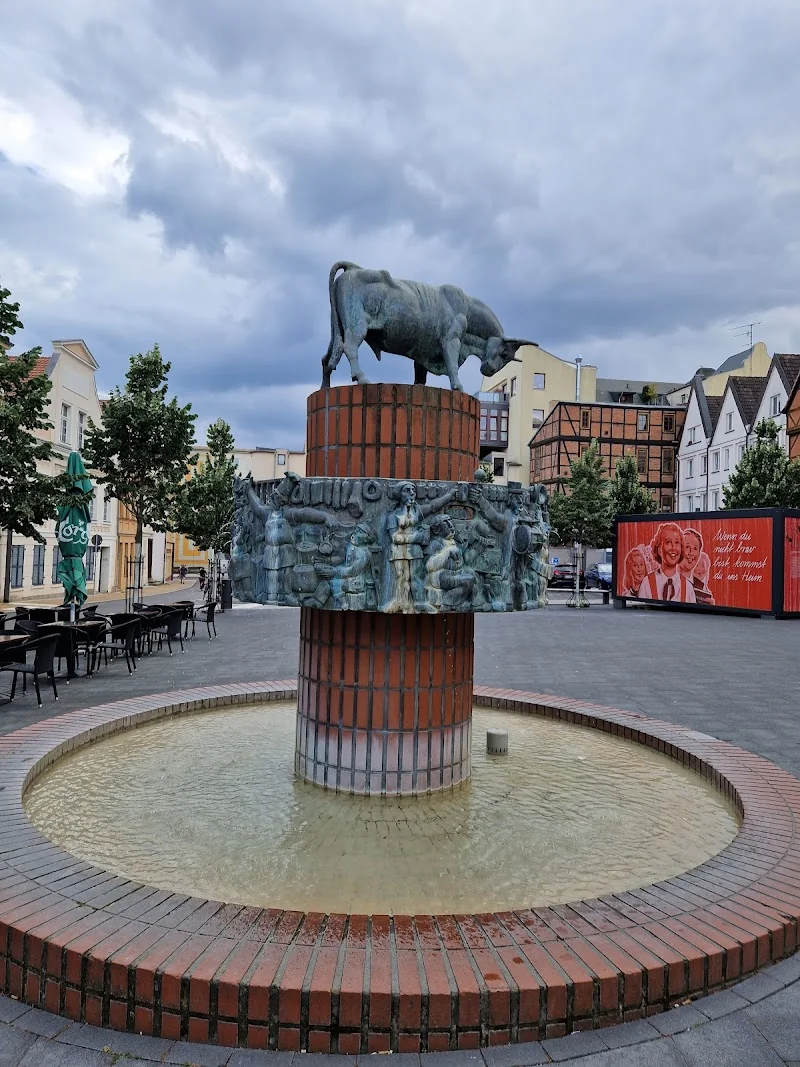
The fountain at the Schlachtermarkt is one of the most important reasons why the square in Schwerin is immediately recognizable. It was designed by the Berlin sculptor Stefan Horota and was installed in 1979 as part of the redesign. The city describes it as an artistic enhancement of the square; at its center is a masonry column topped by the heraldic animal of Mecklenburg, the bull, while a surrounding bronze relief picks up motifs from the old Mecklenburg folk song Von Herrn Pastorn sien Kauh. Thus, the fountain is not just decoration but a consciously set reference to regional culture and local memory. This is what makes it so strong for the perception of the square: those who visit the Schlachtermarkt do not simply experience a market with water basins, but an urban planning sign with musical and sculptural connections. On the back of the town hall, a carillon complements the scene. According to the city, it provides the melody for the fountain, and since the renovation, it has been integrated into the daily routine more often. In the official announcement from 2016, it is stated that the melody of the song sounds daily at 9:00 AM, 12:00 PM, and 5:00 PM. This connection between the fountain and the carillon is unusually close and makes the square acoustically as recognizable as it is visually. Those walking in the old town often orient themselves precisely by this combination. ([schwerin.de](https://www.schwerin.de/news/33e1d3e7-d5fd-11e8-89c1-1967de695b51/))
For the search intent regarding fountains, carillons, or special sights, the Schlachtermarkt is thus a clear hit. The city explicitly emphasizes that the fountain and the carillon should be understood as a cohesive ensemble. This is not just an art historical detail but an essential part of the square's identity. The fountain anchors the market in Schwerin's city history, the carillon brings movement into the daily rhythm, and together both elements create an atmosphere that many visitors immediately perceive. Especially in photos, city walks, and short visits, this is important: the Schlachtermarkt lives not only from its function as a market but from a very distinct image that is easily imprinted. The motifs of the relief, the historical reference to a folk song, and the position directly at the back of the town hall give the square a narrative quality that is rarely found so concentrated in the city center. Therefore, the fountain is not a minor point for the SEO logic here, but one of the strongest semantic anchors for the entire place. ([schwerin.de](https://www.schwerin.de/news/33e1d3e7-d5fd-11e8-89c1-1967de695b51/))
Schlachtermarkt on the City Map: Location, Orientation, and Short Walk
Those looking for the Schlachtermarkt on a map should locate it in Schwerin's old town behind the town hall. The official monument area regulation names it as a square between the back of the town hall and Schlachterstraße; to the north, it is bounded by Domstraße and to the south by the back of the buildings Großer Moor 4-6. This location is very practical for visitors, as the square is thus very close to the most important paths of the old town and can easily be incorporated into a walk. The tourist city tour of the state capital also names the Schlachtermarkt as one of the historical stations of the city center, together with the cathedral, castle, and other central places. For search queries regarding maps, location, or city plans, this is helpful because orientation at the town hall is immediately understandable: from the market square, the Schlachtermarkt is just a short distance away, and the route through the old town remains manageable. This compact location makes the square interesting for people who do not want to search long in a city but need quick, clear orientation. On the city map, the Schlachtermarkt is therefore a good reference point that is both historically and practically readable. ([forum.schwerin.de](https://forum.schwerin.de/export/sites/default/.galleries/Dokumente/Planen-Bauen/DVO_Altstadt.pdf))
For a short walk, it is worthwhile to view the Schlachtermarkt not in isolation but as part of a small old town triangle of market, town hall, and adjacent alleys. Especially those who want to take photos or gain a first impression of Schwerin's historical center will find here a very dense urban space. The square is open enough to see its structure but compact enough to grasp the connection between the market, fountain, town hall, and footpaths without long distances. This makes it attractive for visitors looking for a clear starting point in the old town. Those using the official city map will also quickly recognize the proximity to other inner-city destinations and can extend their visit effortlessly. For the SEO topics maps, access, and old town, this is a significant advantage: the Schlachtermarkt is easy to find, well embedded, and immediately readable as a historical place. The combination of its official classification as a monument area, its location behind the town hall, and its integration into tourist walks makes the square a very suitable starting point for a walk through old Schwerin. ([forum.schwerin.de](https://forum.schwerin.de/export/sites/default/.galleries/Dokumente/Planen-Bauen/DVO_Altstadt.pdf))
Access and Parking in Schwerin's City Center
Regarding the practical question of access, the Schlachtermarkt is well connected, even though it is not a classic parking lot itself. The state capital Schwerin recommends using the existing parking garages and larger parking areas for visits to the city center. According to the official city map, there are around 2000 parking spaces for cars in parking garages and larger areas within a radius of just 650 meters around the market square; among others, the Schlossparkcenter with 1100 spaces, the Schweriner Höfe with 360 spaces, the parking garage at the castle with 350 spaces, and the parking lot Altstadt/Grüne Straße with 200 spaces are mentioned. For visitors to the Schlachtermarkt, this means: the city center is usually well accessible, and those planning to visit the market or stroll through the old town will find several sensible options within walking distance. The parking question is thus not a hindrance but rather a matter of choice between proximity, comfort, and duration of stay. This is precisely why the search for parking or access at the Schlachtermarkt is so frequently associated with the entire city center. ([schwerin.de](https://www.schwerin.de/kultur-tourismus/veranstaltungen/parken-bei-veranstaltungen-in-der-schweriner-innenstadt/))
It is particularly practical that the parking options cannot be reduced to a single solution. Those who want to start directly in the old town can choose city center garages; those who want to combine the visit with a larger stroll can park more generously and then continue on foot. This is sensible for the Schlachtermarkt because the square works best as part of a compact city center walk. The city also points out that visitors to larger events can relax in the parking garages of the city center or at P+R locations. This is particularly relevant when the Schlachtermarkt is more frequented during markets or city festivals. Those arriving from Google Maps or the city map will quickly find a planable combination of parking and walking. For the search terms schlachtermarkt schwerin maps, schlachtermarkt schwerin parking, and schlachtermarkt schwerin access, this mix is important: not a single parking space, but a range of well-documented options in the city center that make the visit uncomplicated. The proximity to the old town also ensures that the walk from the car to the square itself becomes part of the urban experience. ([schwerin.de](https://www.schwerin.de/kultur-tourismus/veranstaltungen/parken-bei-veranstaltungen-in-der-schweriner-innenstadt/))
Events, Atmosphere, and Old Town Flair
The Schlachtermarkt is not only a market and monument square but also an urban space for atmosphere and events. The state capital explicitly describes it as an area used as a market place, event location, outdoor restaurant, recreational area, and traffic-calmed access road. This multifunctionality makes it so interesting: the square can be a fresh market while also serving as a stage for seasonal events or part of an evening city stroll. During the Lichterbummel, for example, the Schlachtermarkt is officially announced to become a playground for children, while light installations, music, and gastronomy transform the old town. Such events show that the square plays an active role in modern urban life and is not just viewed as a historical object. For visitors, this is a clear added value, as different expectations can be fulfilled here: those seeking tranquility experience a comparatively open old town square; those wanting to experience something find market operations, activities, or urban events depending on the season. The special effect of the Schlachtermarkt arises precisely from this changeability. It is a usable space during the day, an experiential place during events, and a prominent reference point in the urban landscape. ([schwerin.de](https://www.schwerin.de/news/verkehrsfreigabe-grosser-moor/?utm_source=openai))
For photos, social media, and a first impression of Schwerin, the Schlachtermarkt is therefore particularly grateful. The fountain provides a strong motif, the carillon creates recognizability, and the old town location offers a backdrop that appears traditional yet open. Those visiting the square get a compact impression of how Schwerin brings together historical substance and contemporary use. This is also the reason why the Schlachtermarkt repeatedly appears in city tours and walking offers: it connects history, wayfinding, and everyday culture in a small, easily graspable space. For visitors looking for an authentic city center address, this is often more convincing than large, purely representative squares. The Schlachtermarkt is approachable, regularly lively, and still historically readable. These characteristics make it a strong location for SEO content, as search intents from history to photos to parking converge very naturally. Those searching for the Schlachtermarkt Schwerin are essentially always looking for the same thing: a place where Schwerin as a city becomes visible, audible, and experienceable in everyday life. ([stadtumbau.schwerin.de](https://www.stadtumbau.schwerin.de/kultur-tourismus/erlebnisse-in-schwerin/stadtfuehrung-rundfahrten/stempelpass-app/index.html?utm_source=openai))
Sources:
- State Capital Schwerin - Schwerin Markets & Open Sundays
- State Capital Schwerin - Market Activity Returns to the Schlachtermarkt
- State Capital Schwerin - Schlachtermarkt Receives Thorough Beautification
- State Capital Schwerin - Carillon at the Schlachtermarkt Sounds More Often Now
- State Capital Schwerin - Parking at Events in Schwerin's City Center
- State Capital Schwerin - Monument Area Regulation Old Town
Show moreShow less
Schlachtermarkt Schwerin | Market Times & Parking
The Schlachtermarkt is one of the most distinctive places in Schwerin's old town, as it combines everyday market activity, urban history, and a very unique character of the square. Those looking for the square will not find a random forecourt, but a historically grown place behind the town hall, which has been redesigned and carefully renewed several times in recent decades. This mixture makes the Schlachtermarkt particularly interesting for visitors looking for a weekly market, a stroll through the old town, a fountain motif, or practical access to the city center. On Wednesdays and Fridays, the square is a fixed point for the weekly market, while it remains a venue for events, a place to stay, and a short route through the historical center of Schwerin. ([schwerin.de](https://www.schwerin.de/kultur-tourismus/veranstaltungen/maerkte-verkaufsoffene-sonntage/))
Weekly Market at Schlachtermarkt: Market Times, Offerings, and Visit
The most important search impulse around the Schlachtermarkt is still the weekly market itself, and this is where the special strength of the square lies. The state capital Schwerin officially lists the Schlachtermarkt as a weekly market location on Wednesdays and Fridays from 9:00 AM to 3:00 PM. Thus, the square is one of the fixed supply and meeting places in the city center and complements the other weekly market areas in Schwerin without losing its own role. For many visitors, this is crucial because the Schlachtermarkt is not just a monument square, but a functioning market place with regular opening hours. After the renovation, the vendors returned to their traditional spots in 2021; since then, the market has been visibly anchored as a fresh market in the old town. This return is important for the atmosphere, as the square does not feel like a backdrop, but like a vibrant urban space where shopping, encounters, and short distances belong together. For this reason, the Schlachtermarkt is particularly suitable for a visit in the morning or at lunchtime: then the market is in operation, the old town is lively, and the square unfolds its classic mix of function and flair. Also, for people searching for market times, weekly market, old town, or opening hours, the Schlachtermarkt provides a very clear profile. It is regular, central, and well integrated into the city center, which distinguishes it from purely seasonal event spaces. ([schwerin.de](https://www.schwerin.de/kultur-tourismus/veranstaltungen/maerkte-verkaufsoffene-sonntage/))
Especially for the search intent around market, program, or visit tip, it is important that the Schlachtermarkt functions not only as a sales location but as part of urban everyday life. The city describes it as a weekly market location, and the developments of recent years show that despite construction phases and detours, it has repeatedly returned to the center of old town life. Those looking to combine fresh products, a short lunch break, or a walk through the historical center will find a suitable framework here. The market times make the visit planable, and the location in the old town ensures that the walk across the square can easily be combined with other routes. Thus, a simple search for Schlachtermarkt Schwerin quickly turns into a meaningful visit plan: first the market, then a tour through the old town, later perhaps a look at the fountain or a coffee nearby. This usability explains why the square is so frequently searched online with terms like weekly market, market times, access, and parking. The Schlachtermarkt is not only historical but also relevant in everyday life. ([schwerin.de](https://www.schwerin.de/kultur-tourismus/veranstaltungen/maerkte-verkaufsoffene-sonntage/))
History of the Schlachtermarkt: From a Narrow Old Town Quarter to a Protected Square
To understand the history of the Schlachtermarkt, one must look at the development of Schwerin's old town. According to the city, the square only took its current form a little over 100 years ago. Previously, the area behind the town hall was densely built up, and the flower and vegetable market developed between 1886 and 1897 through the demolition of the western row of houses in Schlachterstraße, known as the Riege. Thus, the Schlachtermarkt is a comparatively young square, although it today appears as a historically naturally grown place. This is typical for Schwerin's old town: many areas have medieval roots but were reorganized, densified, or opened up in the 19th and 20th centuries. The Schlachtermarkt showcases this development particularly well, as it transformed from a narrow structural framework into an open square space. Its later history is also closely linked to urban redevelopment and monument protection. The monument area regulation explicitly protects the square as part of Schwerin's old town; the area, the square spaces, and the urban planning references are to be preserved. The official justification names the Schlachtermarkt as a square between the back of the town hall and Schlachterstraße, which was created in its current extent through demolitions in 1886/1897, 1903, and 1978. For the historical classification, this is important because the square is thus not a static monument but an urban planning result of several phases that are visibly intertwined. ([forum.schwerin.de](https://forum.schwerin.de/export/sites/default/.galleries/Dokumente/Planen-Bauen/DVO_Altstadt.pdf))
Particularly formative was the redesign from 1977 to 1980. At that time, the Schlachtermarkt received a new surface and a fountain, while part of the old linden trees was preserved. This phase explains why the square still radiates a mix of historical structure and design clarity. The city speaks in this context of a renovation and modernization that should better enable its use as a market area, event location, outdoor restaurant, recreational area, and traffic-calmed access road. Later, another comprehensive renovation followed between 2018 and 2021, after which the market could be fully utilized again in 2021. For search queries related to history, Wikipedia, or special facts, this process is central: the square is not medieval, but it is very clearly part of the historical continuity of the old town. Its history tells of demolition, opening, design, protection, and renewed renewal. This is precisely what creates the current effect. The Schlachtermarkt is a square that does not hide its historical origins but continues them in a contemporary form. It is thus a good example of how urban history, monument protection, and everyday use can come together in an old town. ([forum.schwerin.de](https://forum.schwerin.de/export/sites/default/.galleries/Dokumente/Planen-Bauen/DVO_Altstadt.pdf))
Fountain and Carillon: The Distinctive Heart of the Square
The fountain at the Schlachtermarkt is one of the most important reasons why the square in Schwerin is immediately recognizable. It was designed by the Berlin sculptor Stefan Horota and was installed in 1979 as part of the redesign. The city describes it as an artistic enhancement of the square; at its center is a masonry column topped by the heraldic animal of Mecklenburg, the bull, while a surrounding bronze relief picks up motifs from the old Mecklenburg folk song Von Herrn Pastorn sien Kauh. Thus, the fountain is not just decoration but a consciously set reference to regional culture and local memory. This is what makes it so strong for the perception of the square: those who visit the Schlachtermarkt do not simply experience a market with water basins, but an urban planning sign with musical and sculptural connections. On the back of the town hall, a carillon complements the scene. According to the city, it provides the melody for the fountain, and since the renovation, it has been integrated into the daily routine more often. In the official announcement from 2016, it is stated that the melody of the song sounds daily at 9:00 AM, 12:00 PM, and 5:00 PM. This connection between the fountain and the carillon is unusually close and makes the square acoustically as recognizable as it is visually. Those walking in the old town often orient themselves precisely by this combination. ([schwerin.de](https://www.schwerin.de/news/33e1d3e7-d5fd-11e8-89c1-1967de695b51/))
For the search intent regarding fountains, carillons, or special sights, the Schlachtermarkt is thus a clear hit. The city explicitly emphasizes that the fountain and the carillon should be understood as a cohesive ensemble. This is not just an art historical detail but an essential part of the square's identity. The fountain anchors the market in Schwerin's city history, the carillon brings movement into the daily rhythm, and together both elements create an atmosphere that many visitors immediately perceive. Especially in photos, city walks, and short visits, this is important: the Schlachtermarkt lives not only from its function as a market but from a very distinct image that is easily imprinted. The motifs of the relief, the historical reference to a folk song, and the position directly at the back of the town hall give the square a narrative quality that is rarely found so concentrated in the city center. Therefore, the fountain is not a minor point for the SEO logic here, but one of the strongest semantic anchors for the entire place. ([schwerin.de](https://www.schwerin.de/news/33e1d3e7-d5fd-11e8-89c1-1967de695b51/))
Schlachtermarkt on the City Map: Location, Orientation, and Short Walk
Those looking for the Schlachtermarkt on a map should locate it in Schwerin's old town behind the town hall. The official monument area regulation names it as a square between the back of the town hall and Schlachterstraße; to the north, it is bounded by Domstraße and to the south by the back of the buildings Großer Moor 4-6. This location is very practical for visitors, as the square is thus very close to the most important paths of the old town and can easily be incorporated into a walk. The tourist city tour of the state capital also names the Schlachtermarkt as one of the historical stations of the city center, together with the cathedral, castle, and other central places. For search queries regarding maps, location, or city plans, this is helpful because orientation at the town hall is immediately understandable: from the market square, the Schlachtermarkt is just a short distance away, and the route through the old town remains manageable. This compact location makes the square interesting for people who do not want to search long in a city but need quick, clear orientation. On the city map, the Schlachtermarkt is therefore a good reference point that is both historically and practically readable. ([forum.schwerin.de](https://forum.schwerin.de/export/sites/default/.galleries/Dokumente/Planen-Bauen/DVO_Altstadt.pdf))
For a short walk, it is worthwhile to view the Schlachtermarkt not in isolation but as part of a small old town triangle of market, town hall, and adjacent alleys. Especially those who want to take photos or gain a first impression of Schwerin's historical center will find here a very dense urban space. The square is open enough to see its structure but compact enough to grasp the connection between the market, fountain, town hall, and footpaths without long distances. This makes it attractive for visitors looking for a clear starting point in the old town. Those using the official city map will also quickly recognize the proximity to other inner-city destinations and can extend their visit effortlessly. For the SEO topics maps, access, and old town, this is a significant advantage: the Schlachtermarkt is easy to find, well embedded, and immediately readable as a historical place. The combination of its official classification as a monument area, its location behind the town hall, and its integration into tourist walks makes the square a very suitable starting point for a walk through old Schwerin. ([forum.schwerin.de](https://forum.schwerin.de/export/sites/default/.galleries/Dokumente/Planen-Bauen/DVO_Altstadt.pdf))
Access and Parking in Schwerin's City Center
Regarding the practical question of access, the Schlachtermarkt is well connected, even though it is not a classic parking lot itself. The state capital Schwerin recommends using the existing parking garages and larger parking areas for visits to the city center. According to the official city map, there are around 2000 parking spaces for cars in parking garages and larger areas within a radius of just 650 meters around the market square; among others, the Schlossparkcenter with 1100 spaces, the Schweriner Höfe with 360 spaces, the parking garage at the castle with 350 spaces, and the parking lot Altstadt/Grüne Straße with 200 spaces are mentioned. For visitors to the Schlachtermarkt, this means: the city center is usually well accessible, and those planning to visit the market or stroll through the old town will find several sensible options within walking distance. The parking question is thus not a hindrance but rather a matter of choice between proximity, comfort, and duration of stay. This is precisely why the search for parking or access at the Schlachtermarkt is so frequently associated with the entire city center. ([schwerin.de](https://www.schwerin.de/kultur-tourismus/veranstaltungen/parken-bei-veranstaltungen-in-der-schweriner-innenstadt/))
It is particularly practical that the parking options cannot be reduced to a single solution. Those who want to start directly in the old town can choose city center garages; those who want to combine the visit with a larger stroll can park more generously and then continue on foot. This is sensible for the Schlachtermarkt because the square works best as part of a compact city center walk. The city also points out that visitors to larger events can relax in the parking garages of the city center or at P+R locations. This is particularly relevant when the Schlachtermarkt is more frequented during markets or city festivals. Those arriving from Google Maps or the city map will quickly find a planable combination of parking and walking. For the search terms schlachtermarkt schwerin maps, schlachtermarkt schwerin parking, and schlachtermarkt schwerin access, this mix is important: not a single parking space, but a range of well-documented options in the city center that make the visit uncomplicated. The proximity to the old town also ensures that the walk from the car to the square itself becomes part of the urban experience. ([schwerin.de](https://www.schwerin.de/kultur-tourismus/veranstaltungen/parken-bei-veranstaltungen-in-der-schweriner-innenstadt/))
Events, Atmosphere, and Old Town Flair
The Schlachtermarkt is not only a market and monument square but also an urban space for atmosphere and events. The state capital explicitly describes it as an area used as a market place, event location, outdoor restaurant, recreational area, and traffic-calmed access road. This multifunctionality makes it so interesting: the square can be a fresh market while also serving as a stage for seasonal events or part of an evening city stroll. During the Lichterbummel, for example, the Schlachtermarkt is officially announced to become a playground for children, while light installations, music, and gastronomy transform the old town. Such events show that the square plays an active role in modern urban life and is not just viewed as a historical object. For visitors, this is a clear added value, as different expectations can be fulfilled here: those seeking tranquility experience a comparatively open old town square; those wanting to experience something find market operations, activities, or urban events depending on the season. The special effect of the Schlachtermarkt arises precisely from this changeability. It is a usable space during the day, an experiential place during events, and a prominent reference point in the urban landscape. ([schwerin.de](https://www.schwerin.de/news/verkehrsfreigabe-grosser-moor/?utm_source=openai))
For photos, social media, and a first impression of Schwerin, the Schlachtermarkt is therefore particularly grateful. The fountain provides a strong motif, the carillon creates recognizability, and the old town location offers a backdrop that appears traditional yet open. Those visiting the square get a compact impression of how Schwerin brings together historical substance and contemporary use. This is also the reason why the Schlachtermarkt repeatedly appears in city tours and walking offers: it connects history, wayfinding, and everyday culture in a small, easily graspable space. For visitors looking for an authentic city center address, this is often more convincing than large, purely representative squares. The Schlachtermarkt is approachable, regularly lively, and still historically readable. These characteristics make it a strong location for SEO content, as search intents from history to photos to parking converge very naturally. Those searching for the Schlachtermarkt Schwerin are essentially always looking for the same thing: a place where Schwerin as a city becomes visible, audible, and experienceable in everyday life. ([stadtumbau.schwerin.de](https://www.stadtumbau.schwerin.de/kultur-tourismus/erlebnisse-in-schwerin/stadtfuehrung-rundfahrten/stempelpass-app/index.html?utm_source=openai))
Sources:
- State Capital Schwerin - Schwerin Markets & Open Sundays
- State Capital Schwerin - Market Activity Returns to the Schlachtermarkt
- State Capital Schwerin - Schlachtermarkt Receives Thorough Beautification
- State Capital Schwerin - Carillon at the Schlachtermarkt Sounds More Often Now
- State Capital Schwerin - Parking at Events in Schwerin's City Center
- State Capital Schwerin - Monument Area Regulation Old Town
Schlachtermarkt Schwerin | Market Times & Parking
The Schlachtermarkt is one of the most distinctive places in Schwerin's old town, as it combines everyday market activity, urban history, and a very unique character of the square. Those looking for the square will not find a random forecourt, but a historically grown place behind the town hall, which has been redesigned and carefully renewed several times in recent decades. This mixture makes the Schlachtermarkt particularly interesting for visitors looking for a weekly market, a stroll through the old town, a fountain motif, or practical access to the city center. On Wednesdays and Fridays, the square is a fixed point for the weekly market, while it remains a venue for events, a place to stay, and a short route through the historical center of Schwerin. ([schwerin.de](https://www.schwerin.de/kultur-tourismus/veranstaltungen/maerkte-verkaufsoffene-sonntage/))
Weekly Market at Schlachtermarkt: Market Times, Offerings, and Visit
The most important search impulse around the Schlachtermarkt is still the weekly market itself, and this is where the special strength of the square lies. The state capital Schwerin officially lists the Schlachtermarkt as a weekly market location on Wednesdays and Fridays from 9:00 AM to 3:00 PM. Thus, the square is one of the fixed supply and meeting places in the city center and complements the other weekly market areas in Schwerin without losing its own role. For many visitors, this is crucial because the Schlachtermarkt is not just a monument square, but a functioning market place with regular opening hours. After the renovation, the vendors returned to their traditional spots in 2021; since then, the market has been visibly anchored as a fresh market in the old town. This return is important for the atmosphere, as the square does not feel like a backdrop, but like a vibrant urban space where shopping, encounters, and short distances belong together. For this reason, the Schlachtermarkt is particularly suitable for a visit in the morning or at lunchtime: then the market is in operation, the old town is lively, and the square unfolds its classic mix of function and flair. Also, for people searching for market times, weekly market, old town, or opening hours, the Schlachtermarkt provides a very clear profile. It is regular, central, and well integrated into the city center, which distinguishes it from purely seasonal event spaces. ([schwerin.de](https://www.schwerin.de/kultur-tourismus/veranstaltungen/maerkte-verkaufsoffene-sonntage/))
Especially for the search intent around market, program, or visit tip, it is important that the Schlachtermarkt functions not only as a sales location but as part of urban everyday life. The city describes it as a weekly market location, and the developments of recent years show that despite construction phases and detours, it has repeatedly returned to the center of old town life. Those looking to combine fresh products, a short lunch break, or a walk through the historical center will find a suitable framework here. The market times make the visit planable, and the location in the old town ensures that the walk across the square can easily be combined with other routes. Thus, a simple search for Schlachtermarkt Schwerin quickly turns into a meaningful visit plan: first the market, then a tour through the old town, later perhaps a look at the fountain or a coffee nearby. This usability explains why the square is so frequently searched online with terms like weekly market, market times, access, and parking. The Schlachtermarkt is not only historical but also relevant in everyday life. ([schwerin.de](https://www.schwerin.de/kultur-tourismus/veranstaltungen/maerkte-verkaufsoffene-sonntage/))
History of the Schlachtermarkt: From a Narrow Old Town Quarter to a Protected Square
To understand the history of the Schlachtermarkt, one must look at the development of Schwerin's old town. According to the city, the square only took its current form a little over 100 years ago. Previously, the area behind the town hall was densely built up, and the flower and vegetable market developed between 1886 and 1897 through the demolition of the western row of houses in Schlachterstraße, known as the Riege. Thus, the Schlachtermarkt is a comparatively young square, although it today appears as a historically naturally grown place. This is typical for Schwerin's old town: many areas have medieval roots but were reorganized, densified, or opened up in the 19th and 20th centuries. The Schlachtermarkt showcases this development particularly well, as it transformed from a narrow structural framework into an open square space. Its later history is also closely linked to urban redevelopment and monument protection. The monument area regulation explicitly protects the square as part of Schwerin's old town; the area, the square spaces, and the urban planning references are to be preserved. The official justification names the Schlachtermarkt as a square between the back of the town hall and Schlachterstraße, which was created in its current extent through demolitions in 1886/1897, 1903, and 1978. For the historical classification, this is important because the square is thus not a static monument but an urban planning result of several phases that are visibly intertwined. ([forum.schwerin.de](https://forum.schwerin.de/export/sites/default/.galleries/Dokumente/Planen-Bauen/DVO_Altstadt.pdf))
Particularly formative was the redesign from 1977 to 1980. At that time, the Schlachtermarkt received a new surface and a fountain, while part of the old linden trees was preserved. This phase explains why the square still radiates a mix of historical structure and design clarity. The city speaks in this context of a renovation and modernization that should better enable its use as a market area, event location, outdoor restaurant, recreational area, and traffic-calmed access road. Later, another comprehensive renovation followed between 2018 and 2021, after which the market could be fully utilized again in 2021. For search queries related to history, Wikipedia, or special facts, this process is central: the square is not medieval, but it is very clearly part of the historical continuity of the old town. Its history tells of demolition, opening, design, protection, and renewed renewal. This is precisely what creates the current effect. The Schlachtermarkt is a square that does not hide its historical origins but continues them in a contemporary form. It is thus a good example of how urban history, monument protection, and everyday use can come together in an old town. ([forum.schwerin.de](https://forum.schwerin.de/export/sites/default/.galleries/Dokumente/Planen-Bauen/DVO_Altstadt.pdf))
Fountain and Carillon: The Distinctive Heart of the Square
The fountain at the Schlachtermarkt is one of the most important reasons why the square in Schwerin is immediately recognizable. It was designed by the Berlin sculptor Stefan Horota and was installed in 1979 as part of the redesign. The city describes it as an artistic enhancement of the square; at its center is a masonry column topped by the heraldic animal of Mecklenburg, the bull, while a surrounding bronze relief picks up motifs from the old Mecklenburg folk song Von Herrn Pastorn sien Kauh. Thus, the fountain is not just decoration but a consciously set reference to regional culture and local memory. This is what makes it so strong for the perception of the square: those who visit the Schlachtermarkt do not simply experience a market with water basins, but an urban planning sign with musical and sculptural connections. On the back of the town hall, a carillon complements the scene. According to the city, it provides the melody for the fountain, and since the renovation, it has been integrated into the daily routine more often. In the official announcement from 2016, it is stated that the melody of the song sounds daily at 9:00 AM, 12:00 PM, and 5:00 PM. This connection between the fountain and the carillon is unusually close and makes the square acoustically as recognizable as it is visually. Those walking in the old town often orient themselves precisely by this combination. ([schwerin.de](https://www.schwerin.de/news/33e1d3e7-d5fd-11e8-89c1-1967de695b51/))
For the search intent regarding fountains, carillons, or special sights, the Schlachtermarkt is thus a clear hit. The city explicitly emphasizes that the fountain and the carillon should be understood as a cohesive ensemble. This is not just an art historical detail but an essential part of the square's identity. The fountain anchors the market in Schwerin's city history, the carillon brings movement into the daily rhythm, and together both elements create an atmosphere that many visitors immediately perceive. Especially in photos, city walks, and short visits, this is important: the Schlachtermarkt lives not only from its function as a market but from a very distinct image that is easily imprinted. The motifs of the relief, the historical reference to a folk song, and the position directly at the back of the town hall give the square a narrative quality that is rarely found so concentrated in the city center. Therefore, the fountain is not a minor point for the SEO logic here, but one of the strongest semantic anchors for the entire place. ([schwerin.de](https://www.schwerin.de/news/33e1d3e7-d5fd-11e8-89c1-1967de695b51/))
Schlachtermarkt on the City Map: Location, Orientation, and Short Walk
Those looking for the Schlachtermarkt on a map should locate it in Schwerin's old town behind the town hall. The official monument area regulation names it as a square between the back of the town hall and Schlachterstraße; to the north, it is bounded by Domstraße and to the south by the back of the buildings Großer Moor 4-6. This location is very practical for visitors, as the square is thus very close to the most important paths of the old town and can easily be incorporated into a walk. The tourist city tour of the state capital also names the Schlachtermarkt as one of the historical stations of the city center, together with the cathedral, castle, and other central places. For search queries regarding maps, location, or city plans, this is helpful because orientation at the town hall is immediately understandable: from the market square, the Schlachtermarkt is just a short distance away, and the route through the old town remains manageable. This compact location makes the square interesting for people who do not want to search long in a city but need quick, clear orientation. On the city map, the Schlachtermarkt is therefore a good reference point that is both historically and practically readable. ([forum.schwerin.de](https://forum.schwerin.de/export/sites/default/.galleries/Dokumente/Planen-Bauen/DVO_Altstadt.pdf))
For a short walk, it is worthwhile to view the Schlachtermarkt not in isolation but as part of a small old town triangle of market, town hall, and adjacent alleys. Especially those who want to take photos or gain a first impression of Schwerin's historical center will find here a very dense urban space. The square is open enough to see its structure but compact enough to grasp the connection between the market, fountain, town hall, and footpaths without long distances. This makes it attractive for visitors looking for a clear starting point in the old town. Those using the official city map will also quickly recognize the proximity to other inner-city destinations and can extend their visit effortlessly. For the SEO topics maps, access, and old town, this is a significant advantage: the Schlachtermarkt is easy to find, well embedded, and immediately readable as a historical place. The combination of its official classification as a monument area, its location behind the town hall, and its integration into tourist walks makes the square a very suitable starting point for a walk through old Schwerin. ([forum.schwerin.de](https://forum.schwerin.de/export/sites/default/.galleries/Dokumente/Planen-Bauen/DVO_Altstadt.pdf))
Access and Parking in Schwerin's City Center
Regarding the practical question of access, the Schlachtermarkt is well connected, even though it is not a classic parking lot itself. The state capital Schwerin recommends using the existing parking garages and larger parking areas for visits to the city center. According to the official city map, there are around 2000 parking spaces for cars in parking garages and larger areas within a radius of just 650 meters around the market square; among others, the Schlossparkcenter with 1100 spaces, the Schweriner Höfe with 360 spaces, the parking garage at the castle with 350 spaces, and the parking lot Altstadt/Grüne Straße with 200 spaces are mentioned. For visitors to the Schlachtermarkt, this means: the city center is usually well accessible, and those planning to visit the market or stroll through the old town will find several sensible options within walking distance. The parking question is thus not a hindrance but rather a matter of choice between proximity, comfort, and duration of stay. This is precisely why the search for parking or access at the Schlachtermarkt is so frequently associated with the entire city center. ([schwerin.de](https://www.schwerin.de/kultur-tourismus/veranstaltungen/parken-bei-veranstaltungen-in-der-schweriner-innenstadt/))
It is particularly practical that the parking options cannot be reduced to a single solution. Those who want to start directly in the old town can choose city center garages; those who want to combine the visit with a larger stroll can park more generously and then continue on foot. This is sensible for the Schlachtermarkt because the square works best as part of a compact city center walk. The city also points out that visitors to larger events can relax in the parking garages of the city center or at P+R locations. This is particularly relevant when the Schlachtermarkt is more frequented during markets or city festivals. Those arriving from Google Maps or the city map will quickly find a planable combination of parking and walking. For the search terms schlachtermarkt schwerin maps, schlachtermarkt schwerin parking, and schlachtermarkt schwerin access, this mix is important: not a single parking space, but a range of well-documented options in the city center that make the visit uncomplicated. The proximity to the old town also ensures that the walk from the car to the square itself becomes part of the urban experience. ([schwerin.de](https://www.schwerin.de/kultur-tourismus/veranstaltungen/parken-bei-veranstaltungen-in-der-schweriner-innenstadt/))
Events, Atmosphere, and Old Town Flair
The Schlachtermarkt is not only a market and monument square but also an urban space for atmosphere and events. The state capital explicitly describes it as an area used as a market place, event location, outdoor restaurant, recreational area, and traffic-calmed access road. This multifunctionality makes it so interesting: the square can be a fresh market while also serving as a stage for seasonal events or part of an evening city stroll. During the Lichterbummel, for example, the Schlachtermarkt is officially announced to become a playground for children, while light installations, music, and gastronomy transform the old town. Such events show that the square plays an active role in modern urban life and is not just viewed as a historical object. For visitors, this is a clear added value, as different expectations can be fulfilled here: those seeking tranquility experience a comparatively open old town square; those wanting to experience something find market operations, activities, or urban events depending on the season. The special effect of the Schlachtermarkt arises precisely from this changeability. It is a usable space during the day, an experiential place during events, and a prominent reference point in the urban landscape. ([schwerin.de](https://www.schwerin.de/news/verkehrsfreigabe-grosser-moor/?utm_source=openai))
For photos, social media, and a first impression of Schwerin, the Schlachtermarkt is therefore particularly grateful. The fountain provides a strong motif, the carillon creates recognizability, and the old town location offers a backdrop that appears traditional yet open. Those visiting the square get a compact impression of how Schwerin brings together historical substance and contemporary use. This is also the reason why the Schlachtermarkt repeatedly appears in city tours and walking offers: it connects history, wayfinding, and everyday culture in a small, easily graspable space. For visitors looking for an authentic city center address, this is often more convincing than large, purely representative squares. The Schlachtermarkt is approachable, regularly lively, and still historically readable. These characteristics make it a strong location for SEO content, as search intents from history to photos to parking converge very naturally. Those searching for the Schlachtermarkt Schwerin are essentially always looking for the same thing: a place where Schwerin as a city becomes visible, audible, and experienceable in everyday life. ([stadtumbau.schwerin.de](https://www.stadtumbau.schwerin.de/kultur-tourismus/erlebnisse-in-schwerin/stadtfuehrung-rundfahrten/stempelpass-app/index.html?utm_source=openai))
Sources:
- State Capital Schwerin - Schwerin Markets & Open Sundays
- State Capital Schwerin - Market Activity Returns to the Schlachtermarkt
- State Capital Schwerin - Schlachtermarkt Receives Thorough Beautification
- State Capital Schwerin - Carillon at the Schlachtermarkt Sounds More Often Now
- State Capital Schwerin - Parking at Events in Schwerin's City Center
- State Capital Schwerin - Monument Area Regulation Old Town
Frequently Asked Questions
Reviews
Silvia Martini
25. August 2017
A historic site. The fountain is worth seeing. The glockenspiel is beautiful, and there are a few really nice pubs and restaurants on the corner, catering to a wide variety of tastes. The small shops as you walk toward the Marstall are always lovely too. From antique dealers to mink shops...
A Eichholz
13. August 2020
The square has been redesigned – all the old trees are gone. There's plenty of space for events. In the height of summer, the square is avoided by visitors. Perhaps that will change...
F. S.
28. November 2025
Christmas spirit was well captured
Wolfgang Hinderjock
1. September 2019
A beautiful old town ensemble connected to Schwerin's market square by arcades, the very place where the actual markets were and still are held. The fountain in the Schlachtermarkt (Butcher's Market) tells the story of Herr Pastor sin Kau (The Pastor and his Cow). In the Schlachtermarkt stands a memorial to the synagogue destroyed during the Nazi era. The entire area is currently undergoing reconstruction, during which some interesting archaeological finds have been unearthed.
Diana Hartwig
6. July 2022
Very important... public restrooms available... a few benches for resting, and the fountain is worth seeing...