
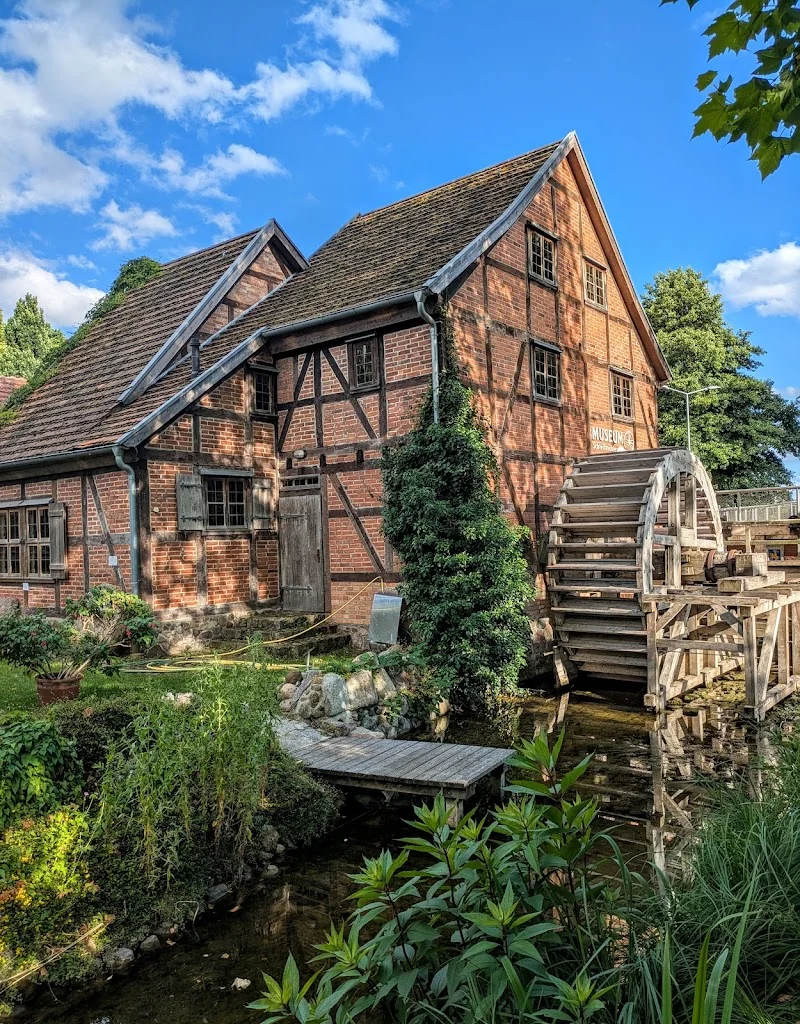
Schleifmühlenweg 1, Schwerin
Schleifmühlenweg 1, 19061 Schwerin, Germany
Schleifmühle Schwerin | Opening Hours & Events
The Schleifmühle Schwerin is a vibrant technical monument on the southern edge of the Schwerin Castle Garden directly on the banks of the Faulen See. The historic mill site, whose roots date back to 1704, was expanded in the 18th and 19th centuries into a ducal stone grinding mill and provided, among other things, work for the reconstruction of Schwerin Castle in the mid-19th century. Today, the house presents itself as a museum with permanent exhibitions, a functional demonstration facility, and expert guided tours that vividly explain the use of hydropower as well as the sawing, grinding, and polishing of stone. Visitors experience authentic technology, craftsmanship, and history in the original building – complemented by outdoor areas, a boulder path, and a renovated miller’s house. Additionally, the Schleifmühle serves as an external location for the Schwerin registry office, making it a special address for civil weddings in an intimate setting. Conveniently: From January 5, 2026, clear opening hours will apply from Monday to Friday, with the last admission at 4:30 PM. Access is easy on foot, by bicycle, or via public transport; best to take the tram to Marienplatz and then bus line 14 to the Schleifmühle stop. Those wishing to attend events such as the autumn festival, German Mill Day, or the Wine Festival 2026 will find all the key details and information below. This makes the Schleifmühle a place where history, culture, and special occasions come together in a unique way.
Events and Program: Tours, Mill Day, Autumn Festival, Wine Festival 2026
In regular museum operations, tours and demonstrations of the historical demonstration facility form the programmatic core. In about an hour, the team explains the over 300-year history of the site, the special mill technology, and the ways in which natural forces – here the water of the Faulen See – were used to saw, smooth, and polish stone. These tours can be booked for groups of up to 25 people and are complemented by the exhibition in the mill building and the outdoor area. In addition to everyday life in the museum, the Schleifmühle sets accents with seasonal and thematic events. Traditionally, the site participates in German Mill Day, where historical mills in Germany showcase their technology and special actions take place in many places. In Schwerin, the day is so relevant that the Schleifmühlenweg section between Lennéstraße and Mühlenende can be closed to traffic, allowing visitors to safely reach the facility; therefore, advance planning is important for arrival and parking on this day. In autumn, festivals with a craft reference are also on the calendar: An autumn festival took place at the museum on October 20, 2024 – with artisan stands, ongoing demonstrations of the demonstration facility, and reduced admission. This mix of market character and technical experience particularly attracts families and culture-interested day visitors, as it combines hands-on craftsmanship with lively communication. For 2026, a culinary-cultural highlight is specifically scheduled: On Saturday, September 5, 2026, the Wine Festival in the Schleifmühlengarten invites you to enjoy discovering from 4:00 PM to 8:00 PM. In addition to wine tastings from regional providers, musical accompaniment with the duo We Two is announced; admission is €25. The combination of a historic atmosphere in the green, the water wheels as a photogenic backdrop, and a curated enjoyment program creates an intimate, almost village-like festive atmosphere in the heart of the state capital. Those planning their visit should check whether additional actions – such as special tours, lectures, or small concerts – are scheduled at the same time. A look at the museum communication is also worthwhile, as additional program points can emerge at short notice, such as thematic demonstrations of sawing and polishing techniques or family-friendly activities in the outdoor area. Overall, the program of the Schleifmühle is broad enough to appeal to technology enthusiasts, history lovers, connoisseurs, and couples alike.
Opening Hours, Admission Prices, and Tickets
For planning a visit, the times and prices are clearly regulated: From January 5, 2026, the museum is open Monday to Friday from 9:00 AM to 5:00 PM, with the last admission at 4:30 PM. On weekends and public holidays, the Schleifmühle is closed. Group tours can also be arranged outside regular hours by prior appointment – especially for school classes, clubs, or travel groups. Admission follows a transparent structure: Adults pay €4.00, reduced tickets cost €3.00. Discounts apply, among others, to students, trainees, social assistance recipients, and holders of the Schwerin Card (each against proof). For families, there is a family ticket for €10.00; valid for a maximum of two adults with two or more children. Groups of ten or more pay €3.00 per person without a guide. The group tour itself costs a flat rate of €40.00 for up to 25 people plus admission. There are also advantages for holders of the Schwerin Ticket: full payers pay €3.50, reduced €3.00. An important service note: Card payment is not possible on site, so cash payment should be planned. Those arriving with dogs may take them to the outdoor area; dogs are not allowed in the indoor areas. For questions about times, bookings, and special dates, the museum is available by phone; especially for groups, timely coordination is recommended, as demonstrations and tours need to be organized. During holiday periods, on action days such as German Mill Day, or around special events (e.g., Wine Festival), a higher number of visitors is to be expected, which is why early arrival, fixed time slots for tours, and adherence to the last admission are important. Since the museum is closed on weekends, excursions during the week can be easily combined with a walk through the castle garden. Those who only want to briefly experience the demonstration facility and the outdoor area should still plan enough time to not miss the demonstrations and to read the exhibition texts at leisure.
Directions and Parking at Schleifmühle Schwerin
The location of the Schleifmühle is idyllic and at the same time central: From the city center of Schwerin, it is about a 30-minute walk or approximately 2.4 kilometers to Schleifmühlenweg 1. The path leads picturesque along the castle garden and the Faulen See and is attractive for walkers and cyclists. Those using public transport can take tram lines 1 or 4 to the Marienplatz junction and transfer to bus line 14 towards the youth hostel; the Schleifmühle stop is close to the museum entrance. For people who depend on accessibility, it is advisable to arrive by bus to the mentioned stop, as the surroundings have steep bank paths. Those arriving by car should note that there are no parking spaces for cars available at the museum itself. It has proven effective to park the vehicle in the area of Johannes-Stelling-Straße near the tax office; from there, a short walk leads to the facility. Those using a navigation device should enter Schleifmühlenweg 1, 19061 Schwerin and orient themselves on site towards the footpaths leading to the castle garden and Fauler See. Due to the location on the banks and the protection status of the surroundings, parking spaces are limited – another reason to rely on public transport or bicycles. On special days such as German Mill Day, traffic restrictions apply on Schleifmühlenweg, including temporary closures for motorized traffic; arriving without a car saves time and nerves here. Cyclists have access to the bank path around the Faulen See; bringing a bike lock is advisable, as parking facilities are needed on the grounds. Those arriving from the surrounding area can also use city parking garages or central parking spaces in the city center and walk the remaining distance. Due to weekend closure times, visitor flow is better manageable during the week, making morning time slots suitable for arrival. Tip for photography fans: The approach through the castle garden offers atmospheric views of water, bank vegetation, and the historic silhouette of the mill – especially with a low sun, a plus for successful shots.
Getting Married in a Historic Setting: Registry Office, Capacity, and Celebration Options
The Schleifmühle is an external location of the Schwerin registry office and offers couples an extraordinary, intimate setting for their civil wedding. In the mill room, up to 20 guests are allowed – close to the historic water wheel, framed by wood, stone, and iron. For the subsequent reception or a small celebration, two immediately adjacent options are available: the Schleifmüllerhaus with space for a maximum of 30 people and/or the outdoor area, which allows celebrations with up to 50 guests in total. These capacities make the Schleifmühle ideal for small to medium-sized wedding parties, where atmosphere and authenticity are more important than large halls. The location by the castle garden and the Faulen See provides extraordinary photo motifs: from views of the water wheels over the boulder path opposite the mill to bank perspectives towards the castle park. For planning, close coordination with the Schwerin registry office regarding dates, wedding times, and required documents is advisable, as well as with the museum team if rooms and outdoor areas are to be used for the reception. Gastronomic catering is usually organized individually; at selected festivals, a mill café with homemade cakes was experienced on site, but for weddings, external providers are common. Guest arrival and time planning should consider that parking is not possible directly at the museum and that the paths partly lead over park and bank areas. For people with limited mobility, access via the nearby surroundings is practical; since 2011, there has also been a public, accessible toilet at the functional building. Those wishing to further stage the ambiance can book tours or demonstrations as program points – an added value that combines historical depth with communal experience. Practical notes: Card payment is not possible in the museum, so it is advisable to plan for cash payment. Dogs are only allowed in the outdoor area; this should be considered during the wedding and photo shoot. Overall, the Schleifmühle combines the special nature of a monument with the requirements of modern, personal celebrations in a small space.
Museum, History, and Technology of the Schleifmühle
The site of the Schleifmühle was first established as a water mill in 1704 and was repurposed several times in the following decades: in 1711 as a bark mill, in 1720 as a groat mill, and in 1747 equipped with a new mill building and a small stone grinding workshop. In 1755, Duke Christian Ludwig II had the facility converted into a ducal stone grinding mill. For generations, grinders such as Johann August Wangel (from 1757) and later his son shaped the production. In the 19th century, the technical management by court architect Georg Adolph Demmler (from 1842) ensured the quality and performance of the facility. Between 1845 and 1857, work was primarily carried out for the major reconstruction of the castle – decorative stone slabs, monument bases, fireplace casings, or sarcophagi, often made from ton-heavy granite boulders. With the structural change, the uses changed: in 1862, for example, a wool spinning mill moved into the mill, which was discontinued in 1904 due to dilapidation. From 1983 to 1985, the mill building was converted into a visitable demonstration facility; sawing and polishing technology from the 18th century was reconstructed, allowing visitors to trace the drive and workflow. In 1996, the Schwerin City History and Museum Association took over the sponsorship. In the 21st century, substantial investments followed in preservation and communication: from 1998 to 2000, the Schleifmüllerhaus was renovated, and in 2000, a second new water wheel was installed. 2005 marked a jubilee year (300 years of water mill, 250 years of stone grinding mill, 20 years of museum) with the installation of a large band saw as an outdoor exhibit and the transport of a 38-ton boulder, which was placed opposite the mill as a visual highlight. In 2011, a new functional building with a public, accessible toilet was created; in 2012, the outdoor area was completed, and the Schleifmüllerhaus was enlarged. In 2013, the mill received a new main shaft with bearing block and channel, in 2014 the roof was renovated, and in 2018, a third new water wheel was installed. In 2016/17, the museum renewed its exhibition texts and created a boulder path that vividly illustrates the geology and significance of glacial drift in northern Germany. For technology enthusiasts, it is particularly exciting how the water of the Faulen See provides the drive energy via channels and wheels, which is transmitted through shafts, gears, and belts to sawing and grinding aggregates. The demonstrations make sparks fly when stone meets grinding body and illustrate how much manual labor was needed at that time to produce a perfectly polished stone. At the same time, the Schleifmühle illustrates the role of waterways, mills, and farm crafts in a residence city like Schwerin – a context that can be directly traced in the castle garden and the surrounding cultural landscape.
Address, Contact, and Service: Phone, Photos, and Notes
The Schleifmühle Schwerin is located at Schleifmühlenweg 1, 19061 Schwerin. For inquiries about opening hours, group offers, tours, special events, and wedding inquiries, the museum can be reached by phone at 0385 562751. For school classes and groups, prior registration is required; tours last about an hour and are designed for a maximum of 25 participants. Those wishing to take photographs will already find numerous motifs on the outdoor area: the water wheels, the wooden mill house contrasting with the water, the 38-ton boulder placed opposite, as well as the paths along the bank. Especially during demonstrations and tours, atmospheric impressions of the historical technology arise. At special events – for example, during the mill festival – homemade cakes were offered on site in the mill café; what gastronomic offerings currently exist depends on the respective event. Important service notes for the visit: Card payment is currently not possible; please have cash ready. Dogs are allowed in the outdoor area, but not indoors. Those arriving by car should note that there are no parking spaces directly at the museum and should better park in the city center area or switch to bus and footpaths. For public transport, it is advisable to combine tram 1 or 4 to Marienplatz and bus 14 to the Schleifmühle stop. Due to the weekend closure, visits are planable on weekdays; an ideal time window is in the morning or early afternoon to calmly attend the demonstrations. For couples considering a wedding, it is advisable to make an early appointment inquiry with the Schwerin registry office and to closely coordinate with the museum team regarding capacities in the Schleifmüllerhaus and in the outdoor area. The proximity to the castle garden also offers beautiful stations for a photo or walk, such as along the French path by the lakeshore.
Sources:
- Schleifmühle Schwerin – Opening Hours & Prices (Official Website)
- Schleifmühle Schwerin – Location and Directions (Official Website)
- Schleifmühle Schwerin – History (Official Website)
- Schleifmühle Schwerin – Getting Married in the Schleifmühle (External Registry Office Location)
- Kultur-MV – Autumn Festival at Schleifmühle Schwerin (20.10.2024)
- Auf-nach-MV – The Different Wine Festival in the Schleifmühlengarten (05.09.2026)
- State Capital Schwerin – Traffic Reports with Note on German Mill Day at Schleifmühlenweg
- Schwerin-NEWS – Mill Festival Note with Arrival/Parking Tip (Archive)
Show moreShow less
Schleifmühle Schwerin | Opening Hours & Events
The Schleifmühle Schwerin is a vibrant technical monument on the southern edge of the Schwerin Castle Garden directly on the banks of the Faulen See. The historic mill site, whose roots date back to 1704, was expanded in the 18th and 19th centuries into a ducal stone grinding mill and provided, among other things, work for the reconstruction of Schwerin Castle in the mid-19th century. Today, the house presents itself as a museum with permanent exhibitions, a functional demonstration facility, and expert guided tours that vividly explain the use of hydropower as well as the sawing, grinding, and polishing of stone. Visitors experience authentic technology, craftsmanship, and history in the original building – complemented by outdoor areas, a boulder path, and a renovated miller’s house. Additionally, the Schleifmühle serves as an external location for the Schwerin registry office, making it a special address for civil weddings in an intimate setting. Conveniently: From January 5, 2026, clear opening hours will apply from Monday to Friday, with the last admission at 4:30 PM. Access is easy on foot, by bicycle, or via public transport; best to take the tram to Marienplatz and then bus line 14 to the Schleifmühle stop. Those wishing to attend events such as the autumn festival, German Mill Day, or the Wine Festival 2026 will find all the key details and information below. This makes the Schleifmühle a place where history, culture, and special occasions come together in a unique way.
Events and Program: Tours, Mill Day, Autumn Festival, Wine Festival 2026
In regular museum operations, tours and demonstrations of the historical demonstration facility form the programmatic core. In about an hour, the team explains the over 300-year history of the site, the special mill technology, and the ways in which natural forces – here the water of the Faulen See – were used to saw, smooth, and polish stone. These tours can be booked for groups of up to 25 people and are complemented by the exhibition in the mill building and the outdoor area. In addition to everyday life in the museum, the Schleifmühle sets accents with seasonal and thematic events. Traditionally, the site participates in German Mill Day, where historical mills in Germany showcase their technology and special actions take place in many places. In Schwerin, the day is so relevant that the Schleifmühlenweg section between Lennéstraße and Mühlenende can be closed to traffic, allowing visitors to safely reach the facility; therefore, advance planning is important for arrival and parking on this day. In autumn, festivals with a craft reference are also on the calendar: An autumn festival took place at the museum on October 20, 2024 – with artisan stands, ongoing demonstrations of the demonstration facility, and reduced admission. This mix of market character and technical experience particularly attracts families and culture-interested day visitors, as it combines hands-on craftsmanship with lively communication. For 2026, a culinary-cultural highlight is specifically scheduled: On Saturday, September 5, 2026, the Wine Festival in the Schleifmühlengarten invites you to enjoy discovering from 4:00 PM to 8:00 PM. In addition to wine tastings from regional providers, musical accompaniment with the duo We Two is announced; admission is €25. The combination of a historic atmosphere in the green, the water wheels as a photogenic backdrop, and a curated enjoyment program creates an intimate, almost village-like festive atmosphere in the heart of the state capital. Those planning their visit should check whether additional actions – such as special tours, lectures, or small concerts – are scheduled at the same time. A look at the museum communication is also worthwhile, as additional program points can emerge at short notice, such as thematic demonstrations of sawing and polishing techniques or family-friendly activities in the outdoor area. Overall, the program of the Schleifmühle is broad enough to appeal to technology enthusiasts, history lovers, connoisseurs, and couples alike.
Opening Hours, Admission Prices, and Tickets
For planning a visit, the times and prices are clearly regulated: From January 5, 2026, the museum is open Monday to Friday from 9:00 AM to 5:00 PM, with the last admission at 4:30 PM. On weekends and public holidays, the Schleifmühle is closed. Group tours can also be arranged outside regular hours by prior appointment – especially for school classes, clubs, or travel groups. Admission follows a transparent structure: Adults pay €4.00, reduced tickets cost €3.00. Discounts apply, among others, to students, trainees, social assistance recipients, and holders of the Schwerin Card (each against proof). For families, there is a family ticket for €10.00; valid for a maximum of two adults with two or more children. Groups of ten or more pay €3.00 per person without a guide. The group tour itself costs a flat rate of €40.00 for up to 25 people plus admission. There are also advantages for holders of the Schwerin Ticket: full payers pay €3.50, reduced €3.00. An important service note: Card payment is not possible on site, so cash payment should be planned. Those arriving with dogs may take them to the outdoor area; dogs are not allowed in the indoor areas. For questions about times, bookings, and special dates, the museum is available by phone; especially for groups, timely coordination is recommended, as demonstrations and tours need to be organized. During holiday periods, on action days such as German Mill Day, or around special events (e.g., Wine Festival), a higher number of visitors is to be expected, which is why early arrival, fixed time slots for tours, and adherence to the last admission are important. Since the museum is closed on weekends, excursions during the week can be easily combined with a walk through the castle garden. Those who only want to briefly experience the demonstration facility and the outdoor area should still plan enough time to not miss the demonstrations and to read the exhibition texts at leisure.
Directions and Parking at Schleifmühle Schwerin
The location of the Schleifmühle is idyllic and at the same time central: From the city center of Schwerin, it is about a 30-minute walk or approximately 2.4 kilometers to Schleifmühlenweg 1. The path leads picturesque along the castle garden and the Faulen See and is attractive for walkers and cyclists. Those using public transport can take tram lines 1 or 4 to the Marienplatz junction and transfer to bus line 14 towards the youth hostel; the Schleifmühle stop is close to the museum entrance. For people who depend on accessibility, it is advisable to arrive by bus to the mentioned stop, as the surroundings have steep bank paths. Those arriving by car should note that there are no parking spaces for cars available at the museum itself. It has proven effective to park the vehicle in the area of Johannes-Stelling-Straße near the tax office; from there, a short walk leads to the facility. Those using a navigation device should enter Schleifmühlenweg 1, 19061 Schwerin and orient themselves on site towards the footpaths leading to the castle garden and Fauler See. Due to the location on the banks and the protection status of the surroundings, parking spaces are limited – another reason to rely on public transport or bicycles. On special days such as German Mill Day, traffic restrictions apply on Schleifmühlenweg, including temporary closures for motorized traffic; arriving without a car saves time and nerves here. Cyclists have access to the bank path around the Faulen See; bringing a bike lock is advisable, as parking facilities are needed on the grounds. Those arriving from the surrounding area can also use city parking garages or central parking spaces in the city center and walk the remaining distance. Due to weekend closure times, visitor flow is better manageable during the week, making morning time slots suitable for arrival. Tip for photography fans: The approach through the castle garden offers atmospheric views of water, bank vegetation, and the historic silhouette of the mill – especially with a low sun, a plus for successful shots.
Getting Married in a Historic Setting: Registry Office, Capacity, and Celebration Options
The Schleifmühle is an external location of the Schwerin registry office and offers couples an extraordinary, intimate setting for their civil wedding. In the mill room, up to 20 guests are allowed – close to the historic water wheel, framed by wood, stone, and iron. For the subsequent reception or a small celebration, two immediately adjacent options are available: the Schleifmüllerhaus with space for a maximum of 30 people and/or the outdoor area, which allows celebrations with up to 50 guests in total. These capacities make the Schleifmühle ideal for small to medium-sized wedding parties, where atmosphere and authenticity are more important than large halls. The location by the castle garden and the Faulen See provides extraordinary photo motifs: from views of the water wheels over the boulder path opposite the mill to bank perspectives towards the castle park. For planning, close coordination with the Schwerin registry office regarding dates, wedding times, and required documents is advisable, as well as with the museum team if rooms and outdoor areas are to be used for the reception. Gastronomic catering is usually organized individually; at selected festivals, a mill café with homemade cakes was experienced on site, but for weddings, external providers are common. Guest arrival and time planning should consider that parking is not possible directly at the museum and that the paths partly lead over park and bank areas. For people with limited mobility, access via the nearby surroundings is practical; since 2011, there has also been a public, accessible toilet at the functional building. Those wishing to further stage the ambiance can book tours or demonstrations as program points – an added value that combines historical depth with communal experience. Practical notes: Card payment is not possible in the museum, so it is advisable to plan for cash payment. Dogs are only allowed in the outdoor area; this should be considered during the wedding and photo shoot. Overall, the Schleifmühle combines the special nature of a monument with the requirements of modern, personal celebrations in a small space.
Museum, History, and Technology of the Schleifmühle
The site of the Schleifmühle was first established as a water mill in 1704 and was repurposed several times in the following decades: in 1711 as a bark mill, in 1720 as a groat mill, and in 1747 equipped with a new mill building and a small stone grinding workshop. In 1755, Duke Christian Ludwig II had the facility converted into a ducal stone grinding mill. For generations, grinders such as Johann August Wangel (from 1757) and later his son shaped the production. In the 19th century, the technical management by court architect Georg Adolph Demmler (from 1842) ensured the quality and performance of the facility. Between 1845 and 1857, work was primarily carried out for the major reconstruction of the castle – decorative stone slabs, monument bases, fireplace casings, or sarcophagi, often made from ton-heavy granite boulders. With the structural change, the uses changed: in 1862, for example, a wool spinning mill moved into the mill, which was discontinued in 1904 due to dilapidation. From 1983 to 1985, the mill building was converted into a visitable demonstration facility; sawing and polishing technology from the 18th century was reconstructed, allowing visitors to trace the drive and workflow. In 1996, the Schwerin City History and Museum Association took over the sponsorship. In the 21st century, substantial investments followed in preservation and communication: from 1998 to 2000, the Schleifmüllerhaus was renovated, and in 2000, a second new water wheel was installed. 2005 marked a jubilee year (300 years of water mill, 250 years of stone grinding mill, 20 years of museum) with the installation of a large band saw as an outdoor exhibit and the transport of a 38-ton boulder, which was placed opposite the mill as a visual highlight. In 2011, a new functional building with a public, accessible toilet was created; in 2012, the outdoor area was completed, and the Schleifmüllerhaus was enlarged. In 2013, the mill received a new main shaft with bearing block and channel, in 2014 the roof was renovated, and in 2018, a third new water wheel was installed. In 2016/17, the museum renewed its exhibition texts and created a boulder path that vividly illustrates the geology and significance of glacial drift in northern Germany. For technology enthusiasts, it is particularly exciting how the water of the Faulen See provides the drive energy via channels and wheels, which is transmitted through shafts, gears, and belts to sawing and grinding aggregates. The demonstrations make sparks fly when stone meets grinding body and illustrate how much manual labor was needed at that time to produce a perfectly polished stone. At the same time, the Schleifmühle illustrates the role of waterways, mills, and farm crafts in a residence city like Schwerin – a context that can be directly traced in the castle garden and the surrounding cultural landscape.
Address, Contact, and Service: Phone, Photos, and Notes
The Schleifmühle Schwerin is located at Schleifmühlenweg 1, 19061 Schwerin. For inquiries about opening hours, group offers, tours, special events, and wedding inquiries, the museum can be reached by phone at 0385 562751. For school classes and groups, prior registration is required; tours last about an hour and are designed for a maximum of 25 participants. Those wishing to take photographs will already find numerous motifs on the outdoor area: the water wheels, the wooden mill house contrasting with the water, the 38-ton boulder placed opposite, as well as the paths along the bank. Especially during demonstrations and tours, atmospheric impressions of the historical technology arise. At special events – for example, during the mill festival – homemade cakes were offered on site in the mill café; what gastronomic offerings currently exist depends on the respective event. Important service notes for the visit: Card payment is currently not possible; please have cash ready. Dogs are allowed in the outdoor area, but not indoors. Those arriving by car should note that there are no parking spaces directly at the museum and should better park in the city center area or switch to bus and footpaths. For public transport, it is advisable to combine tram 1 or 4 to Marienplatz and bus 14 to the Schleifmühle stop. Due to the weekend closure, visits are planable on weekdays; an ideal time window is in the morning or early afternoon to calmly attend the demonstrations. For couples considering a wedding, it is advisable to make an early appointment inquiry with the Schwerin registry office and to closely coordinate with the museum team regarding capacities in the Schleifmüllerhaus and in the outdoor area. The proximity to the castle garden also offers beautiful stations for a photo or walk, such as along the French path by the lakeshore.
Sources:
- Schleifmühle Schwerin – Opening Hours & Prices (Official Website)
- Schleifmühle Schwerin – Location and Directions (Official Website)
- Schleifmühle Schwerin – History (Official Website)
- Schleifmühle Schwerin – Getting Married in the Schleifmühle (External Registry Office Location)
- Kultur-MV – Autumn Festival at Schleifmühle Schwerin (20.10.2024)
- Auf-nach-MV – The Different Wine Festival in the Schleifmühlengarten (05.09.2026)
- State Capital Schwerin – Traffic Reports with Note on German Mill Day at Schleifmühlenweg
- Schwerin-NEWS – Mill Festival Note with Arrival/Parking Tip (Archive)
Schleifmühle Schwerin | Opening Hours & Events
The Schleifmühle Schwerin is a vibrant technical monument on the southern edge of the Schwerin Castle Garden directly on the banks of the Faulen See. The historic mill site, whose roots date back to 1704, was expanded in the 18th and 19th centuries into a ducal stone grinding mill and provided, among other things, work for the reconstruction of Schwerin Castle in the mid-19th century. Today, the house presents itself as a museum with permanent exhibitions, a functional demonstration facility, and expert guided tours that vividly explain the use of hydropower as well as the sawing, grinding, and polishing of stone. Visitors experience authentic technology, craftsmanship, and history in the original building – complemented by outdoor areas, a boulder path, and a renovated miller’s house. Additionally, the Schleifmühle serves as an external location for the Schwerin registry office, making it a special address for civil weddings in an intimate setting. Conveniently: From January 5, 2026, clear opening hours will apply from Monday to Friday, with the last admission at 4:30 PM. Access is easy on foot, by bicycle, or via public transport; best to take the tram to Marienplatz and then bus line 14 to the Schleifmühle stop. Those wishing to attend events such as the autumn festival, German Mill Day, or the Wine Festival 2026 will find all the key details and information below. This makes the Schleifmühle a place where history, culture, and special occasions come together in a unique way.
Events and Program: Tours, Mill Day, Autumn Festival, Wine Festival 2026
In regular museum operations, tours and demonstrations of the historical demonstration facility form the programmatic core. In about an hour, the team explains the over 300-year history of the site, the special mill technology, and the ways in which natural forces – here the water of the Faulen See – were used to saw, smooth, and polish stone. These tours can be booked for groups of up to 25 people and are complemented by the exhibition in the mill building and the outdoor area. In addition to everyday life in the museum, the Schleifmühle sets accents with seasonal and thematic events. Traditionally, the site participates in German Mill Day, where historical mills in Germany showcase their technology and special actions take place in many places. In Schwerin, the day is so relevant that the Schleifmühlenweg section between Lennéstraße and Mühlenende can be closed to traffic, allowing visitors to safely reach the facility; therefore, advance planning is important for arrival and parking on this day. In autumn, festivals with a craft reference are also on the calendar: An autumn festival took place at the museum on October 20, 2024 – with artisan stands, ongoing demonstrations of the demonstration facility, and reduced admission. This mix of market character and technical experience particularly attracts families and culture-interested day visitors, as it combines hands-on craftsmanship with lively communication. For 2026, a culinary-cultural highlight is specifically scheduled: On Saturday, September 5, 2026, the Wine Festival in the Schleifmühlengarten invites you to enjoy discovering from 4:00 PM to 8:00 PM. In addition to wine tastings from regional providers, musical accompaniment with the duo We Two is announced; admission is €25. The combination of a historic atmosphere in the green, the water wheels as a photogenic backdrop, and a curated enjoyment program creates an intimate, almost village-like festive atmosphere in the heart of the state capital. Those planning their visit should check whether additional actions – such as special tours, lectures, or small concerts – are scheduled at the same time. A look at the museum communication is also worthwhile, as additional program points can emerge at short notice, such as thematic demonstrations of sawing and polishing techniques or family-friendly activities in the outdoor area. Overall, the program of the Schleifmühle is broad enough to appeal to technology enthusiasts, history lovers, connoisseurs, and couples alike.
Opening Hours, Admission Prices, and Tickets
For planning a visit, the times and prices are clearly regulated: From January 5, 2026, the museum is open Monday to Friday from 9:00 AM to 5:00 PM, with the last admission at 4:30 PM. On weekends and public holidays, the Schleifmühle is closed. Group tours can also be arranged outside regular hours by prior appointment – especially for school classes, clubs, or travel groups. Admission follows a transparent structure: Adults pay €4.00, reduced tickets cost €3.00. Discounts apply, among others, to students, trainees, social assistance recipients, and holders of the Schwerin Card (each against proof). For families, there is a family ticket for €10.00; valid for a maximum of two adults with two or more children. Groups of ten or more pay €3.00 per person without a guide. The group tour itself costs a flat rate of €40.00 for up to 25 people plus admission. There are also advantages for holders of the Schwerin Ticket: full payers pay €3.50, reduced €3.00. An important service note: Card payment is not possible on site, so cash payment should be planned. Those arriving with dogs may take them to the outdoor area; dogs are not allowed in the indoor areas. For questions about times, bookings, and special dates, the museum is available by phone; especially for groups, timely coordination is recommended, as demonstrations and tours need to be organized. During holiday periods, on action days such as German Mill Day, or around special events (e.g., Wine Festival), a higher number of visitors is to be expected, which is why early arrival, fixed time slots for tours, and adherence to the last admission are important. Since the museum is closed on weekends, excursions during the week can be easily combined with a walk through the castle garden. Those who only want to briefly experience the demonstration facility and the outdoor area should still plan enough time to not miss the demonstrations and to read the exhibition texts at leisure.
Directions and Parking at Schleifmühle Schwerin
The location of the Schleifmühle is idyllic and at the same time central: From the city center of Schwerin, it is about a 30-minute walk or approximately 2.4 kilometers to Schleifmühlenweg 1. The path leads picturesque along the castle garden and the Faulen See and is attractive for walkers and cyclists. Those using public transport can take tram lines 1 or 4 to the Marienplatz junction and transfer to bus line 14 towards the youth hostel; the Schleifmühle stop is close to the museum entrance. For people who depend on accessibility, it is advisable to arrive by bus to the mentioned stop, as the surroundings have steep bank paths. Those arriving by car should note that there are no parking spaces for cars available at the museum itself. It has proven effective to park the vehicle in the area of Johannes-Stelling-Straße near the tax office; from there, a short walk leads to the facility. Those using a navigation device should enter Schleifmühlenweg 1, 19061 Schwerin and orient themselves on site towards the footpaths leading to the castle garden and Fauler See. Due to the location on the banks and the protection status of the surroundings, parking spaces are limited – another reason to rely on public transport or bicycles. On special days such as German Mill Day, traffic restrictions apply on Schleifmühlenweg, including temporary closures for motorized traffic; arriving without a car saves time and nerves here. Cyclists have access to the bank path around the Faulen See; bringing a bike lock is advisable, as parking facilities are needed on the grounds. Those arriving from the surrounding area can also use city parking garages or central parking spaces in the city center and walk the remaining distance. Due to weekend closure times, visitor flow is better manageable during the week, making morning time slots suitable for arrival. Tip for photography fans: The approach through the castle garden offers atmospheric views of water, bank vegetation, and the historic silhouette of the mill – especially with a low sun, a plus for successful shots.
Getting Married in a Historic Setting: Registry Office, Capacity, and Celebration Options
The Schleifmühle is an external location of the Schwerin registry office and offers couples an extraordinary, intimate setting for their civil wedding. In the mill room, up to 20 guests are allowed – close to the historic water wheel, framed by wood, stone, and iron. For the subsequent reception or a small celebration, two immediately adjacent options are available: the Schleifmüllerhaus with space for a maximum of 30 people and/or the outdoor area, which allows celebrations with up to 50 guests in total. These capacities make the Schleifmühle ideal for small to medium-sized wedding parties, where atmosphere and authenticity are more important than large halls. The location by the castle garden and the Faulen See provides extraordinary photo motifs: from views of the water wheels over the boulder path opposite the mill to bank perspectives towards the castle park. For planning, close coordination with the Schwerin registry office regarding dates, wedding times, and required documents is advisable, as well as with the museum team if rooms and outdoor areas are to be used for the reception. Gastronomic catering is usually organized individually; at selected festivals, a mill café with homemade cakes was experienced on site, but for weddings, external providers are common. Guest arrival and time planning should consider that parking is not possible directly at the museum and that the paths partly lead over park and bank areas. For people with limited mobility, access via the nearby surroundings is practical; since 2011, there has also been a public, accessible toilet at the functional building. Those wishing to further stage the ambiance can book tours or demonstrations as program points – an added value that combines historical depth with communal experience. Practical notes: Card payment is not possible in the museum, so it is advisable to plan for cash payment. Dogs are only allowed in the outdoor area; this should be considered during the wedding and photo shoot. Overall, the Schleifmühle combines the special nature of a monument with the requirements of modern, personal celebrations in a small space.
Museum, History, and Technology of the Schleifmühle
The site of the Schleifmühle was first established as a water mill in 1704 and was repurposed several times in the following decades: in 1711 as a bark mill, in 1720 as a groat mill, and in 1747 equipped with a new mill building and a small stone grinding workshop. In 1755, Duke Christian Ludwig II had the facility converted into a ducal stone grinding mill. For generations, grinders such as Johann August Wangel (from 1757) and later his son shaped the production. In the 19th century, the technical management by court architect Georg Adolph Demmler (from 1842) ensured the quality and performance of the facility. Between 1845 and 1857, work was primarily carried out for the major reconstruction of the castle – decorative stone slabs, monument bases, fireplace casings, or sarcophagi, often made from ton-heavy granite boulders. With the structural change, the uses changed: in 1862, for example, a wool spinning mill moved into the mill, which was discontinued in 1904 due to dilapidation. From 1983 to 1985, the mill building was converted into a visitable demonstration facility; sawing and polishing technology from the 18th century was reconstructed, allowing visitors to trace the drive and workflow. In 1996, the Schwerin City History and Museum Association took over the sponsorship. In the 21st century, substantial investments followed in preservation and communication: from 1998 to 2000, the Schleifmüllerhaus was renovated, and in 2000, a second new water wheel was installed. 2005 marked a jubilee year (300 years of water mill, 250 years of stone grinding mill, 20 years of museum) with the installation of a large band saw as an outdoor exhibit and the transport of a 38-ton boulder, which was placed opposite the mill as a visual highlight. In 2011, a new functional building with a public, accessible toilet was created; in 2012, the outdoor area was completed, and the Schleifmüllerhaus was enlarged. In 2013, the mill received a new main shaft with bearing block and channel, in 2014 the roof was renovated, and in 2018, a third new water wheel was installed. In 2016/17, the museum renewed its exhibition texts and created a boulder path that vividly illustrates the geology and significance of glacial drift in northern Germany. For technology enthusiasts, it is particularly exciting how the water of the Faulen See provides the drive energy via channels and wheels, which is transmitted through shafts, gears, and belts to sawing and grinding aggregates. The demonstrations make sparks fly when stone meets grinding body and illustrate how much manual labor was needed at that time to produce a perfectly polished stone. At the same time, the Schleifmühle illustrates the role of waterways, mills, and farm crafts in a residence city like Schwerin – a context that can be directly traced in the castle garden and the surrounding cultural landscape.
Address, Contact, and Service: Phone, Photos, and Notes
The Schleifmühle Schwerin is located at Schleifmühlenweg 1, 19061 Schwerin. For inquiries about opening hours, group offers, tours, special events, and wedding inquiries, the museum can be reached by phone at 0385 562751. For school classes and groups, prior registration is required; tours last about an hour and are designed for a maximum of 25 participants. Those wishing to take photographs will already find numerous motifs on the outdoor area: the water wheels, the wooden mill house contrasting with the water, the 38-ton boulder placed opposite, as well as the paths along the bank. Especially during demonstrations and tours, atmospheric impressions of the historical technology arise. At special events – for example, during the mill festival – homemade cakes were offered on site in the mill café; what gastronomic offerings currently exist depends on the respective event. Important service notes for the visit: Card payment is currently not possible; please have cash ready. Dogs are allowed in the outdoor area, but not indoors. Those arriving by car should note that there are no parking spaces directly at the museum and should better park in the city center area or switch to bus and footpaths. For public transport, it is advisable to combine tram 1 or 4 to Marienplatz and bus 14 to the Schleifmühle stop. Due to the weekend closure, visits are planable on weekdays; an ideal time window is in the morning or early afternoon to calmly attend the demonstrations. For couples considering a wedding, it is advisable to make an early appointment inquiry with the Schwerin registry office and to closely coordinate with the museum team regarding capacities in the Schleifmüllerhaus and in the outdoor area. The proximity to the castle garden also offers beautiful stations for a photo or walk, such as along the French path by the lakeshore.
Sources:
- Schleifmühle Schwerin – Opening Hours & Prices (Official Website)
- Schleifmühle Schwerin – Location and Directions (Official Website)
- Schleifmühle Schwerin – History (Official Website)
- Schleifmühle Schwerin – Getting Married in the Schleifmühle (External Registry Office Location)
- Kultur-MV – Autumn Festival at Schleifmühle Schwerin (20.10.2024)
- Auf-nach-MV – The Different Wine Festival in the Schleifmühlengarten (05.09.2026)
- State Capital Schwerin – Traffic Reports with Note on German Mill Day at Schleifmühlenweg
- Schwerin-NEWS – Mill Festival Note with Arrival/Parking Tip (Archive)
Upcoming Events
HansHagen in the Mühlengarten: Concert Guitars & Vocals
Summer acoustic concert in the Mühlengarten: HansHagen interprets favorite songs from Sting to Bowie – delicate, close, emotional. 16.08.2026, 4–6 PM. Secure your date now! #SchwerinLive

The Slightly Different Wine Festival in Schleifmühlengarten
Enjoy regional wines in Schleifmühlengarten Schwerin: tastings, Duo 'We Two', and historic open-air flair. 05.09.2026, 16–20, 25 €. Experience culinary culture live. #WineFestivalSchwerin
Frequently Asked Questions
Reviews
Shema Biswas
2. January 2026
A quiet and charming historic spot by the water. Even though it was closed and I couldn’t go inside, the building and surroundings were lovely to see from outside.
Thilo Martens
17. August 2025
A nice place, where you can learn how the marble was cut and polished for the castle.
Ines Held
25. August 2024
Interesting little museum, nice couple presenting the working mill.
qcdc
29. April 2023
We had an unexpectedly great time here. We visit old wind and watermills a lot and usually love looking at the old technology. Here we expected another nice visit but instead it was wonderful, due to the two excellent and enthusiastic guides, who took their time to explain the workings of the mills and the working conditions endured in the past. Highly recommend this museum!
Runamile Czyborra
12. October 2023
Lovely marble cutting water mill museum.