
Schwerin
19053 Schwerin, Germany
Schwerin Victory Column | Victory Column & History
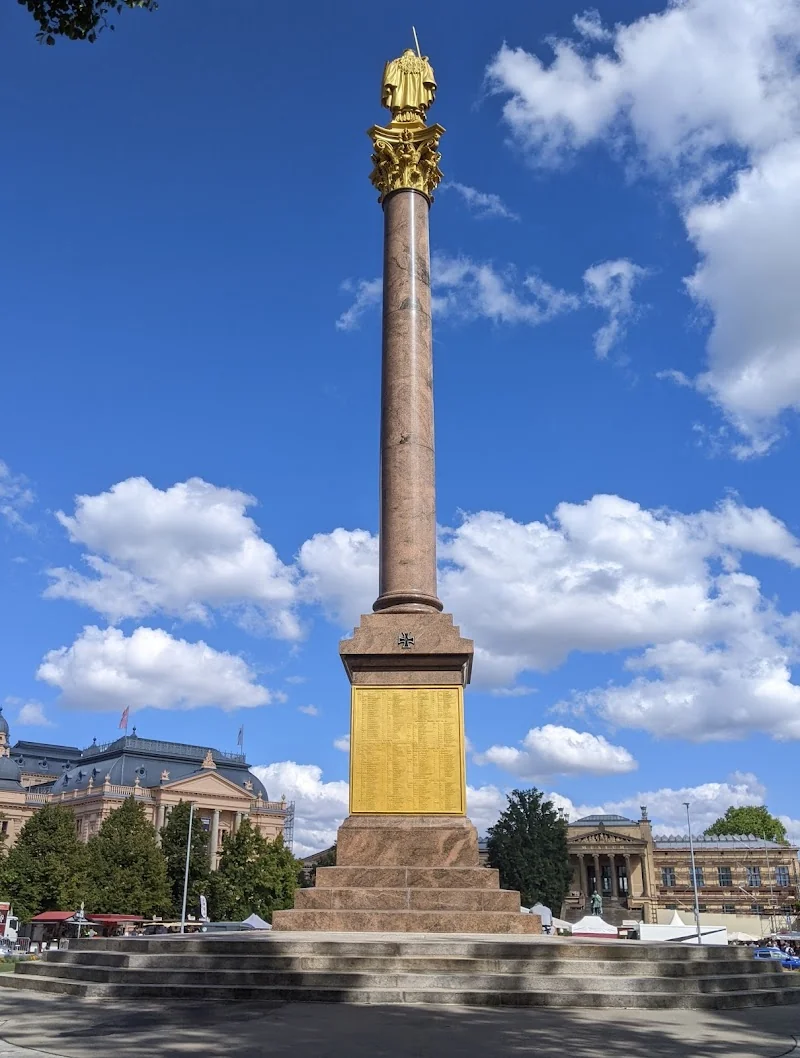
The Schwerin Victory Column, commonly referred to in German as Siegessäule, is one of the most prominent memorial sites in the state capital. Those searching for victory column or victoria schwerin generally mean this historic monument located at the Alten Garten, directly between the castle, museum, theater, and Burgsee. It is not a classic event venue with a seating plan or ticket sales, but a monument that can be freely perceived, seamlessly integrating into the Schwerin cityscape during a stroll. This is precisely what makes it appealing: it is not just a monument, but a landmark in the cultural center of the city. The surrounding area is part of the Schwerin residence ensemble, which has been a UNESCO World Heritage Site since July 27, 2024, and according to the city, includes more than 30 historic buildings, squares, and gardens. Standing here, one experiences not just a single monument, but a piece of city history in context. The Victory Column is often discovered within a tour, for example, on the way from the castle to the old town or while looking over the Burgsee. Many visitors initially perceive it as an elegant, golden accent before recognizing its historical significance. It is precisely this connection of beauty, memory, and landscape that gives the site its special effect. ([de.wikipedia.org](https://de.wikipedia.org/wiki/Siegess%C3%A4ule_%28Schwerin%29))
History and Significance of the Schwerin Victory Column
The history of the Schwerin Victory Column dates back to the time after the war of 1870/71. The monument was erected in memory of the fallen, those who succumbed to their wounds, or those who died from illness in Mecklenburg. The commission for designs of a victory monument was given in 1872 to the chief court architect Hermann Willebrand. By early 1873, work on the foundation began, the installation was completed in October 1874, and the ceremonial dedication of the monument took place on December 2, 1874. The monument was inscribed with a dedication that commemorates the fallen of the war of 1870/71. The structure is a replica of the Phocas Column in the Roman Forum in Rome and reaches a height of about 23 meters up to the sword tip of the figure. On the pedestal stands the figure Megalopolis, an allegorical female figure that personifies Mecklenburg. Gustav Willgohs is mentioned for the modeling of the figure. This combination of classical monumentality, regional symbolism, and military historical commemoration explains why the column functions not only as a decorative element but as a consciously designed historical monument. Its effect unfolds precisely through the contrast between strict monumentality and the soft, park-like surroundings. At the same time, it is a testament to the memorial culture of the 19th century, in which memory, representation, and landscape design were closely intertwined. Thus, the Victory Column tells not only of a war but also of a historical image that can still be read in the urban layout of Schwerin today. ([de.wikipedia.org](https://de.wikipedia.org/wiki/Siegess%C3%A4ule_%28Schwerin%29))
Location at the Alten Garten, Burgsee, and in the UNESCO Residence Ensemble
The Victory Column stands at the Alten Garten, one of the most prominent squares in Schwerin. The area is framed by the castle, museum, and theater and opens up towards Burgsee and Schweriner See. This very location makes the Victory Column an ideal focal point for anyone exploring Schwerin on foot. According to the monument list, the Alten Garten, as a square with the Victory Column, linden planting, and waterfront and path layout, is part of the protected cityscape. The immediate surroundings are thus not randomly designed but are part of a developed historical ensemble. The city history also locates the Alten Garten as a place that was significantly enhanced in the 19th century by the Paul-Friedrich monument, the Victory Column, the museum, a new theater, and the semicircular avenue at Burgsee. Today, those standing there see these urban spaces intertwining: the representative square, the water area, the castle backdrop, and the promenade. This is one of the reasons why the Victory Column is often described as particularly photogenic. Its location makes it a transition between courtly architecture, urban space, and landscape garden. This is also important for a first visit to Schwerin, as the site often serves as an anchor point for a half or full stroll. Particularly in the context of the UNESCO residence ensemble, it becomes clear that the Victory Column does not function as an isolated monument but as part of a larger cultural context. Anyone wanting to understand Schwerin should not only see this place but also take the time to walk around it and consciously perceive the sight lines to the castle, museum, and water. ([legalegraffiti.schwerin.de](https://legalegraffiti.schwerin.de/export/sites/default/.galleries/Dokumente/Planen-Bauen/Denkmalschutz/Denkmalliste-Schwerin-_1_2026.pdf))
Castle, Museum, and Tour: What Can Be Discovered Around the Victory Column
Surrounding the Victory Column are some of Schwerin's most important sights closely together. The Schwerin Castle with its garden is just a few steps away, as is the state museum and the theater at the Alten Garten. The official city describes the castle as located directly in the city and particularly emphasizes the castle garden with its many details. For visitors, this means: The Victory Column is ideally embedded in a larger exploration tour. Starting at the square, one can direct their gaze towards the castle, walk along the Burgsee, take in the garden space, and then continue towards the old town. The city advertises this connection between the old town, castle garden, and lakeshore in its tour and package offerings. For short visits, the Victory Column itself often suffices as a concentrated photo stop, but it is precisely its neighborhood that makes the stay worthwhile. It serves as a calm counterpoint to the grand attractions of the castle and theater. At the same time, it is a good starting point for thematic city tours, where Schwerin's history is told from the Middle Ages through the residence period to the present. In the everyday life of the city, the area is also used as a meeting point and backdrop, for example, for events in the castle area or for walks by the lake. Those traveling with children or with little time will still find a lot of atmosphere in a small space. The monument reveals itself best not through haste but through the contrast of monument, water, and garden. This very mix makes the place so typical for Schwerin and explains why it almost automatically appears in many travel guides and tours. ([schwerin.de](https://www.schwerin.de/en/visit-schwerin/attractions/schwerin-castle/))
Directions, Parking, and the Best Way to the Victory Column
Schwerin's city center is well connected for getting to the Victory Column. The city points out that Schwerin is located between Hamburg and Berlin and can be reached by car via the A24, A14, and A20 highways. For the castle and old garden area, the city names the parking garages Schlosspark-Center, Marienplatz-Galerie, and Schweriner Höfe, which are about 500 meters from the castle. Even without a car, the location is uncomplicated: from the main train station, the walking distance to the event area is about 1300 meters, from Schwerin Mitte station it is similarly manageable; from Marienplatz it is about 750 meters. Those arriving by train can thus comfortably walk towards the old town, castle, and Victory Column. For a relaxed visit, a combination of public transport or parking garage followed by a walk is generally recommended. This is not only practical but also fits better with the site itself, as the Victory Column unfolds its effect while walking and from changing perspectives. The city also provides traffic information for the castle festival weekend, during which the area around the Alten Garten and Schlossstraße may be temporarily closed. This is important if one combines a visit with event days. Especially on heavily frequented days, it is advisable to experience the city center on foot rather than trying to drive directly to the monument. Thus, the journey itself becomes part of the experience: first the approach through the historical square spaces, then the view of the column, and finally the interplay with Burgsee and the castle. This route is likely the most pleasant and practical access at the same time. ([legalegraffiti.schwerin.de](https://legalegraffiti.schwerin.de/kultur-tourismus/veranstaltungen/veranstaltungshoehepunkte/schweriner-schlossfestwochenende/anfahrt-parken-verkehrshinweise/index.html))
Events, Castle Festival, and Handmade Market at the Victory Column
The Victory Column is not only a monument but also a lively place in Schwerin's event calendar. The city regularly uses the area for festivals and cultural formats, most famously for the castle festival weekend and the Handmade art and crafts market around the Victory Column. According to the city, over 40 exhibitors with leather goods, jewelry, glass art, pottery, and other works find their place there. For visitors, this is a special advantage, as the historic environment is thus filled with contemporary urban life. The Victory Column then serves as a backdrop for a market that can be very well combined with a visit to the castle and old town. The official event planning of the city also continues to name the site as a venue for larger events. It becomes clear that the site is not museum-like and stagnant but actively influences the present. Particularly exciting is the contrast between the memorial character of the column and the open, festive use of the square. This very tension characterizes Schwerin: representative history in a small space, but continually revitalized by culture, craftsmanship, and city festivals. Therefore, those traveling in early summer or during the season in Schwerin should not only keep an eye on the monument itself but also on the calendar. Because around the Victory Column, history can often be directly connected with programs, markets, and public life. This makes the place particularly attractive for city visitors, as one can walk within minutes from the quiet monument to the colorful market and back to the serene lakeside promenade. ([schwerin.de](https://www.schwerin.de/news/schlossfest-2025/))
Photo Spot, Visitor Tips, and What Makes the Schwerin Victory Column Special
The Schwerin Victory Column is particularly impressive when viewed calmly. Its charm lies less in spectacular effects than in a clear, elegant monumentality. Those wanting to take good photos should test the various viewing directions: from the Alten Garten with the historic facades in the background, from the Burgsee shore with water and castle backdrop, or from a distance to show the column within the urban fabric. The square is well-suited for short stays, but the impression deepens when one walks around the monument and perceives the spatial effect of the ensemble. The surroundings themselves also provide strong motifs, as the historic sight lines between the castle, museum, theater, and lake are typical for Schwerin. This is precisely why the Victory Column is more than just a single monument for visitors: it is a place of condensed city history. Those with only ten minutes can easily take the monument as a short stop. Those staying longer should continue along the Burgsee and experience the Alten Garten as a complete composition. The monument symbolically represents several levels of Schwerin at once: memory of the Prussian-Mecklenburg history of the 19th century, representative residence architecture, later urban use, and today's integration into a UNESCO World Heritage Site. It is precisely these layers that make the place unique. The Victory Column is not a place for loud effects but for careful observation. It rewards visitors with historical depth, beautiful surroundings, and a very clear sense of the city's identity. Those wanting to truly experience Schwerin should not just walk by here but take the time to let the square, the water, and the architecture as a whole resonate. ([de.wikipedia.org](https://de.wikipedia.org/wiki/Siegess%C3%A4ule_%28Schwerin%29))
Sources:
Show moreShow less
Schwerin Victory Column | Victory Column & History
The Schwerin Victory Column, commonly referred to in German as Siegessäule, is one of the most prominent memorial sites in the state capital. Those searching for victory column or victoria schwerin generally mean this historic monument located at the Alten Garten, directly between the castle, museum, theater, and Burgsee. It is not a classic event venue with a seating plan or ticket sales, but a monument that can be freely perceived, seamlessly integrating into the Schwerin cityscape during a stroll. This is precisely what makes it appealing: it is not just a monument, but a landmark in the cultural center of the city. The surrounding area is part of the Schwerin residence ensemble, which has been a UNESCO World Heritage Site since July 27, 2024, and according to the city, includes more than 30 historic buildings, squares, and gardens. Standing here, one experiences not just a single monument, but a piece of city history in context. The Victory Column is often discovered within a tour, for example, on the way from the castle to the old town or while looking over the Burgsee. Many visitors initially perceive it as an elegant, golden accent before recognizing its historical significance. It is precisely this connection of beauty, memory, and landscape that gives the site its special effect. ([de.wikipedia.org](https://de.wikipedia.org/wiki/Siegess%C3%A4ule_%28Schwerin%29))
History and Significance of the Schwerin Victory Column
The history of the Schwerin Victory Column dates back to the time after the war of 1870/71. The monument was erected in memory of the fallen, those who succumbed to their wounds, or those who died from illness in Mecklenburg. The commission for designs of a victory monument was given in 1872 to the chief court architect Hermann Willebrand. By early 1873, work on the foundation began, the installation was completed in October 1874, and the ceremonial dedication of the monument took place on December 2, 1874. The monument was inscribed with a dedication that commemorates the fallen of the war of 1870/71. The structure is a replica of the Phocas Column in the Roman Forum in Rome and reaches a height of about 23 meters up to the sword tip of the figure. On the pedestal stands the figure Megalopolis, an allegorical female figure that personifies Mecklenburg. Gustav Willgohs is mentioned for the modeling of the figure. This combination of classical monumentality, regional symbolism, and military historical commemoration explains why the column functions not only as a decorative element but as a consciously designed historical monument. Its effect unfolds precisely through the contrast between strict monumentality and the soft, park-like surroundings. At the same time, it is a testament to the memorial culture of the 19th century, in which memory, representation, and landscape design were closely intertwined. Thus, the Victory Column tells not only of a war but also of a historical image that can still be read in the urban layout of Schwerin today. ([de.wikipedia.org](https://de.wikipedia.org/wiki/Siegess%C3%A4ule_%28Schwerin%29))
Location at the Alten Garten, Burgsee, and in the UNESCO Residence Ensemble
The Victory Column stands at the Alten Garten, one of the most prominent squares in Schwerin. The area is framed by the castle, museum, and theater and opens up towards Burgsee and Schweriner See. This very location makes the Victory Column an ideal focal point for anyone exploring Schwerin on foot. According to the monument list, the Alten Garten, as a square with the Victory Column, linden planting, and waterfront and path layout, is part of the protected cityscape. The immediate surroundings are thus not randomly designed but are part of a developed historical ensemble. The city history also locates the Alten Garten as a place that was significantly enhanced in the 19th century by the Paul-Friedrich monument, the Victory Column, the museum, a new theater, and the semicircular avenue at Burgsee. Today, those standing there see these urban spaces intertwining: the representative square, the water area, the castle backdrop, and the promenade. This is one of the reasons why the Victory Column is often described as particularly photogenic. Its location makes it a transition between courtly architecture, urban space, and landscape garden. This is also important for a first visit to Schwerin, as the site often serves as an anchor point for a half or full stroll. Particularly in the context of the UNESCO residence ensemble, it becomes clear that the Victory Column does not function as an isolated monument but as part of a larger cultural context. Anyone wanting to understand Schwerin should not only see this place but also take the time to walk around it and consciously perceive the sight lines to the castle, museum, and water. ([legalegraffiti.schwerin.de](https://legalegraffiti.schwerin.de/export/sites/default/.galleries/Dokumente/Planen-Bauen/Denkmalschutz/Denkmalliste-Schwerin-_1_2026.pdf))
Castle, Museum, and Tour: What Can Be Discovered Around the Victory Column
Surrounding the Victory Column are some of Schwerin's most important sights closely together. The Schwerin Castle with its garden is just a few steps away, as is the state museum and the theater at the Alten Garten. The official city describes the castle as located directly in the city and particularly emphasizes the castle garden with its many details. For visitors, this means: The Victory Column is ideally embedded in a larger exploration tour. Starting at the square, one can direct their gaze towards the castle, walk along the Burgsee, take in the garden space, and then continue towards the old town. The city advertises this connection between the old town, castle garden, and lakeshore in its tour and package offerings. For short visits, the Victory Column itself often suffices as a concentrated photo stop, but it is precisely its neighborhood that makes the stay worthwhile. It serves as a calm counterpoint to the grand attractions of the castle and theater. At the same time, it is a good starting point for thematic city tours, where Schwerin's history is told from the Middle Ages through the residence period to the present. In the everyday life of the city, the area is also used as a meeting point and backdrop, for example, for events in the castle area or for walks by the lake. Those traveling with children or with little time will still find a lot of atmosphere in a small space. The monument reveals itself best not through haste but through the contrast of monument, water, and garden. This very mix makes the place so typical for Schwerin and explains why it almost automatically appears in many travel guides and tours. ([schwerin.de](https://www.schwerin.de/en/visit-schwerin/attractions/schwerin-castle/))
Directions, Parking, and the Best Way to the Victory Column
Schwerin's city center is well connected for getting to the Victory Column. The city points out that Schwerin is located between Hamburg and Berlin and can be reached by car via the A24, A14, and A20 highways. For the castle and old garden area, the city names the parking garages Schlosspark-Center, Marienplatz-Galerie, and Schweriner Höfe, which are about 500 meters from the castle. Even without a car, the location is uncomplicated: from the main train station, the walking distance to the event area is about 1300 meters, from Schwerin Mitte station it is similarly manageable; from Marienplatz it is about 750 meters. Those arriving by train can thus comfortably walk towards the old town, castle, and Victory Column. For a relaxed visit, a combination of public transport or parking garage followed by a walk is generally recommended. This is not only practical but also fits better with the site itself, as the Victory Column unfolds its effect while walking and from changing perspectives. The city also provides traffic information for the castle festival weekend, during which the area around the Alten Garten and Schlossstraße may be temporarily closed. This is important if one combines a visit with event days. Especially on heavily frequented days, it is advisable to experience the city center on foot rather than trying to drive directly to the monument. Thus, the journey itself becomes part of the experience: first the approach through the historical square spaces, then the view of the column, and finally the interplay with Burgsee and the castle. This route is likely the most pleasant and practical access at the same time. ([legalegraffiti.schwerin.de](https://legalegraffiti.schwerin.de/kultur-tourismus/veranstaltungen/veranstaltungshoehepunkte/schweriner-schlossfestwochenende/anfahrt-parken-verkehrshinweise/index.html))
Events, Castle Festival, and Handmade Market at the Victory Column
The Victory Column is not only a monument but also a lively place in Schwerin's event calendar. The city regularly uses the area for festivals and cultural formats, most famously for the castle festival weekend and the Handmade art and crafts market around the Victory Column. According to the city, over 40 exhibitors with leather goods, jewelry, glass art, pottery, and other works find their place there. For visitors, this is a special advantage, as the historic environment is thus filled with contemporary urban life. The Victory Column then serves as a backdrop for a market that can be very well combined with a visit to the castle and old town. The official event planning of the city also continues to name the site as a venue for larger events. It becomes clear that the site is not museum-like and stagnant but actively influences the present. Particularly exciting is the contrast between the memorial character of the column and the open, festive use of the square. This very tension characterizes Schwerin: representative history in a small space, but continually revitalized by culture, craftsmanship, and city festivals. Therefore, those traveling in early summer or during the season in Schwerin should not only keep an eye on the monument itself but also on the calendar. Because around the Victory Column, history can often be directly connected with programs, markets, and public life. This makes the place particularly attractive for city visitors, as one can walk within minutes from the quiet monument to the colorful market and back to the serene lakeside promenade. ([schwerin.de](https://www.schwerin.de/news/schlossfest-2025/))
Photo Spot, Visitor Tips, and What Makes the Schwerin Victory Column Special
The Schwerin Victory Column is particularly impressive when viewed calmly. Its charm lies less in spectacular effects than in a clear, elegant monumentality. Those wanting to take good photos should test the various viewing directions: from the Alten Garten with the historic facades in the background, from the Burgsee shore with water and castle backdrop, or from a distance to show the column within the urban fabric. The square is well-suited for short stays, but the impression deepens when one walks around the monument and perceives the spatial effect of the ensemble. The surroundings themselves also provide strong motifs, as the historic sight lines between the castle, museum, theater, and lake are typical for Schwerin. This is precisely why the Victory Column is more than just a single monument for visitors: it is a place of condensed city history. Those with only ten minutes can easily take the monument as a short stop. Those staying longer should continue along the Burgsee and experience the Alten Garten as a complete composition. The monument symbolically represents several levels of Schwerin at once: memory of the Prussian-Mecklenburg history of the 19th century, representative residence architecture, later urban use, and today's integration into a UNESCO World Heritage Site. It is precisely these layers that make the place unique. The Victory Column is not a place for loud effects but for careful observation. It rewards visitors with historical depth, beautiful surroundings, and a very clear sense of the city's identity. Those wanting to truly experience Schwerin should not just walk by here but take the time to let the square, the water, and the architecture as a whole resonate. ([de.wikipedia.org](https://de.wikipedia.org/wiki/Siegess%C3%A4ule_%28Schwerin%29))
Sources:
Schwerin Victory Column | Victory Column & History
The Schwerin Victory Column, commonly referred to in German as Siegessäule, is one of the most prominent memorial sites in the state capital. Those searching for victory column or victoria schwerin generally mean this historic monument located at the Alten Garten, directly between the castle, museum, theater, and Burgsee. It is not a classic event venue with a seating plan or ticket sales, but a monument that can be freely perceived, seamlessly integrating into the Schwerin cityscape during a stroll. This is precisely what makes it appealing: it is not just a monument, but a landmark in the cultural center of the city. The surrounding area is part of the Schwerin residence ensemble, which has been a UNESCO World Heritage Site since July 27, 2024, and according to the city, includes more than 30 historic buildings, squares, and gardens. Standing here, one experiences not just a single monument, but a piece of city history in context. The Victory Column is often discovered within a tour, for example, on the way from the castle to the old town or while looking over the Burgsee. Many visitors initially perceive it as an elegant, golden accent before recognizing its historical significance. It is precisely this connection of beauty, memory, and landscape that gives the site its special effect. ([de.wikipedia.org](https://de.wikipedia.org/wiki/Siegess%C3%A4ule_%28Schwerin%29))
History and Significance of the Schwerin Victory Column
The history of the Schwerin Victory Column dates back to the time after the war of 1870/71. The monument was erected in memory of the fallen, those who succumbed to their wounds, or those who died from illness in Mecklenburg. The commission for designs of a victory monument was given in 1872 to the chief court architect Hermann Willebrand. By early 1873, work on the foundation began, the installation was completed in October 1874, and the ceremonial dedication of the monument took place on December 2, 1874. The monument was inscribed with a dedication that commemorates the fallen of the war of 1870/71. The structure is a replica of the Phocas Column in the Roman Forum in Rome and reaches a height of about 23 meters up to the sword tip of the figure. On the pedestal stands the figure Megalopolis, an allegorical female figure that personifies Mecklenburg. Gustav Willgohs is mentioned for the modeling of the figure. This combination of classical monumentality, regional symbolism, and military historical commemoration explains why the column functions not only as a decorative element but as a consciously designed historical monument. Its effect unfolds precisely through the contrast between strict monumentality and the soft, park-like surroundings. At the same time, it is a testament to the memorial culture of the 19th century, in which memory, representation, and landscape design were closely intertwined. Thus, the Victory Column tells not only of a war but also of a historical image that can still be read in the urban layout of Schwerin today. ([de.wikipedia.org](https://de.wikipedia.org/wiki/Siegess%C3%A4ule_%28Schwerin%29))
Location at the Alten Garten, Burgsee, and in the UNESCO Residence Ensemble
The Victory Column stands at the Alten Garten, one of the most prominent squares in Schwerin. The area is framed by the castle, museum, and theater and opens up towards Burgsee and Schweriner See. This very location makes the Victory Column an ideal focal point for anyone exploring Schwerin on foot. According to the monument list, the Alten Garten, as a square with the Victory Column, linden planting, and waterfront and path layout, is part of the protected cityscape. The immediate surroundings are thus not randomly designed but are part of a developed historical ensemble. The city history also locates the Alten Garten as a place that was significantly enhanced in the 19th century by the Paul-Friedrich monument, the Victory Column, the museum, a new theater, and the semicircular avenue at Burgsee. Today, those standing there see these urban spaces intertwining: the representative square, the water area, the castle backdrop, and the promenade. This is one of the reasons why the Victory Column is often described as particularly photogenic. Its location makes it a transition between courtly architecture, urban space, and landscape garden. This is also important for a first visit to Schwerin, as the site often serves as an anchor point for a half or full stroll. Particularly in the context of the UNESCO residence ensemble, it becomes clear that the Victory Column does not function as an isolated monument but as part of a larger cultural context. Anyone wanting to understand Schwerin should not only see this place but also take the time to walk around it and consciously perceive the sight lines to the castle, museum, and water. ([legalegraffiti.schwerin.de](https://legalegraffiti.schwerin.de/export/sites/default/.galleries/Dokumente/Planen-Bauen/Denkmalschutz/Denkmalliste-Schwerin-_1_2026.pdf))
Castle, Museum, and Tour: What Can Be Discovered Around the Victory Column
Surrounding the Victory Column are some of Schwerin's most important sights closely together. The Schwerin Castle with its garden is just a few steps away, as is the state museum and the theater at the Alten Garten. The official city describes the castle as located directly in the city and particularly emphasizes the castle garden with its many details. For visitors, this means: The Victory Column is ideally embedded in a larger exploration tour. Starting at the square, one can direct their gaze towards the castle, walk along the Burgsee, take in the garden space, and then continue towards the old town. The city advertises this connection between the old town, castle garden, and lakeshore in its tour and package offerings. For short visits, the Victory Column itself often suffices as a concentrated photo stop, but it is precisely its neighborhood that makes the stay worthwhile. It serves as a calm counterpoint to the grand attractions of the castle and theater. At the same time, it is a good starting point for thematic city tours, where Schwerin's history is told from the Middle Ages through the residence period to the present. In the everyday life of the city, the area is also used as a meeting point and backdrop, for example, for events in the castle area or for walks by the lake. Those traveling with children or with little time will still find a lot of atmosphere in a small space. The monument reveals itself best not through haste but through the contrast of monument, water, and garden. This very mix makes the place so typical for Schwerin and explains why it almost automatically appears in many travel guides and tours. ([schwerin.de](https://www.schwerin.de/en/visit-schwerin/attractions/schwerin-castle/))
Directions, Parking, and the Best Way to the Victory Column
Schwerin's city center is well connected for getting to the Victory Column. The city points out that Schwerin is located between Hamburg and Berlin and can be reached by car via the A24, A14, and A20 highways. For the castle and old garden area, the city names the parking garages Schlosspark-Center, Marienplatz-Galerie, and Schweriner Höfe, which are about 500 meters from the castle. Even without a car, the location is uncomplicated: from the main train station, the walking distance to the event area is about 1300 meters, from Schwerin Mitte station it is similarly manageable; from Marienplatz it is about 750 meters. Those arriving by train can thus comfortably walk towards the old town, castle, and Victory Column. For a relaxed visit, a combination of public transport or parking garage followed by a walk is generally recommended. This is not only practical but also fits better with the site itself, as the Victory Column unfolds its effect while walking and from changing perspectives. The city also provides traffic information for the castle festival weekend, during which the area around the Alten Garten and Schlossstraße may be temporarily closed. This is important if one combines a visit with event days. Especially on heavily frequented days, it is advisable to experience the city center on foot rather than trying to drive directly to the monument. Thus, the journey itself becomes part of the experience: first the approach through the historical square spaces, then the view of the column, and finally the interplay with Burgsee and the castle. This route is likely the most pleasant and practical access at the same time. ([legalegraffiti.schwerin.de](https://legalegraffiti.schwerin.de/kultur-tourismus/veranstaltungen/veranstaltungshoehepunkte/schweriner-schlossfestwochenende/anfahrt-parken-verkehrshinweise/index.html))
Events, Castle Festival, and Handmade Market at the Victory Column
The Victory Column is not only a monument but also a lively place in Schwerin's event calendar. The city regularly uses the area for festivals and cultural formats, most famously for the castle festival weekend and the Handmade art and crafts market around the Victory Column. According to the city, over 40 exhibitors with leather goods, jewelry, glass art, pottery, and other works find their place there. For visitors, this is a special advantage, as the historic environment is thus filled with contemporary urban life. The Victory Column then serves as a backdrop for a market that can be very well combined with a visit to the castle and old town. The official event planning of the city also continues to name the site as a venue for larger events. It becomes clear that the site is not museum-like and stagnant but actively influences the present. Particularly exciting is the contrast between the memorial character of the column and the open, festive use of the square. This very tension characterizes Schwerin: representative history in a small space, but continually revitalized by culture, craftsmanship, and city festivals. Therefore, those traveling in early summer or during the season in Schwerin should not only keep an eye on the monument itself but also on the calendar. Because around the Victory Column, history can often be directly connected with programs, markets, and public life. This makes the place particularly attractive for city visitors, as one can walk within minutes from the quiet monument to the colorful market and back to the serene lakeside promenade. ([schwerin.de](https://www.schwerin.de/news/schlossfest-2025/))
Photo Spot, Visitor Tips, and What Makes the Schwerin Victory Column Special
The Schwerin Victory Column is particularly impressive when viewed calmly. Its charm lies less in spectacular effects than in a clear, elegant monumentality. Those wanting to take good photos should test the various viewing directions: from the Alten Garten with the historic facades in the background, from the Burgsee shore with water and castle backdrop, or from a distance to show the column within the urban fabric. The square is well-suited for short stays, but the impression deepens when one walks around the monument and perceives the spatial effect of the ensemble. The surroundings themselves also provide strong motifs, as the historic sight lines between the castle, museum, theater, and lake are typical for Schwerin. This is precisely why the Victory Column is more than just a single monument for visitors: it is a place of condensed city history. Those with only ten minutes can easily take the monument as a short stop. Those staying longer should continue along the Burgsee and experience the Alten Garten as a complete composition. The monument symbolically represents several levels of Schwerin at once: memory of the Prussian-Mecklenburg history of the 19th century, representative residence architecture, later urban use, and today's integration into a UNESCO World Heritage Site. It is precisely these layers that make the place unique. The Victory Column is not a place for loud effects but for careful observation. It rewards visitors with historical depth, beautiful surroundings, and a very clear sense of the city's identity. Those wanting to truly experience Schwerin should not just walk by here but take the time to let the square, the water, and the architecture as a whole resonate. ([de.wikipedia.org](https://de.wikipedia.org/wiki/Siegess%C3%A4ule_%28Schwerin%29))
Sources:
Upcoming Events
No events found
Frequently Asked Questions
Reviews
Michael Mack
14. April 2024
A beautiful column right before you get to the Schwerin Castle. Enjoyed our visit. Sits around a beautiful garden by the lake.
Marin “SayanMk” Kolev
20. April 2023
Just before the bridge to the castle. Not so big, but beautiful and gold-painted. Very nice garden around it.
Praveen Mehrotra
30. September 2018
This monument is located just in front of Museum and before entry to Schwerin Castle. In small park, with lake and Castle facing on one side the monument stands tall and impressive. It is a small activity and may be you can spend about 10 minutes here.
A R
23. July 2022
This historical column is located to the right grounds when approaching the castle from the front.
Pushpraj Singh
7. August 2022
Nice area with the serene lake nearby.