
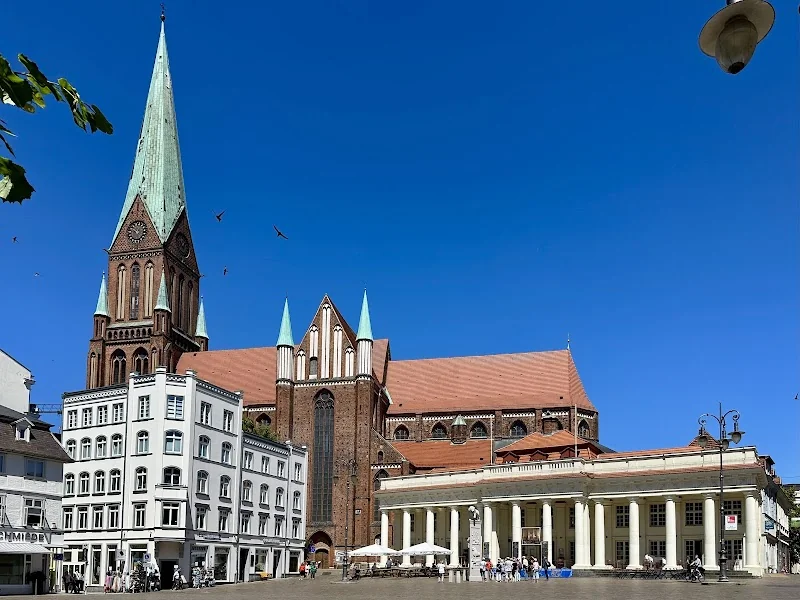
Am Dom 4, Schwerin
Am Dom 4, 19055 Schwerin, Germany
St. Mary's Cathedral in Schwerin | Opening Hours & Tower Climb
St. Mary's Cathedral in Schwerin is much more than a religious site. As the oldest building in the city, a prominent landmark of the old town, and a vibrant center of the cathedral community, it connects history, architecture, music, and quiet visits in a single ensemble. Entering the cathedral, one experiences not only the powerful brick Gothic architecture and the tall tower but also services, midday prayers, guided tours, and changing artistic impulses. This mix makes the visit attractive for travelers, architecture fans, families, and anyone looking for a special place in Schwerin. The cathedral is easily accessible, open to the public, and offers many reasons to stay longer than just for a quick glance, with its tower climb, organ music, and light art. ([kirche-mv.de](https://www.kirche-mv.de/schwerin-domgemeinde/der-schweriner-dom))
Opening Hours, Admission, and Tower Climb
Those planning to visit Schwerin Cathedral should pay attention to the opening hours, as they are clearly regulated and will change on May 1, 2026. Until April 30, 2026, the cathedral with the tower is open from Monday to Saturday from 11 AM to 3 PM and on Sundays from 12 PM to 3 PM. From May 1, 2026, longer hours will apply from Monday to Saturday from 10 AM to 5 PM and on Sundays from 12 PM to 5 PM. The last opportunity to visit the tower ends 45 minutes before closing. This is important if one wants to plan the ascent calmly with a view of the city rather than rushing in and out. Admission to the cathedral is free, but a donation of 2 euros is requested for maintenance. The tower climb costs 3 euros for adults and 1 euro for children and teenagers up to 16 years. ([kirche-mv.de](https://www.kirche-mv.de/schwerin-domgemeinde))
Practically, the cathedral also has clear advantages: According to tourism information, it is accessible for people with disabilities, and its central location makes it easy to combine with a stroll through the old town. Those wishing to climb the tower should plan enough time, as the 220 steps are not a short walk but a small excursion above the rooftops of the city. At the top, a wide view over Schwerin's lake landscape, the castle, and the old town awaits. For this reason, it is worthwhile not to start the visit in the last minutes before closing. Those wanting to take photos will find one of the best views of the city from the tower, and those who prefer to avoid heights can experience the cathedral as a quiet, free place of reflection on the ground floor. ([visit-mv.com](https://www.visit-mv.com/destinations/a-dom-schwerin))
History of Schwerin Cathedral
The history of the cathedral dates back a long way. As early as 1154, a Christian community was documented in Schwerin, the first consecration took place in 1171, and the Romanesque cathedral was consecrated in 1248. The bricked-up portal on the western south side, known as the Paradise Gate, remains from the Romanesque building. Around 1270, the construction of the Gothic cathedral began because the veneration of the Holy Blood and other relics had bound the medieval pilgrimage stream to the site. The choir was completed in 1326, the transept in 1370, and in 1426 the nave was vaulted, thus completing the cathedral construction. This long construction history explains why the cathedral does not appear as a single moment but as a narrative grown over centuries of faith, power, art, and urban history. ([kirche-mv.de](https://www.kirche-mv.de/schwerin-domgemeinde/der-schweriner-dom))
Even after the Middle Ages, the cathedral remained influential. Since 1552, it has been an evangelical parish church, and since 1922, it has been the seat of the Evangelical Lutheran Bishop of the State. The current tower dates from 1889 to 1892 and marks the last major architectural accent of the overall complex. At 117.5 meters, it towers over the city and makes the cathedral the tallest church tower in Mecklenburg. For visitors, this history is not just a chain of data but is palpable in the space itself: the Romanesque origin, the Gothic expansion, the later use as an evangelical church, and the current role as a vibrant parish cathedral interconnect. This is precisely what makes Schwerin Cathedral so exciting for history enthusiasts - one does not just see a monument but a structural development that tells the story of Mecklenburg's transformation over centuries. ([kirche-mv.de](https://www.kirche-mv.de/schwerin-domgemeinde/der-schweriner-dom))
Architecture, Artwork, and Special Photo Opportunities
Architecturally, the cathedral is a textbook example of North German brick Gothic. With a length of 105 meters, its massive pillars and the high, light-filled interior create a strict yet surprisingly light impression. Even the preserved Paradise Gate recalls the Romanesque prehistory, while the large Gothic structures consistently lead the gaze upward. Inside, the space was reconstructed between 1980 and 1988 so that the late Gothic painting became tangible again. This creates a balance today between historical depth and clear, comprehensible spatial effect. Those who walk slowly through the cathedral will particularly notice this mixture of strength and tranquility: heavy brick surfaces, bright window zones, historical tomb monuments, and an architecture that does not impose itself with effects but lives from proportion and light. ([kirche-mv.de](https://www.kirche-mv.de/schwerin-domgemeinde/der-schweriner-dom))
Among the particularly noteworthy artworks are the bronze baptismal font from the early 14th century, the bronze grave slabs for four bishops from the House of Bülow in the northern transept, medieval paintings in the Assumption of Mary Chapel, and the choir aisle with a ring of chapels that became the burial place of Mecklenburg princes after the Reformation. The cathedral once had 42 altars; today, the idea of a highly complex medieval interior world remains. In addition, stained glass windows, tombs, and altars not only decorate the space but also make its history visible. For photos, this means: there is not just one view but many strong motifs - the portal, the pillars, the baptismal font, the tomb monuments, and the play of light and shadow in the choir. ([kirche-mv.de](https://www.kirche-mv.de/schwerin-domgemeinde/der-schweriner-dom))
A particularly current accent is the four windows designed by Günther Uecker under the title Light Arc. They were created in two chapels of the transept; a total of around 130 glass fields shine in blue light over approximately 62 square meters. The commissioning took place on December 1, 2024, after the cathedral community and the support group had worked on it for a long time. These windows connect contemporary art with the historical space and noticeably change the impression of the cathedral depending on the time of day. Especially for visitors looking for photos or wanting to experience light moods, they are a special attraction: the blue provides a cool, almost floating contrast to brick, vaults, and stone. This shows that monument protection and contemporary art do not exclude each other but can complement one another. ([kirche-mv.de](https://www.kirche-mv.de/nachrichten/2024/november/uecker-fenster-werden-in-dienst-gestellt))
Services, Midday Prayer, and Cathedral Tours
Schwerin Cathedral is not just a sightseeing object but a place with vibrant community life. Every Sunday at 10 AM, a service takes place in the cathedral or in the Thomas Chapel, each with a children's service. From Monday to Friday, the responsible parties invite everyone to a midday prayer lasting about ten minutes at 12:10 PM, which is also accompanied by organ music in summer. These fixed times make the cathedral interesting for people who are not just ticking off sights but are looking for a calm spiritual atmosphere. The midday prayer is a nice anchor point for a visit to the city center: short, accessible, and organized so that spontaneous guests are also welcome. Therefore, those who want to not just visit the cathedral but experience it will find a place where church life remains visible and audible. ([kirche-mv.de](https://www.kirche-mv.de/schwerin-domgemeinde))
There are also clear offerings for guided tours. The cathedral community offers public tours; until April 30, 2026, they take place on Mondays and Saturdays at 2 PM, and from May 1, 2026, on Mondays, Tuesdays, Thursdays, and Saturdays at 3 PM. Generally, one can participate without prior registration, but for larger groups or other times, the community recommends prior registration at the cathedral community office. Additionally, the cathedral guide guild has been offering weekly tours for many years; it consists of more than 20 volunteers who regularly continue their education. Therefore, those seeking background knowledge about architecture, history, and furnishings are much better advised with a guided tour than with a quick walk. This makes Schwerin Cathedral particularly attractive for school classes, travel groups, and individual travelers who want to understand the place more deeply. ([kirche-mv.de](https://www.kirche-mv.de/schwerin-domgemeinde))
Church Music, Ladegast Organ, and Concerts
Musically, the cathedral is also a significant address. At the center is the historic Ladegast organ, which was consecrated in 1871. According to the cathedral community, it is the largest original preserved work of Friedrich Ladegast: four manuals, with 84 speaking registers and 5235 pipes. The organ was restored in 1988 and continues to shape the sound of the cathedral today. For visitors, this is not just a technical number but an invitation to listen: the space is designed so that the organ sound makes the architecture almost physically tangible. Those who experience a service, a midday prayer, or a concert quickly realize how much architecture and music belong together here. Therefore, the cathedral is an experience not just for the eyes but also for the ears. ([kirche-mv.de](https://www.kirche-mv.de/schwerin-domgemeinde/der-schweriner-dom))
The cathedral community maintains a strong musical infrastructure for this purpose. The city and cathedral choir is led by church music director Christian Domke; its tasks include the design of services, community events, and the performance of large choral works and oratorios. The support association Music in the Cathedral e.V. has been supporting this work since 1994, financing special projects and relieving the community during events. The church music page also offers audio examples of the Ladegast organ, and the program shows that concerts, choir work, and special music formats regularly take place in the cathedral. For culture-interested visitors, this is a strong argument to consider the cathedral not just during the day but also in the evening or during concert dates. Thus, a visit becomes a cultural moment in which architecture, liturgy, and music intertwine. ([kirche-mv.de](https://www.kirche-mv.de/schwerin-domgemeinde/kirchenmusik-und-konzerte))
Access, Parking, and Barrier-Free Visit
The location of the cathedral is ideal for a visit, as it is located in the middle of Schwerin's old town at the address Am Dom 4. From the outside, it stands out from afar, and the tourist description emphasizes that it towers over the city center and the market area. Those arriving by car should plan to use the city center parking garages or the nearby parking lot Grüne Straße, which is about 400 meters from the cathedral. The parking garages are about 500 meters away. This makes it easy to incorporate a visit to the cathedral into a city walk without having to drive directly to the door. Those already in the city can also combine the visit with other sights, such as the castle, the State Museum, or a walk through the historic city center. ([visit-mv.com](https://www.visit-mv.com/destinations/a-dom-schwerin))
For practical planning, it is also worth taking a look at the parking situation in Schwerin overall: According to the city administration, the public parking spaces in the city center are managed and mostly chargeable, with parking zone 1 currently costing 2.50 euros per hour. Therefore, those wanting to arrive stress-free should plan either a city center parking garage, a short walk, or public transport. This fits well with the character of the cathedral, as it is more about a calm, conscious visit than a quick tick-off. Its location in the old town makes it equally attractive for tourists, locals, and day visitors: one passes by, goes inside, looks up, perhaps hears the organ or prayer - and finds oneself back in the midst of city life after just a few minutes. ([schwerin.de](https://www.schwerin.de/mein-schwerin/leben/ordnung-sicherheit-verkehr/verkehr-mobilitaet/mit-dem-kfz/parken/index.html))
Photos, Views, and Why the Cathedral Stays in Memory
Those looking for photos will find an unusually wide range of motifs at Schwerin Cathedral. Outside, it is the brick facades, the tall westwork, and the tower that define the city's silhouette. Inside, the baptismal font, the grave slabs, the chapels, and the clearly readable construction phases impress. The cathedral appears particularly strong where light and material meet: at the historic windows, in the choir, at the vaults, and since 2024 additionally at the blue glowing Light Arc windows by Günther Uecker. For social media images, this is important because the cathedral does not just provide a classic church view but several layers of imagery: monumental, tranquil, colorful, and detailed. Therefore, anyone planning photos of Schwerin Cathedral should include both exterior shots and interior views and, if possible, the view from the tower. ([kirche-mv.de](https://www.kirche-mv.de/schwerin-domgemeinde/der-schweriner-dom))
Another appeal lies in the time-dependence of the visit. How strongly the cathedral impacts depends on the daylight: in the morning, at noon, and in the late afternoon, the shadows, the window effects, and the perception of the vaults change. The Uecker windows enhance this impression because their blue does not simply adorn the space but atmospherically reinterprets it. For this reason, a second look or even a second visit is worthwhile. What may appear monumental the first time seems much more intimate, colorful, and tranquil on the next visit. Thus, a single photo stop quickly becomes a place one remembers. ([kirche-mv.de](https://www.kirche-mv.de/nachrichten/2024/november/uecker-fenster-werden-in-dienst-gestellt))
In the end, Schwerin Cathedral is a place that draws its impact from the connection of old and new, of silence and sound, of history and present. One can read it as an architectural monument, as a parish church, as a cultural site, or as a photographic motif - but it is strongest when these perspectives are not separated. This is precisely what makes the visit so worthwhile: first, one sees the size of the building, then the details, then the space, then the light. When one steps back into the old town afterward, one takes not only a beautiful building with them but a clear image of why Schwerin Cathedral has been one of the most influential places in the city for centuries. ([kirche-mv.de](https://www.kirche-mv.de/schwerin-domgemeinde/der-schweriner-dom))
Sources:
Show moreShow less
St. Mary's Cathedral in Schwerin | Opening Hours & Tower Climb
St. Mary's Cathedral in Schwerin is much more than a religious site. As the oldest building in the city, a prominent landmark of the old town, and a vibrant center of the cathedral community, it connects history, architecture, music, and quiet visits in a single ensemble. Entering the cathedral, one experiences not only the powerful brick Gothic architecture and the tall tower but also services, midday prayers, guided tours, and changing artistic impulses. This mix makes the visit attractive for travelers, architecture fans, families, and anyone looking for a special place in Schwerin. The cathedral is easily accessible, open to the public, and offers many reasons to stay longer than just for a quick glance, with its tower climb, organ music, and light art. ([kirche-mv.de](https://www.kirche-mv.de/schwerin-domgemeinde/der-schweriner-dom))
Opening Hours, Admission, and Tower Climb
Those planning to visit Schwerin Cathedral should pay attention to the opening hours, as they are clearly regulated and will change on May 1, 2026. Until April 30, 2026, the cathedral with the tower is open from Monday to Saturday from 11 AM to 3 PM and on Sundays from 12 PM to 3 PM. From May 1, 2026, longer hours will apply from Monday to Saturday from 10 AM to 5 PM and on Sundays from 12 PM to 5 PM. The last opportunity to visit the tower ends 45 minutes before closing. This is important if one wants to plan the ascent calmly with a view of the city rather than rushing in and out. Admission to the cathedral is free, but a donation of 2 euros is requested for maintenance. The tower climb costs 3 euros for adults and 1 euro for children and teenagers up to 16 years. ([kirche-mv.de](https://www.kirche-mv.de/schwerin-domgemeinde))
Practically, the cathedral also has clear advantages: According to tourism information, it is accessible for people with disabilities, and its central location makes it easy to combine with a stroll through the old town. Those wishing to climb the tower should plan enough time, as the 220 steps are not a short walk but a small excursion above the rooftops of the city. At the top, a wide view over Schwerin's lake landscape, the castle, and the old town awaits. For this reason, it is worthwhile not to start the visit in the last minutes before closing. Those wanting to take photos will find one of the best views of the city from the tower, and those who prefer to avoid heights can experience the cathedral as a quiet, free place of reflection on the ground floor. ([visit-mv.com](https://www.visit-mv.com/destinations/a-dom-schwerin))
History of Schwerin Cathedral
The history of the cathedral dates back a long way. As early as 1154, a Christian community was documented in Schwerin, the first consecration took place in 1171, and the Romanesque cathedral was consecrated in 1248. The bricked-up portal on the western south side, known as the Paradise Gate, remains from the Romanesque building. Around 1270, the construction of the Gothic cathedral began because the veneration of the Holy Blood and other relics had bound the medieval pilgrimage stream to the site. The choir was completed in 1326, the transept in 1370, and in 1426 the nave was vaulted, thus completing the cathedral construction. This long construction history explains why the cathedral does not appear as a single moment but as a narrative grown over centuries of faith, power, art, and urban history. ([kirche-mv.de](https://www.kirche-mv.de/schwerin-domgemeinde/der-schweriner-dom))
Even after the Middle Ages, the cathedral remained influential. Since 1552, it has been an evangelical parish church, and since 1922, it has been the seat of the Evangelical Lutheran Bishop of the State. The current tower dates from 1889 to 1892 and marks the last major architectural accent of the overall complex. At 117.5 meters, it towers over the city and makes the cathedral the tallest church tower in Mecklenburg. For visitors, this history is not just a chain of data but is palpable in the space itself: the Romanesque origin, the Gothic expansion, the later use as an evangelical church, and the current role as a vibrant parish cathedral interconnect. This is precisely what makes Schwerin Cathedral so exciting for history enthusiasts - one does not just see a monument but a structural development that tells the story of Mecklenburg's transformation over centuries. ([kirche-mv.de](https://www.kirche-mv.de/schwerin-domgemeinde/der-schweriner-dom))
Architecture, Artwork, and Special Photo Opportunities
Architecturally, the cathedral is a textbook example of North German brick Gothic. With a length of 105 meters, its massive pillars and the high, light-filled interior create a strict yet surprisingly light impression. Even the preserved Paradise Gate recalls the Romanesque prehistory, while the large Gothic structures consistently lead the gaze upward. Inside, the space was reconstructed between 1980 and 1988 so that the late Gothic painting became tangible again. This creates a balance today between historical depth and clear, comprehensible spatial effect. Those who walk slowly through the cathedral will particularly notice this mixture of strength and tranquility: heavy brick surfaces, bright window zones, historical tomb monuments, and an architecture that does not impose itself with effects but lives from proportion and light. ([kirche-mv.de](https://www.kirche-mv.de/schwerin-domgemeinde/der-schweriner-dom))
Among the particularly noteworthy artworks are the bronze baptismal font from the early 14th century, the bronze grave slabs for four bishops from the House of Bülow in the northern transept, medieval paintings in the Assumption of Mary Chapel, and the choir aisle with a ring of chapels that became the burial place of Mecklenburg princes after the Reformation. The cathedral once had 42 altars; today, the idea of a highly complex medieval interior world remains. In addition, stained glass windows, tombs, and altars not only decorate the space but also make its history visible. For photos, this means: there is not just one view but many strong motifs - the portal, the pillars, the baptismal font, the tomb monuments, and the play of light and shadow in the choir. ([kirche-mv.de](https://www.kirche-mv.de/schwerin-domgemeinde/der-schweriner-dom))
A particularly current accent is the four windows designed by Günther Uecker under the title Light Arc. They were created in two chapels of the transept; a total of around 130 glass fields shine in blue light over approximately 62 square meters. The commissioning took place on December 1, 2024, after the cathedral community and the support group had worked on it for a long time. These windows connect contemporary art with the historical space and noticeably change the impression of the cathedral depending on the time of day. Especially for visitors looking for photos or wanting to experience light moods, they are a special attraction: the blue provides a cool, almost floating contrast to brick, vaults, and stone. This shows that monument protection and contemporary art do not exclude each other but can complement one another. ([kirche-mv.de](https://www.kirche-mv.de/nachrichten/2024/november/uecker-fenster-werden-in-dienst-gestellt))
Services, Midday Prayer, and Cathedral Tours
Schwerin Cathedral is not just a sightseeing object but a place with vibrant community life. Every Sunday at 10 AM, a service takes place in the cathedral or in the Thomas Chapel, each with a children's service. From Monday to Friday, the responsible parties invite everyone to a midday prayer lasting about ten minutes at 12:10 PM, which is also accompanied by organ music in summer. These fixed times make the cathedral interesting for people who are not just ticking off sights but are looking for a calm spiritual atmosphere. The midday prayer is a nice anchor point for a visit to the city center: short, accessible, and organized so that spontaneous guests are also welcome. Therefore, those who want to not just visit the cathedral but experience it will find a place where church life remains visible and audible. ([kirche-mv.de](https://www.kirche-mv.de/schwerin-domgemeinde))
There are also clear offerings for guided tours. The cathedral community offers public tours; until April 30, 2026, they take place on Mondays and Saturdays at 2 PM, and from May 1, 2026, on Mondays, Tuesdays, Thursdays, and Saturdays at 3 PM. Generally, one can participate without prior registration, but for larger groups or other times, the community recommends prior registration at the cathedral community office. Additionally, the cathedral guide guild has been offering weekly tours for many years; it consists of more than 20 volunteers who regularly continue their education. Therefore, those seeking background knowledge about architecture, history, and furnishings are much better advised with a guided tour than with a quick walk. This makes Schwerin Cathedral particularly attractive for school classes, travel groups, and individual travelers who want to understand the place more deeply. ([kirche-mv.de](https://www.kirche-mv.de/schwerin-domgemeinde))
Church Music, Ladegast Organ, and Concerts
Musically, the cathedral is also a significant address. At the center is the historic Ladegast organ, which was consecrated in 1871. According to the cathedral community, it is the largest original preserved work of Friedrich Ladegast: four manuals, with 84 speaking registers and 5235 pipes. The organ was restored in 1988 and continues to shape the sound of the cathedral today. For visitors, this is not just a technical number but an invitation to listen: the space is designed so that the organ sound makes the architecture almost physically tangible. Those who experience a service, a midday prayer, or a concert quickly realize how much architecture and music belong together here. Therefore, the cathedral is an experience not just for the eyes but also for the ears. ([kirche-mv.de](https://www.kirche-mv.de/schwerin-domgemeinde/der-schweriner-dom))
The cathedral community maintains a strong musical infrastructure for this purpose. The city and cathedral choir is led by church music director Christian Domke; its tasks include the design of services, community events, and the performance of large choral works and oratorios. The support association Music in the Cathedral e.V. has been supporting this work since 1994, financing special projects and relieving the community during events. The church music page also offers audio examples of the Ladegast organ, and the program shows that concerts, choir work, and special music formats regularly take place in the cathedral. For culture-interested visitors, this is a strong argument to consider the cathedral not just during the day but also in the evening or during concert dates. Thus, a visit becomes a cultural moment in which architecture, liturgy, and music intertwine. ([kirche-mv.de](https://www.kirche-mv.de/schwerin-domgemeinde/kirchenmusik-und-konzerte))
Access, Parking, and Barrier-Free Visit
The location of the cathedral is ideal for a visit, as it is located in the middle of Schwerin's old town at the address Am Dom 4. From the outside, it stands out from afar, and the tourist description emphasizes that it towers over the city center and the market area. Those arriving by car should plan to use the city center parking garages or the nearby parking lot Grüne Straße, which is about 400 meters from the cathedral. The parking garages are about 500 meters away. This makes it easy to incorporate a visit to the cathedral into a city walk without having to drive directly to the door. Those already in the city can also combine the visit with other sights, such as the castle, the State Museum, or a walk through the historic city center. ([visit-mv.com](https://www.visit-mv.com/destinations/a-dom-schwerin))
For practical planning, it is also worth taking a look at the parking situation in Schwerin overall: According to the city administration, the public parking spaces in the city center are managed and mostly chargeable, with parking zone 1 currently costing 2.50 euros per hour. Therefore, those wanting to arrive stress-free should plan either a city center parking garage, a short walk, or public transport. This fits well with the character of the cathedral, as it is more about a calm, conscious visit than a quick tick-off. Its location in the old town makes it equally attractive for tourists, locals, and day visitors: one passes by, goes inside, looks up, perhaps hears the organ or prayer - and finds oneself back in the midst of city life after just a few minutes. ([schwerin.de](https://www.schwerin.de/mein-schwerin/leben/ordnung-sicherheit-verkehr/verkehr-mobilitaet/mit-dem-kfz/parken/index.html))
Photos, Views, and Why the Cathedral Stays in Memory
Those looking for photos will find an unusually wide range of motifs at Schwerin Cathedral. Outside, it is the brick facades, the tall westwork, and the tower that define the city's silhouette. Inside, the baptismal font, the grave slabs, the chapels, and the clearly readable construction phases impress. The cathedral appears particularly strong where light and material meet: at the historic windows, in the choir, at the vaults, and since 2024 additionally at the blue glowing Light Arc windows by Günther Uecker. For social media images, this is important because the cathedral does not just provide a classic church view but several layers of imagery: monumental, tranquil, colorful, and detailed. Therefore, anyone planning photos of Schwerin Cathedral should include both exterior shots and interior views and, if possible, the view from the tower. ([kirche-mv.de](https://www.kirche-mv.de/schwerin-domgemeinde/der-schweriner-dom))
Another appeal lies in the time-dependence of the visit. How strongly the cathedral impacts depends on the daylight: in the morning, at noon, and in the late afternoon, the shadows, the window effects, and the perception of the vaults change. The Uecker windows enhance this impression because their blue does not simply adorn the space but atmospherically reinterprets it. For this reason, a second look or even a second visit is worthwhile. What may appear monumental the first time seems much more intimate, colorful, and tranquil on the next visit. Thus, a single photo stop quickly becomes a place one remembers. ([kirche-mv.de](https://www.kirche-mv.de/nachrichten/2024/november/uecker-fenster-werden-in-dienst-gestellt))
In the end, Schwerin Cathedral is a place that draws its impact from the connection of old and new, of silence and sound, of history and present. One can read it as an architectural monument, as a parish church, as a cultural site, or as a photographic motif - but it is strongest when these perspectives are not separated. This is precisely what makes the visit so worthwhile: first, one sees the size of the building, then the details, then the space, then the light. When one steps back into the old town afterward, one takes not only a beautiful building with them but a clear image of why Schwerin Cathedral has been one of the most influential places in the city for centuries. ([kirche-mv.de](https://www.kirche-mv.de/schwerin-domgemeinde/der-schweriner-dom))
Sources:
St. Mary's Cathedral in Schwerin | Opening Hours & Tower Climb
St. Mary's Cathedral in Schwerin is much more than a religious site. As the oldest building in the city, a prominent landmark of the old town, and a vibrant center of the cathedral community, it connects history, architecture, music, and quiet visits in a single ensemble. Entering the cathedral, one experiences not only the powerful brick Gothic architecture and the tall tower but also services, midday prayers, guided tours, and changing artistic impulses. This mix makes the visit attractive for travelers, architecture fans, families, and anyone looking for a special place in Schwerin. The cathedral is easily accessible, open to the public, and offers many reasons to stay longer than just for a quick glance, with its tower climb, organ music, and light art. ([kirche-mv.de](https://www.kirche-mv.de/schwerin-domgemeinde/der-schweriner-dom))
Opening Hours, Admission, and Tower Climb
Those planning to visit Schwerin Cathedral should pay attention to the opening hours, as they are clearly regulated and will change on May 1, 2026. Until April 30, 2026, the cathedral with the tower is open from Monday to Saturday from 11 AM to 3 PM and on Sundays from 12 PM to 3 PM. From May 1, 2026, longer hours will apply from Monday to Saturday from 10 AM to 5 PM and on Sundays from 12 PM to 5 PM. The last opportunity to visit the tower ends 45 minutes before closing. This is important if one wants to plan the ascent calmly with a view of the city rather than rushing in and out. Admission to the cathedral is free, but a donation of 2 euros is requested for maintenance. The tower climb costs 3 euros for adults and 1 euro for children and teenagers up to 16 years. ([kirche-mv.de](https://www.kirche-mv.de/schwerin-domgemeinde))
Practically, the cathedral also has clear advantages: According to tourism information, it is accessible for people with disabilities, and its central location makes it easy to combine with a stroll through the old town. Those wishing to climb the tower should plan enough time, as the 220 steps are not a short walk but a small excursion above the rooftops of the city. At the top, a wide view over Schwerin's lake landscape, the castle, and the old town awaits. For this reason, it is worthwhile not to start the visit in the last minutes before closing. Those wanting to take photos will find one of the best views of the city from the tower, and those who prefer to avoid heights can experience the cathedral as a quiet, free place of reflection on the ground floor. ([visit-mv.com](https://www.visit-mv.com/destinations/a-dom-schwerin))
History of Schwerin Cathedral
The history of the cathedral dates back a long way. As early as 1154, a Christian community was documented in Schwerin, the first consecration took place in 1171, and the Romanesque cathedral was consecrated in 1248. The bricked-up portal on the western south side, known as the Paradise Gate, remains from the Romanesque building. Around 1270, the construction of the Gothic cathedral began because the veneration of the Holy Blood and other relics had bound the medieval pilgrimage stream to the site. The choir was completed in 1326, the transept in 1370, and in 1426 the nave was vaulted, thus completing the cathedral construction. This long construction history explains why the cathedral does not appear as a single moment but as a narrative grown over centuries of faith, power, art, and urban history. ([kirche-mv.de](https://www.kirche-mv.de/schwerin-domgemeinde/der-schweriner-dom))
Even after the Middle Ages, the cathedral remained influential. Since 1552, it has been an evangelical parish church, and since 1922, it has been the seat of the Evangelical Lutheran Bishop of the State. The current tower dates from 1889 to 1892 and marks the last major architectural accent of the overall complex. At 117.5 meters, it towers over the city and makes the cathedral the tallest church tower in Mecklenburg. For visitors, this history is not just a chain of data but is palpable in the space itself: the Romanesque origin, the Gothic expansion, the later use as an evangelical church, and the current role as a vibrant parish cathedral interconnect. This is precisely what makes Schwerin Cathedral so exciting for history enthusiasts - one does not just see a monument but a structural development that tells the story of Mecklenburg's transformation over centuries. ([kirche-mv.de](https://www.kirche-mv.de/schwerin-domgemeinde/der-schweriner-dom))
Architecture, Artwork, and Special Photo Opportunities
Architecturally, the cathedral is a textbook example of North German brick Gothic. With a length of 105 meters, its massive pillars and the high, light-filled interior create a strict yet surprisingly light impression. Even the preserved Paradise Gate recalls the Romanesque prehistory, while the large Gothic structures consistently lead the gaze upward. Inside, the space was reconstructed between 1980 and 1988 so that the late Gothic painting became tangible again. This creates a balance today between historical depth and clear, comprehensible spatial effect. Those who walk slowly through the cathedral will particularly notice this mixture of strength and tranquility: heavy brick surfaces, bright window zones, historical tomb monuments, and an architecture that does not impose itself with effects but lives from proportion and light. ([kirche-mv.de](https://www.kirche-mv.de/schwerin-domgemeinde/der-schweriner-dom))
Among the particularly noteworthy artworks are the bronze baptismal font from the early 14th century, the bronze grave slabs for four bishops from the House of Bülow in the northern transept, medieval paintings in the Assumption of Mary Chapel, and the choir aisle with a ring of chapels that became the burial place of Mecklenburg princes after the Reformation. The cathedral once had 42 altars; today, the idea of a highly complex medieval interior world remains. In addition, stained glass windows, tombs, and altars not only decorate the space but also make its history visible. For photos, this means: there is not just one view but many strong motifs - the portal, the pillars, the baptismal font, the tomb monuments, and the play of light and shadow in the choir. ([kirche-mv.de](https://www.kirche-mv.de/schwerin-domgemeinde/der-schweriner-dom))
A particularly current accent is the four windows designed by Günther Uecker under the title Light Arc. They were created in two chapels of the transept; a total of around 130 glass fields shine in blue light over approximately 62 square meters. The commissioning took place on December 1, 2024, after the cathedral community and the support group had worked on it for a long time. These windows connect contemporary art with the historical space and noticeably change the impression of the cathedral depending on the time of day. Especially for visitors looking for photos or wanting to experience light moods, they are a special attraction: the blue provides a cool, almost floating contrast to brick, vaults, and stone. This shows that monument protection and contemporary art do not exclude each other but can complement one another. ([kirche-mv.de](https://www.kirche-mv.de/nachrichten/2024/november/uecker-fenster-werden-in-dienst-gestellt))
Services, Midday Prayer, and Cathedral Tours
Schwerin Cathedral is not just a sightseeing object but a place with vibrant community life. Every Sunday at 10 AM, a service takes place in the cathedral or in the Thomas Chapel, each with a children's service. From Monday to Friday, the responsible parties invite everyone to a midday prayer lasting about ten minutes at 12:10 PM, which is also accompanied by organ music in summer. These fixed times make the cathedral interesting for people who are not just ticking off sights but are looking for a calm spiritual atmosphere. The midday prayer is a nice anchor point for a visit to the city center: short, accessible, and organized so that spontaneous guests are also welcome. Therefore, those who want to not just visit the cathedral but experience it will find a place where church life remains visible and audible. ([kirche-mv.de](https://www.kirche-mv.de/schwerin-domgemeinde))
There are also clear offerings for guided tours. The cathedral community offers public tours; until April 30, 2026, they take place on Mondays and Saturdays at 2 PM, and from May 1, 2026, on Mondays, Tuesdays, Thursdays, and Saturdays at 3 PM. Generally, one can participate without prior registration, but for larger groups or other times, the community recommends prior registration at the cathedral community office. Additionally, the cathedral guide guild has been offering weekly tours for many years; it consists of more than 20 volunteers who regularly continue their education. Therefore, those seeking background knowledge about architecture, history, and furnishings are much better advised with a guided tour than with a quick walk. This makes Schwerin Cathedral particularly attractive for school classes, travel groups, and individual travelers who want to understand the place more deeply. ([kirche-mv.de](https://www.kirche-mv.de/schwerin-domgemeinde))
Church Music, Ladegast Organ, and Concerts
Musically, the cathedral is also a significant address. At the center is the historic Ladegast organ, which was consecrated in 1871. According to the cathedral community, it is the largest original preserved work of Friedrich Ladegast: four manuals, with 84 speaking registers and 5235 pipes. The organ was restored in 1988 and continues to shape the sound of the cathedral today. For visitors, this is not just a technical number but an invitation to listen: the space is designed so that the organ sound makes the architecture almost physically tangible. Those who experience a service, a midday prayer, or a concert quickly realize how much architecture and music belong together here. Therefore, the cathedral is an experience not just for the eyes but also for the ears. ([kirche-mv.de](https://www.kirche-mv.de/schwerin-domgemeinde/der-schweriner-dom))
The cathedral community maintains a strong musical infrastructure for this purpose. The city and cathedral choir is led by church music director Christian Domke; its tasks include the design of services, community events, and the performance of large choral works and oratorios. The support association Music in the Cathedral e.V. has been supporting this work since 1994, financing special projects and relieving the community during events. The church music page also offers audio examples of the Ladegast organ, and the program shows that concerts, choir work, and special music formats regularly take place in the cathedral. For culture-interested visitors, this is a strong argument to consider the cathedral not just during the day but also in the evening or during concert dates. Thus, a visit becomes a cultural moment in which architecture, liturgy, and music intertwine. ([kirche-mv.de](https://www.kirche-mv.de/schwerin-domgemeinde/kirchenmusik-und-konzerte))
Access, Parking, and Barrier-Free Visit
The location of the cathedral is ideal for a visit, as it is located in the middle of Schwerin's old town at the address Am Dom 4. From the outside, it stands out from afar, and the tourist description emphasizes that it towers over the city center and the market area. Those arriving by car should plan to use the city center parking garages or the nearby parking lot Grüne Straße, which is about 400 meters from the cathedral. The parking garages are about 500 meters away. This makes it easy to incorporate a visit to the cathedral into a city walk without having to drive directly to the door. Those already in the city can also combine the visit with other sights, such as the castle, the State Museum, or a walk through the historic city center. ([visit-mv.com](https://www.visit-mv.com/destinations/a-dom-schwerin))
For practical planning, it is also worth taking a look at the parking situation in Schwerin overall: According to the city administration, the public parking spaces in the city center are managed and mostly chargeable, with parking zone 1 currently costing 2.50 euros per hour. Therefore, those wanting to arrive stress-free should plan either a city center parking garage, a short walk, or public transport. This fits well with the character of the cathedral, as it is more about a calm, conscious visit than a quick tick-off. Its location in the old town makes it equally attractive for tourists, locals, and day visitors: one passes by, goes inside, looks up, perhaps hears the organ or prayer - and finds oneself back in the midst of city life after just a few minutes. ([schwerin.de](https://www.schwerin.de/mein-schwerin/leben/ordnung-sicherheit-verkehr/verkehr-mobilitaet/mit-dem-kfz/parken/index.html))
Photos, Views, and Why the Cathedral Stays in Memory
Those looking for photos will find an unusually wide range of motifs at Schwerin Cathedral. Outside, it is the brick facades, the tall westwork, and the tower that define the city's silhouette. Inside, the baptismal font, the grave slabs, the chapels, and the clearly readable construction phases impress. The cathedral appears particularly strong where light and material meet: at the historic windows, in the choir, at the vaults, and since 2024 additionally at the blue glowing Light Arc windows by Günther Uecker. For social media images, this is important because the cathedral does not just provide a classic church view but several layers of imagery: monumental, tranquil, colorful, and detailed. Therefore, anyone planning photos of Schwerin Cathedral should include both exterior shots and interior views and, if possible, the view from the tower. ([kirche-mv.de](https://www.kirche-mv.de/schwerin-domgemeinde/der-schweriner-dom))
Another appeal lies in the time-dependence of the visit. How strongly the cathedral impacts depends on the daylight: in the morning, at noon, and in the late afternoon, the shadows, the window effects, and the perception of the vaults change. The Uecker windows enhance this impression because their blue does not simply adorn the space but atmospherically reinterprets it. For this reason, a second look or even a second visit is worthwhile. What may appear monumental the first time seems much more intimate, colorful, and tranquil on the next visit. Thus, a single photo stop quickly becomes a place one remembers. ([kirche-mv.de](https://www.kirche-mv.de/nachrichten/2024/november/uecker-fenster-werden-in-dienst-gestellt))
In the end, Schwerin Cathedral is a place that draws its impact from the connection of old and new, of silence and sound, of history and present. One can read it as an architectural monument, as a parish church, as a cultural site, or as a photographic motif - but it is strongest when these perspectives are not separated. This is precisely what makes the visit so worthwhile: first, one sees the size of the building, then the details, then the space, then the light. When one steps back into the old town afterward, one takes not only a beautiful building with them but a clear image of why Schwerin Cathedral has been one of the most influential places in the city for centuries. ([kirche-mv.de](https://www.kirche-mv.de/schwerin-domgemeinde/der-schweriner-dom))
Sources:
Upcoming Events
No events found
Frequently Asked Questions
Reviews
Michael Mack
14. April 2024
A beautiful church in the center of Schwerin. We really enjoyed our visit. Beautiful design inside. It is free to enter but costs a few euros to climb the bell tower. Stunning.
SACHIT VARMA
27. August 2017
A very beautiful Roman architectural church! There are so many things to see inside... The tower can be climbed on foot for a pseudo-panoramic view of Schwerin. Definitely worth a visit. This church is visible from long distances when you step out of the main station.
Boas Plinck
2. May 2023
Lutheran Church. You can climb the bell tower for a small fee. You have to take 200+ steps to reach the observation deck, but it's worth the effort. At about 2/3 of the climb you can have a look at the bells of the church. It makes a lot of noise when the bells are rung.
Marin “SayanMk” Kolev
20. April 2023
Great Dom in the very center of Schwerin. Couldn't enter, but still an impressive building.
Emilia Majander
29. January 2017
Beautiful stained glass windows. The tower is worth a visit, the view is really good. The tower costs 2€ and there are 219 steps, no elevator. But if you like high places and a good view, it's worth it. They also have brochures about the church history in several languages. The church closes quite early (at three on a Sunday) so check the times before you go.