
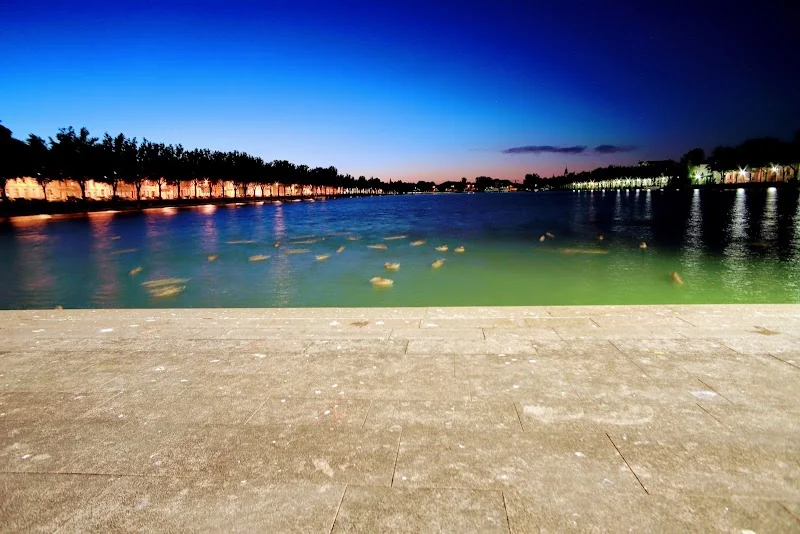
Friedrichstraße, Schwerin
Friedrichstraße, 19055 Schwerin, Germany
South Bank Pfaffenteich Stairs | Stairs & Pfaffenteich
The south bank of the Pfaffenteich is one of those places in Schwerin that seem calm and almost self-evident at first glance, but upon closer inspection, they bundle a surprising amount of city history, everyday life, and atmosphere. Those looking for the stairs on the south bank will not find an isolated attraction, but a significant part of an entire waterfront area: right in the city center, at the artificially dammed Pfaffenteich, framed by promenades, trees, historic facades, and views of the old town. This mixture is precisely what makes the place appealing. It serves as a place to stay, a passageway, a photo spot, a starting point for walks, and in summer, a small stage for urban life. The Pfaffenteich itself has long been considered one of the most important water features of the city, and the south bank is one of the places where this effect is felt most strongly. ([schweriner.de](https://www.schweriner.de/tourismus-kunst-kultur/sehenswertes/der-pfaffenteich))
Particularly characteristic is that the staircase and the waterfront edge do not appear as mere technical solutions, but as part of a historically grown ensemble. The city of Schwerin lists the Pfaffenteich in its monument register with waterfront edges, slopes with staircases, play dam, promenades, tree plantings, a bridge over the Aubach, as well as a lock and weir at the play dam. This makes it clear that the area is not only beautiful but also urbanistically significant. At the same time, this is a place where one experiences the city directly: the water, the paths, the historic houses, and the changing uses throughout the year. Those entering the name South Bank Pfaffenteich Stairs often seek exactly this mixture of orientation, view, and concrete visitor experience. ([forum.schwerin.de](https://forum.schwerin.de/export/sites/default/.galleries/Dokumente/Planen-Bauen/Denkmalschutz/Denkmalliste-Schwerin-_1_2026.pdf))
What is the South Bank of the Pfaffenteich?
The south bank of the Pfaffenteich is the southern waterfront zone of one of the most well-known urban waters in Schwerin. The Pfaffenteich is located right in the city center, is artificially dammed, and dates back to a former mill pond. The city officially describes the pond as a body of water with an area of about 12 hectares and an average depth of 2.80 meters. This is important because it gives the place its special effect: the Pfaffenteich is not a large natural lake on the outskirts, but a central urban space with water, greenery, and buildings in direct proximity. The south bank is therefore not just an edge, but part of the urban walking path that connects the old town with the adjacent neighborhoods. ([schwerin.de](https://www.schwerin.de/kultur-tourismus/sehenswuerdigkeiten/altstadt/pfaffenteich/))
Historically, the Pfaffenteich was shaped early on by dams and weirs. The current shape of the water body is the result of a long urban development closely linked to water supply, mill operation, and fortification. The official city description explains that the former mill pond extended to today's Schlossstraße and also fed the then city moat. Thus, the Pfaffenteich was never just an ornament but always part of the functional urban history. Today, this function has changed: instead of mill driving and city moat, promenades, quality of stay, and leisure life shape the image. The south bank particularly demonstrates this change well, as historical structure and modern use meet directly here. ([schwerin.de](https://www.schwerin.de/kultur-tourismus/sehenswuerdigkeiten/altstadt/pfaffenteich/))
The location in the city center also makes the place interesting for guests visiting Schwerin for the first time. From the south bank, one can look across the water to the opposite side with its buildings and tree stands, while on one's own side, the staircase invites one to linger. The official tourism site describes the south bank as a popular meeting point with summer terraces, from which one can view striking city houses and villas. This creates a special atmosphere: the place is not spectacular in the sense of a large building, but strong in the interplay of water surface, architecture, and public space. Those who want to understand Schwerin will find here a very compact access to the city: water, monument, promenade, and urban life in a single space. ([schwerin.de](https://www.schwerin.de/kultur-tourismus/sehenswuerdigkeiten/altstadt/pfaffenteich/))
Access, Parking, and Traffic Management at the South Bank Pfaffenteich
For access, it is important to know that the south bank of the Pfaffenteich does not function like a classic parking lot, but rather as an urban space for staying and passing through. The city of Schwerin has announced extensive work in the area of the south bank Pfaffenteich for 2026. The Arsenalstraße and the area from Alexandrinenstraße to August-Bebel-Straße will remain accessible, the staircase at the Pfaffenteich will remain reachable on foot, but the square of the south bank Pfaffenteich will be closed to traffic. Therefore, anyone planning a visit should consider walking or a combination of public transport and a short walk rather than direct access to the waterfront. This is particularly relevant because the area is repeatedly shaped by construction or event measures. ([schwerin.de](https://www.schwerin.de/news/erweiterung-fernwaerme-glasfasernetz-altstadt/?utm_source=openai))
For parking, the city generally refers to the downtown parking garages. Official notices mention, among others, Schlosspark-Center, Marienplatz-Galerie, and Schweriner Höfe; for larger events, the city additionally recommends P+R spaces. Although these notices are not exclusively formulated for the south bank, they are particularly useful for visits to the Pfaffenteich because the area is located right in the city center and parking space is limited there. Those who want to remain flexible should plan a bit more time and expect walking distances between the parking garage, old town, and waterfront promenade. Especially during events or seasonal closures, this is the most relaxed solution. ([schwerin.de](https://www.schwerin.de/kultur-tourismus/veranstaltungen/veranstaltungshoehepunkte/schweriner-schlossfestwochenende/anfahrt-parken-verkehrshinweise/index.html?utm_source=openai))
Additionally, the Pfaffenteich and its waterfront areas are regularly organized differently during the outdoor season and major events than in normal everyday traffic. The city has repeatedly pointed out seasonal closures in recent years to enhance the quality of stay. In 2025, the south bank was closed to general traffic from May to the end of September; in 2026, construction work will also take place with changed traffic management. For visitors, this means primarily one thing: before arriving, one should check the current city status if the visit is planned on an event day or during a summer weekend. This way, the path to the water remains uncomplicated, even if the surroundings are temporarily traffic-calmed or redesigned for events. ([cms.schwerin.de](https://cms.schwerin.de/news/verkehrsmeldungen-kw-18-00003/?utm_source=openai))
History, Monument Status, and Architecture around the Stairs
The stairs on the south bank can only be understood if one considers the monument-protected character of the entire Pfaffenteich area. In the monument list of the state capital Schwerin, the Pfaffenteich is listed as an ensemble with waterfront edges, slopes with staircases, play dam, promenades, and tree plantings. This is more than a formal protection note: it shows that the waterfront design itself is considered a historical value. The stairs are thus part of an urban composition that allows access to water, visual relationships, and movement along the shore. This form of public space is typical for historic Schwerin, where water is not only a natural backdrop but a defining design element. ([forum.schwerin.de](https://forum.schwerin.de/export/sites/default/.galleries/Dokumente/Planen-Bauen/Denkmalschutz/Denkmalliste-Schwerin-_1_2026.pdf))
The surrounding architecture also tells a lot about the development of the place. The official tourism site particularly mentions the Kücken Foundation on the south bank, a representative neoclassical building that was constructed between 1866 and 1868 and is named after the composer Friedrich-Wilhelm Kücken. Today, it houses, among other things, a restaurant and the state studio of ZDF. In the same vicinity, the Arsenal shapes the image of the Pfaffenteich, and the city describes that the currently surrounding linden alley and the current framing of the pond go back to urban planning ideas of court architect Georg Adolph Demmler. This means: when standing at the stairs, one does not look at random houses, but at consciously composed urban history. ([schwerin.de](https://www.schwerin.de/kultur-tourismus/sehenswuerdigkeiten/altstadt/pfaffenteich/kuecken-stiftung/))
For visitors, the architectural environment is particularly interesting because one can experience different epochs in a small space. Neoclassical facades, historic promenades, green spaces, and the waterline of the pond together form an ensemble that appears unique in Schwerin. The Pfaffenteich is not just a city pond, but a historically charged urban space where one can trace the development from a functional water facility to a representative promenade. This is precisely where the strength of the stairs on the south bank lies: they are not an isolated object, but a threshold between city and water, between stay and movement, between history and present. ([schweriner.de](https://www.schweriner.de/tourismus-kunst-kultur/sehenswertes/der-pfaffenteich))
Events at the South Bank Pfaffenteich: Stage, Lounge, and City Festival
The south bank of the Pfaffenteich is not only a place for walking in Schwerin but also one of the central stages for urban events. At the Altstadtfete 2026, the south bank is explicitly designated as a party zone: DJs, dance floors, and lounge areas are to enable long evenings by the water. At the same time, the big fireworks for the city festival take place at the Pfaffenteich itself. This shows how strongly the place is anchored as a public event space. Those who want to experience the atmosphere of the shore should therefore not only think of quiet hours but also of the days when light, music, and streams of visitors shape the image of the waterfront area. ([schwerin.de](https://www.schwerin.de/kultur-tourismus/veranstaltungen/veranstaltungshoehepunkte/altstadtfete/index.html))
The Lichterbummel also uses the south bank as an atmospheric anchor point. The city reports that light water lilies float on the Pfaffenteich, a lounge with chillout and house music is set up on the south bank, and a pyromusical takes place at the Pfaffenteich. The street music festival, in turn, explicitly moves its main stage to the south bank of the Pfaffenteich, while smaller formats and participatory offers additionally enliven the city center. The city's event calendar also features uses such as an ice rink or open-air offerings on the south bank. All of this makes it clear: the stairs are not just a backdrop but a functioning hub for events of various kinds, from music to family formats to seasonal city actions. ([schwerin.de](https://www.schwerin.de/news/lichterbummel-2024/))
For visitors, this density of events is an important SEO and practical aspect, as many specifically search for terms like program, event, open air, or city festival together with Pfaffenteich and south bank. The search behind it is understandable: the place delivers exactly what such keywords promise, namely an urban water environment with regular cultural references. Even outside of major events, the surroundings remain lively because the south bank has a high quality of stay due to summer terraces, promenades, and its city center location. So, those looking for a place that can offer a walk during the day and an event in the evening will find it at the south bank Pfaffenteich. ([schwerin.de](https://www.schwerin.de/kultur-tourismus/sehenswuerdigkeiten/altstadt/pfaffenteich/))
Walks, Photo Spots, and the Petermännchen Ferry
For many guests, the appeal of the south bank begins simply with a walk. The official city description emphasizes that Schwerin residents and tourists relax on the grassy banks and look at the water. This is exactly what makes the place so attractive: it is easily accessible, urban, and yet open enough to gain a moment of distance from the traffic and hustle of the old town. Those who want to take photos will find a very clear mix of water surface, waterfront edge, historic houses, and movement space on the south bank. Particularly the view towards the opposite shore and the architecturally strong buildings like the Kücken Foundation or the Arsenal make the location photogenic without appearing artificially staged. ([schwerin.de](https://www.schwerin.de/kultur-tourismus/sehenswuerdigkeiten/altstadt/pfaffenteich/))
Another typical experience is the ride on the Petermännchen ferry. The city describes it as a small, inexpensive crossing over the Pfaffenteich: the boat operates from May to September, Tuesday to Sunday, between 10 AM and 6 PM and costs 2 euros. The ferry is historically interesting because it has been in operation since 1924, and it fits perfectly with the character of the place, which focuses more on atmosphere than speed. Those who want to experience the Pfaffenteich and its south bank not just from above but also want to experience the water can switch between shore and crossing here. This short ride makes it understandable why the Pfaffenteich is often described as a very urban water experience in Schwerin. ([schwerin.de](https://www.schwerin.de/kultur-tourismus/sehenswuerdigkeiten/altstadt/pfaffenteich/))
Practically, this means for a visit: one can easily combine the place with a round trip, where one first looks at the stairs and the waterfront edge, then walks along the promenade and enjoys the view of the historic buildings. Those combining the visit with an event should arrive a bit earlier, as the south bank quickly becomes the center of activity. Those seeking tranquility are better off during the hours outside of major events. In both cases, the south bank Pfaffenteich stairs remain a place where Schwerin shows its character very concentrated: water, history, city, and present lie close together here. ([schwerin.de](https://www.schwerin.de/kultur-tourismus/sehenswuerdigkeiten/altstadt/pfaffenteich/))
Practical Tips for the Visit
A good visit to the south bank of the Pfaffenteich begins with the right timing. Those who want to experience the quiet side should come outside of the major city festivals or in the early hours of the day when the promenade is less frequented. Conversely, those seeking the full city feeling should plan their visit for an event like the Altstadtfete, Lichterbummel, or street music festival. Both are sensible because the place works in both situations: once as a quiet waterfront area, once as an urban stage. It remains important to pay attention to the current traffic and construction situation, as the area will not be equally accessible in every phase due to expansion work and other measures in 2026. ([schwerin.de](https://www.schwerin.de/news/erweiterung-fernwaerme-glasfasernetz-altstadt/?utm_source=openai))
It is also helpful to look at the special quality of the place: the south bank is not a fenced attraction with admission and fixed opening hours, but a freely accessible urban space that changes throughout the year. In summer, the staying function dominates with terraces, walkers, and event use. In winter, other formats come to the forefront, such as seasonal installations or temporary uses like an ice rink. This adaptability makes the area interesting for SEO texts, as many search queries connect the name Pfaffenteich with terms like stairs, waterfront, parking, access, events, or walks. The place answers all these questions in a very compact way. ([schwerin.de](https://www.schwerin.de/kultur-tourismus/sehenswuerdigkeiten/altstadt/pfaffenteich/))
Those who want to round off their visit should not view the Pfaffenteich in isolation but as part of a larger Schwerin city experience. The proximity to the old town, the monument-protected waterfront design, the striking buildings by the water, and the regular cultural formats make the south bank a place that continually reinvents itself. This is precisely why the stairs on the south bank are not just a functional element but a powerful image of Schwerin itself: a city by the water that keeps its history visible while also creating space for the present and encounters. ([forum.schwerin.de](https://forum.schwerin.de/export/sites/default/.galleries/Dokumente/Planen-Bauen/Denkmalschutz/Denkmalliste-Schwerin-_1_2026.pdf))
Sources:
- State Capital Schwerin - Pfaffenteich
- State Capital Schwerin - Kücken Foundation
- State Capital Schwerin - Expansion of District Heating and Fiber Optic Network in the Old Town
- State Capital Schwerin - Altstadtfete Schwerin 2026
- State Capital Schwerin - Schwerin Shines: Lichterbummel Brings Color to the Old Town
- State Capital Schwerin - Schwerin Street Music Festival
Show moreShow less
South Bank Pfaffenteich Stairs | Stairs & Pfaffenteich
The south bank of the Pfaffenteich is one of those places in Schwerin that seem calm and almost self-evident at first glance, but upon closer inspection, they bundle a surprising amount of city history, everyday life, and atmosphere. Those looking for the stairs on the south bank will not find an isolated attraction, but a significant part of an entire waterfront area: right in the city center, at the artificially dammed Pfaffenteich, framed by promenades, trees, historic facades, and views of the old town. This mixture is precisely what makes the place appealing. It serves as a place to stay, a passageway, a photo spot, a starting point for walks, and in summer, a small stage for urban life. The Pfaffenteich itself has long been considered one of the most important water features of the city, and the south bank is one of the places where this effect is felt most strongly. ([schweriner.de](https://www.schweriner.de/tourismus-kunst-kultur/sehenswertes/der-pfaffenteich))
Particularly characteristic is that the staircase and the waterfront edge do not appear as mere technical solutions, but as part of a historically grown ensemble. The city of Schwerin lists the Pfaffenteich in its monument register with waterfront edges, slopes with staircases, play dam, promenades, tree plantings, a bridge over the Aubach, as well as a lock and weir at the play dam. This makes it clear that the area is not only beautiful but also urbanistically significant. At the same time, this is a place where one experiences the city directly: the water, the paths, the historic houses, and the changing uses throughout the year. Those entering the name South Bank Pfaffenteich Stairs often seek exactly this mixture of orientation, view, and concrete visitor experience. ([forum.schwerin.de](https://forum.schwerin.de/export/sites/default/.galleries/Dokumente/Planen-Bauen/Denkmalschutz/Denkmalliste-Schwerin-_1_2026.pdf))
What is the South Bank of the Pfaffenteich?
The south bank of the Pfaffenteich is the southern waterfront zone of one of the most well-known urban waters in Schwerin. The Pfaffenteich is located right in the city center, is artificially dammed, and dates back to a former mill pond. The city officially describes the pond as a body of water with an area of about 12 hectares and an average depth of 2.80 meters. This is important because it gives the place its special effect: the Pfaffenteich is not a large natural lake on the outskirts, but a central urban space with water, greenery, and buildings in direct proximity. The south bank is therefore not just an edge, but part of the urban walking path that connects the old town with the adjacent neighborhoods. ([schwerin.de](https://www.schwerin.de/kultur-tourismus/sehenswuerdigkeiten/altstadt/pfaffenteich/))
Historically, the Pfaffenteich was shaped early on by dams and weirs. The current shape of the water body is the result of a long urban development closely linked to water supply, mill operation, and fortification. The official city description explains that the former mill pond extended to today's Schlossstraße and also fed the then city moat. Thus, the Pfaffenteich was never just an ornament but always part of the functional urban history. Today, this function has changed: instead of mill driving and city moat, promenades, quality of stay, and leisure life shape the image. The south bank particularly demonstrates this change well, as historical structure and modern use meet directly here. ([schwerin.de](https://www.schwerin.de/kultur-tourismus/sehenswuerdigkeiten/altstadt/pfaffenteich/))
The location in the city center also makes the place interesting for guests visiting Schwerin for the first time. From the south bank, one can look across the water to the opposite side with its buildings and tree stands, while on one's own side, the staircase invites one to linger. The official tourism site describes the south bank as a popular meeting point with summer terraces, from which one can view striking city houses and villas. This creates a special atmosphere: the place is not spectacular in the sense of a large building, but strong in the interplay of water surface, architecture, and public space. Those who want to understand Schwerin will find here a very compact access to the city: water, monument, promenade, and urban life in a single space. ([schwerin.de](https://www.schwerin.de/kultur-tourismus/sehenswuerdigkeiten/altstadt/pfaffenteich/))
Access, Parking, and Traffic Management at the South Bank Pfaffenteich
For access, it is important to know that the south bank of the Pfaffenteich does not function like a classic parking lot, but rather as an urban space for staying and passing through. The city of Schwerin has announced extensive work in the area of the south bank Pfaffenteich for 2026. The Arsenalstraße and the area from Alexandrinenstraße to August-Bebel-Straße will remain accessible, the staircase at the Pfaffenteich will remain reachable on foot, but the square of the south bank Pfaffenteich will be closed to traffic. Therefore, anyone planning a visit should consider walking or a combination of public transport and a short walk rather than direct access to the waterfront. This is particularly relevant because the area is repeatedly shaped by construction or event measures. ([schwerin.de](https://www.schwerin.de/news/erweiterung-fernwaerme-glasfasernetz-altstadt/?utm_source=openai))
For parking, the city generally refers to the downtown parking garages. Official notices mention, among others, Schlosspark-Center, Marienplatz-Galerie, and Schweriner Höfe; for larger events, the city additionally recommends P+R spaces. Although these notices are not exclusively formulated for the south bank, they are particularly useful for visits to the Pfaffenteich because the area is located right in the city center and parking space is limited there. Those who want to remain flexible should plan a bit more time and expect walking distances between the parking garage, old town, and waterfront promenade. Especially during events or seasonal closures, this is the most relaxed solution. ([schwerin.de](https://www.schwerin.de/kultur-tourismus/veranstaltungen/veranstaltungshoehepunkte/schweriner-schlossfestwochenende/anfahrt-parken-verkehrshinweise/index.html?utm_source=openai))
Additionally, the Pfaffenteich and its waterfront areas are regularly organized differently during the outdoor season and major events than in normal everyday traffic. The city has repeatedly pointed out seasonal closures in recent years to enhance the quality of stay. In 2025, the south bank was closed to general traffic from May to the end of September; in 2026, construction work will also take place with changed traffic management. For visitors, this means primarily one thing: before arriving, one should check the current city status if the visit is planned on an event day or during a summer weekend. This way, the path to the water remains uncomplicated, even if the surroundings are temporarily traffic-calmed or redesigned for events. ([cms.schwerin.de](https://cms.schwerin.de/news/verkehrsmeldungen-kw-18-00003/?utm_source=openai))
History, Monument Status, and Architecture around the Stairs
The stairs on the south bank can only be understood if one considers the monument-protected character of the entire Pfaffenteich area. In the monument list of the state capital Schwerin, the Pfaffenteich is listed as an ensemble with waterfront edges, slopes with staircases, play dam, promenades, and tree plantings. This is more than a formal protection note: it shows that the waterfront design itself is considered a historical value. The stairs are thus part of an urban composition that allows access to water, visual relationships, and movement along the shore. This form of public space is typical for historic Schwerin, where water is not only a natural backdrop but a defining design element. ([forum.schwerin.de](https://forum.schwerin.de/export/sites/default/.galleries/Dokumente/Planen-Bauen/Denkmalschutz/Denkmalliste-Schwerin-_1_2026.pdf))
The surrounding architecture also tells a lot about the development of the place. The official tourism site particularly mentions the Kücken Foundation on the south bank, a representative neoclassical building that was constructed between 1866 and 1868 and is named after the composer Friedrich-Wilhelm Kücken. Today, it houses, among other things, a restaurant and the state studio of ZDF. In the same vicinity, the Arsenal shapes the image of the Pfaffenteich, and the city describes that the currently surrounding linden alley and the current framing of the pond go back to urban planning ideas of court architect Georg Adolph Demmler. This means: when standing at the stairs, one does not look at random houses, but at consciously composed urban history. ([schwerin.de](https://www.schwerin.de/kultur-tourismus/sehenswuerdigkeiten/altstadt/pfaffenteich/kuecken-stiftung/))
For visitors, the architectural environment is particularly interesting because one can experience different epochs in a small space. Neoclassical facades, historic promenades, green spaces, and the waterline of the pond together form an ensemble that appears unique in Schwerin. The Pfaffenteich is not just a city pond, but a historically charged urban space where one can trace the development from a functional water facility to a representative promenade. This is precisely where the strength of the stairs on the south bank lies: they are not an isolated object, but a threshold between city and water, between stay and movement, between history and present. ([schweriner.de](https://www.schweriner.de/tourismus-kunst-kultur/sehenswertes/der-pfaffenteich))
Events at the South Bank Pfaffenteich: Stage, Lounge, and City Festival
The south bank of the Pfaffenteich is not only a place for walking in Schwerin but also one of the central stages for urban events. At the Altstadtfete 2026, the south bank is explicitly designated as a party zone: DJs, dance floors, and lounge areas are to enable long evenings by the water. At the same time, the big fireworks for the city festival take place at the Pfaffenteich itself. This shows how strongly the place is anchored as a public event space. Those who want to experience the atmosphere of the shore should therefore not only think of quiet hours but also of the days when light, music, and streams of visitors shape the image of the waterfront area. ([schwerin.de](https://www.schwerin.de/kultur-tourismus/veranstaltungen/veranstaltungshoehepunkte/altstadtfete/index.html))
The Lichterbummel also uses the south bank as an atmospheric anchor point. The city reports that light water lilies float on the Pfaffenteich, a lounge with chillout and house music is set up on the south bank, and a pyromusical takes place at the Pfaffenteich. The street music festival, in turn, explicitly moves its main stage to the south bank of the Pfaffenteich, while smaller formats and participatory offers additionally enliven the city center. The city's event calendar also features uses such as an ice rink or open-air offerings on the south bank. All of this makes it clear: the stairs are not just a backdrop but a functioning hub for events of various kinds, from music to family formats to seasonal city actions. ([schwerin.de](https://www.schwerin.de/news/lichterbummel-2024/))
For visitors, this density of events is an important SEO and practical aspect, as many specifically search for terms like program, event, open air, or city festival together with Pfaffenteich and south bank. The search behind it is understandable: the place delivers exactly what such keywords promise, namely an urban water environment with regular cultural references. Even outside of major events, the surroundings remain lively because the south bank has a high quality of stay due to summer terraces, promenades, and its city center location. So, those looking for a place that can offer a walk during the day and an event in the evening will find it at the south bank Pfaffenteich. ([schwerin.de](https://www.schwerin.de/kultur-tourismus/sehenswuerdigkeiten/altstadt/pfaffenteich/))
Walks, Photo Spots, and the Petermännchen Ferry
For many guests, the appeal of the south bank begins simply with a walk. The official city description emphasizes that Schwerin residents and tourists relax on the grassy banks and look at the water. This is exactly what makes the place so attractive: it is easily accessible, urban, and yet open enough to gain a moment of distance from the traffic and hustle of the old town. Those who want to take photos will find a very clear mix of water surface, waterfront edge, historic houses, and movement space on the south bank. Particularly the view towards the opposite shore and the architecturally strong buildings like the Kücken Foundation or the Arsenal make the location photogenic without appearing artificially staged. ([schwerin.de](https://www.schwerin.de/kultur-tourismus/sehenswuerdigkeiten/altstadt/pfaffenteich/))
Another typical experience is the ride on the Petermännchen ferry. The city describes it as a small, inexpensive crossing over the Pfaffenteich: the boat operates from May to September, Tuesday to Sunday, between 10 AM and 6 PM and costs 2 euros. The ferry is historically interesting because it has been in operation since 1924, and it fits perfectly with the character of the place, which focuses more on atmosphere than speed. Those who want to experience the Pfaffenteich and its south bank not just from above but also want to experience the water can switch between shore and crossing here. This short ride makes it understandable why the Pfaffenteich is often described as a very urban water experience in Schwerin. ([schwerin.de](https://www.schwerin.de/kultur-tourismus/sehenswuerdigkeiten/altstadt/pfaffenteich/))
Practically, this means for a visit: one can easily combine the place with a round trip, where one first looks at the stairs and the waterfront edge, then walks along the promenade and enjoys the view of the historic buildings. Those combining the visit with an event should arrive a bit earlier, as the south bank quickly becomes the center of activity. Those seeking tranquility are better off during the hours outside of major events. In both cases, the south bank Pfaffenteich stairs remain a place where Schwerin shows its character very concentrated: water, history, city, and present lie close together here. ([schwerin.de](https://www.schwerin.de/kultur-tourismus/sehenswuerdigkeiten/altstadt/pfaffenteich/))
Practical Tips for the Visit
A good visit to the south bank of the Pfaffenteich begins with the right timing. Those who want to experience the quiet side should come outside of the major city festivals or in the early hours of the day when the promenade is less frequented. Conversely, those seeking the full city feeling should plan their visit for an event like the Altstadtfete, Lichterbummel, or street music festival. Both are sensible because the place works in both situations: once as a quiet waterfront area, once as an urban stage. It remains important to pay attention to the current traffic and construction situation, as the area will not be equally accessible in every phase due to expansion work and other measures in 2026. ([schwerin.de](https://www.schwerin.de/news/erweiterung-fernwaerme-glasfasernetz-altstadt/?utm_source=openai))
It is also helpful to look at the special quality of the place: the south bank is not a fenced attraction with admission and fixed opening hours, but a freely accessible urban space that changes throughout the year. In summer, the staying function dominates with terraces, walkers, and event use. In winter, other formats come to the forefront, such as seasonal installations or temporary uses like an ice rink. This adaptability makes the area interesting for SEO texts, as many search queries connect the name Pfaffenteich with terms like stairs, waterfront, parking, access, events, or walks. The place answers all these questions in a very compact way. ([schwerin.de](https://www.schwerin.de/kultur-tourismus/sehenswuerdigkeiten/altstadt/pfaffenteich/))
Those who want to round off their visit should not view the Pfaffenteich in isolation but as part of a larger Schwerin city experience. The proximity to the old town, the monument-protected waterfront design, the striking buildings by the water, and the regular cultural formats make the south bank a place that continually reinvents itself. This is precisely why the stairs on the south bank are not just a functional element but a powerful image of Schwerin itself: a city by the water that keeps its history visible while also creating space for the present and encounters. ([forum.schwerin.de](https://forum.schwerin.de/export/sites/default/.galleries/Dokumente/Planen-Bauen/Denkmalschutz/Denkmalliste-Schwerin-_1_2026.pdf))
Sources:
- State Capital Schwerin - Pfaffenteich
- State Capital Schwerin - Kücken Foundation
- State Capital Schwerin - Expansion of District Heating and Fiber Optic Network in the Old Town
- State Capital Schwerin - Altstadtfete Schwerin 2026
- State Capital Schwerin - Schwerin Shines: Lichterbummel Brings Color to the Old Town
- State Capital Schwerin - Schwerin Street Music Festival
South Bank Pfaffenteich Stairs | Stairs & Pfaffenteich
The south bank of the Pfaffenteich is one of those places in Schwerin that seem calm and almost self-evident at first glance, but upon closer inspection, they bundle a surprising amount of city history, everyday life, and atmosphere. Those looking for the stairs on the south bank will not find an isolated attraction, but a significant part of an entire waterfront area: right in the city center, at the artificially dammed Pfaffenteich, framed by promenades, trees, historic facades, and views of the old town. This mixture is precisely what makes the place appealing. It serves as a place to stay, a passageway, a photo spot, a starting point for walks, and in summer, a small stage for urban life. The Pfaffenteich itself has long been considered one of the most important water features of the city, and the south bank is one of the places where this effect is felt most strongly. ([schweriner.de](https://www.schweriner.de/tourismus-kunst-kultur/sehenswertes/der-pfaffenteich))
Particularly characteristic is that the staircase and the waterfront edge do not appear as mere technical solutions, but as part of a historically grown ensemble. The city of Schwerin lists the Pfaffenteich in its monument register with waterfront edges, slopes with staircases, play dam, promenades, tree plantings, a bridge over the Aubach, as well as a lock and weir at the play dam. This makes it clear that the area is not only beautiful but also urbanistically significant. At the same time, this is a place where one experiences the city directly: the water, the paths, the historic houses, and the changing uses throughout the year. Those entering the name South Bank Pfaffenteich Stairs often seek exactly this mixture of orientation, view, and concrete visitor experience. ([forum.schwerin.de](https://forum.schwerin.de/export/sites/default/.galleries/Dokumente/Planen-Bauen/Denkmalschutz/Denkmalliste-Schwerin-_1_2026.pdf))
What is the South Bank of the Pfaffenteich?
The south bank of the Pfaffenteich is the southern waterfront zone of one of the most well-known urban waters in Schwerin. The Pfaffenteich is located right in the city center, is artificially dammed, and dates back to a former mill pond. The city officially describes the pond as a body of water with an area of about 12 hectares and an average depth of 2.80 meters. This is important because it gives the place its special effect: the Pfaffenteich is not a large natural lake on the outskirts, but a central urban space with water, greenery, and buildings in direct proximity. The south bank is therefore not just an edge, but part of the urban walking path that connects the old town with the adjacent neighborhoods. ([schwerin.de](https://www.schwerin.de/kultur-tourismus/sehenswuerdigkeiten/altstadt/pfaffenteich/))
Historically, the Pfaffenteich was shaped early on by dams and weirs. The current shape of the water body is the result of a long urban development closely linked to water supply, mill operation, and fortification. The official city description explains that the former mill pond extended to today's Schlossstraße and also fed the then city moat. Thus, the Pfaffenteich was never just an ornament but always part of the functional urban history. Today, this function has changed: instead of mill driving and city moat, promenades, quality of stay, and leisure life shape the image. The south bank particularly demonstrates this change well, as historical structure and modern use meet directly here. ([schwerin.de](https://www.schwerin.de/kultur-tourismus/sehenswuerdigkeiten/altstadt/pfaffenteich/))
The location in the city center also makes the place interesting for guests visiting Schwerin for the first time. From the south bank, one can look across the water to the opposite side with its buildings and tree stands, while on one's own side, the staircase invites one to linger. The official tourism site describes the south bank as a popular meeting point with summer terraces, from which one can view striking city houses and villas. This creates a special atmosphere: the place is not spectacular in the sense of a large building, but strong in the interplay of water surface, architecture, and public space. Those who want to understand Schwerin will find here a very compact access to the city: water, monument, promenade, and urban life in a single space. ([schwerin.de](https://www.schwerin.de/kultur-tourismus/sehenswuerdigkeiten/altstadt/pfaffenteich/))
Access, Parking, and Traffic Management at the South Bank Pfaffenteich
For access, it is important to know that the south bank of the Pfaffenteich does not function like a classic parking lot, but rather as an urban space for staying and passing through. The city of Schwerin has announced extensive work in the area of the south bank Pfaffenteich for 2026. The Arsenalstraße and the area from Alexandrinenstraße to August-Bebel-Straße will remain accessible, the staircase at the Pfaffenteich will remain reachable on foot, but the square of the south bank Pfaffenteich will be closed to traffic. Therefore, anyone planning a visit should consider walking or a combination of public transport and a short walk rather than direct access to the waterfront. This is particularly relevant because the area is repeatedly shaped by construction or event measures. ([schwerin.de](https://www.schwerin.de/news/erweiterung-fernwaerme-glasfasernetz-altstadt/?utm_source=openai))
For parking, the city generally refers to the downtown parking garages. Official notices mention, among others, Schlosspark-Center, Marienplatz-Galerie, and Schweriner Höfe; for larger events, the city additionally recommends P+R spaces. Although these notices are not exclusively formulated for the south bank, they are particularly useful for visits to the Pfaffenteich because the area is located right in the city center and parking space is limited there. Those who want to remain flexible should plan a bit more time and expect walking distances between the parking garage, old town, and waterfront promenade. Especially during events or seasonal closures, this is the most relaxed solution. ([schwerin.de](https://www.schwerin.de/kultur-tourismus/veranstaltungen/veranstaltungshoehepunkte/schweriner-schlossfestwochenende/anfahrt-parken-verkehrshinweise/index.html?utm_source=openai))
Additionally, the Pfaffenteich and its waterfront areas are regularly organized differently during the outdoor season and major events than in normal everyday traffic. The city has repeatedly pointed out seasonal closures in recent years to enhance the quality of stay. In 2025, the south bank was closed to general traffic from May to the end of September; in 2026, construction work will also take place with changed traffic management. For visitors, this means primarily one thing: before arriving, one should check the current city status if the visit is planned on an event day or during a summer weekend. This way, the path to the water remains uncomplicated, even if the surroundings are temporarily traffic-calmed or redesigned for events. ([cms.schwerin.de](https://cms.schwerin.de/news/verkehrsmeldungen-kw-18-00003/?utm_source=openai))
History, Monument Status, and Architecture around the Stairs
The stairs on the south bank can only be understood if one considers the monument-protected character of the entire Pfaffenteich area. In the monument list of the state capital Schwerin, the Pfaffenteich is listed as an ensemble with waterfront edges, slopes with staircases, play dam, promenades, and tree plantings. This is more than a formal protection note: it shows that the waterfront design itself is considered a historical value. The stairs are thus part of an urban composition that allows access to water, visual relationships, and movement along the shore. This form of public space is typical for historic Schwerin, where water is not only a natural backdrop but a defining design element. ([forum.schwerin.de](https://forum.schwerin.de/export/sites/default/.galleries/Dokumente/Planen-Bauen/Denkmalschutz/Denkmalliste-Schwerin-_1_2026.pdf))
The surrounding architecture also tells a lot about the development of the place. The official tourism site particularly mentions the Kücken Foundation on the south bank, a representative neoclassical building that was constructed between 1866 and 1868 and is named after the composer Friedrich-Wilhelm Kücken. Today, it houses, among other things, a restaurant and the state studio of ZDF. In the same vicinity, the Arsenal shapes the image of the Pfaffenteich, and the city describes that the currently surrounding linden alley and the current framing of the pond go back to urban planning ideas of court architect Georg Adolph Demmler. This means: when standing at the stairs, one does not look at random houses, but at consciously composed urban history. ([schwerin.de](https://www.schwerin.de/kultur-tourismus/sehenswuerdigkeiten/altstadt/pfaffenteich/kuecken-stiftung/))
For visitors, the architectural environment is particularly interesting because one can experience different epochs in a small space. Neoclassical facades, historic promenades, green spaces, and the waterline of the pond together form an ensemble that appears unique in Schwerin. The Pfaffenteich is not just a city pond, but a historically charged urban space where one can trace the development from a functional water facility to a representative promenade. This is precisely where the strength of the stairs on the south bank lies: they are not an isolated object, but a threshold between city and water, between stay and movement, between history and present. ([schweriner.de](https://www.schweriner.de/tourismus-kunst-kultur/sehenswertes/der-pfaffenteich))
Events at the South Bank Pfaffenteich: Stage, Lounge, and City Festival
The south bank of the Pfaffenteich is not only a place for walking in Schwerin but also one of the central stages for urban events. At the Altstadtfete 2026, the south bank is explicitly designated as a party zone: DJs, dance floors, and lounge areas are to enable long evenings by the water. At the same time, the big fireworks for the city festival take place at the Pfaffenteich itself. This shows how strongly the place is anchored as a public event space. Those who want to experience the atmosphere of the shore should therefore not only think of quiet hours but also of the days when light, music, and streams of visitors shape the image of the waterfront area. ([schwerin.de](https://www.schwerin.de/kultur-tourismus/veranstaltungen/veranstaltungshoehepunkte/altstadtfete/index.html))
The Lichterbummel also uses the south bank as an atmospheric anchor point. The city reports that light water lilies float on the Pfaffenteich, a lounge with chillout and house music is set up on the south bank, and a pyromusical takes place at the Pfaffenteich. The street music festival, in turn, explicitly moves its main stage to the south bank of the Pfaffenteich, while smaller formats and participatory offers additionally enliven the city center. The city's event calendar also features uses such as an ice rink or open-air offerings on the south bank. All of this makes it clear: the stairs are not just a backdrop but a functioning hub for events of various kinds, from music to family formats to seasonal city actions. ([schwerin.de](https://www.schwerin.de/news/lichterbummel-2024/))
For visitors, this density of events is an important SEO and practical aspect, as many specifically search for terms like program, event, open air, or city festival together with Pfaffenteich and south bank. The search behind it is understandable: the place delivers exactly what such keywords promise, namely an urban water environment with regular cultural references. Even outside of major events, the surroundings remain lively because the south bank has a high quality of stay due to summer terraces, promenades, and its city center location. So, those looking for a place that can offer a walk during the day and an event in the evening will find it at the south bank Pfaffenteich. ([schwerin.de](https://www.schwerin.de/kultur-tourismus/sehenswuerdigkeiten/altstadt/pfaffenteich/))
Walks, Photo Spots, and the Petermännchen Ferry
For many guests, the appeal of the south bank begins simply with a walk. The official city description emphasizes that Schwerin residents and tourists relax on the grassy banks and look at the water. This is exactly what makes the place so attractive: it is easily accessible, urban, and yet open enough to gain a moment of distance from the traffic and hustle of the old town. Those who want to take photos will find a very clear mix of water surface, waterfront edge, historic houses, and movement space on the south bank. Particularly the view towards the opposite shore and the architecturally strong buildings like the Kücken Foundation or the Arsenal make the location photogenic without appearing artificially staged. ([schwerin.de](https://www.schwerin.de/kultur-tourismus/sehenswuerdigkeiten/altstadt/pfaffenteich/))
Another typical experience is the ride on the Petermännchen ferry. The city describes it as a small, inexpensive crossing over the Pfaffenteich: the boat operates from May to September, Tuesday to Sunday, between 10 AM and 6 PM and costs 2 euros. The ferry is historically interesting because it has been in operation since 1924, and it fits perfectly with the character of the place, which focuses more on atmosphere than speed. Those who want to experience the Pfaffenteich and its south bank not just from above but also want to experience the water can switch between shore and crossing here. This short ride makes it understandable why the Pfaffenteich is often described as a very urban water experience in Schwerin. ([schwerin.de](https://www.schwerin.de/kultur-tourismus/sehenswuerdigkeiten/altstadt/pfaffenteich/))
Practically, this means for a visit: one can easily combine the place with a round trip, where one first looks at the stairs and the waterfront edge, then walks along the promenade and enjoys the view of the historic buildings. Those combining the visit with an event should arrive a bit earlier, as the south bank quickly becomes the center of activity. Those seeking tranquility are better off during the hours outside of major events. In both cases, the south bank Pfaffenteich stairs remain a place where Schwerin shows its character very concentrated: water, history, city, and present lie close together here. ([schwerin.de](https://www.schwerin.de/kultur-tourismus/sehenswuerdigkeiten/altstadt/pfaffenteich/))
Practical Tips for the Visit
A good visit to the south bank of the Pfaffenteich begins with the right timing. Those who want to experience the quiet side should come outside of the major city festivals or in the early hours of the day when the promenade is less frequented. Conversely, those seeking the full city feeling should plan their visit for an event like the Altstadtfete, Lichterbummel, or street music festival. Both are sensible because the place works in both situations: once as a quiet waterfront area, once as an urban stage. It remains important to pay attention to the current traffic and construction situation, as the area will not be equally accessible in every phase due to expansion work and other measures in 2026. ([schwerin.de](https://www.schwerin.de/news/erweiterung-fernwaerme-glasfasernetz-altstadt/?utm_source=openai))
It is also helpful to look at the special quality of the place: the south bank is not a fenced attraction with admission and fixed opening hours, but a freely accessible urban space that changes throughout the year. In summer, the staying function dominates with terraces, walkers, and event use. In winter, other formats come to the forefront, such as seasonal installations or temporary uses like an ice rink. This adaptability makes the area interesting for SEO texts, as many search queries connect the name Pfaffenteich with terms like stairs, waterfront, parking, access, events, or walks. The place answers all these questions in a very compact way. ([schwerin.de](https://www.schwerin.de/kultur-tourismus/sehenswuerdigkeiten/altstadt/pfaffenteich/))
Those who want to round off their visit should not view the Pfaffenteich in isolation but as part of a larger Schwerin city experience. The proximity to the old town, the monument-protected waterfront design, the striking buildings by the water, and the regular cultural formats make the south bank a place that continually reinvents itself. This is precisely why the stairs on the south bank are not just a functional element but a powerful image of Schwerin itself: a city by the water that keeps its history visible while also creating space for the present and encounters. ([forum.schwerin.de](https://forum.schwerin.de/export/sites/default/.galleries/Dokumente/Planen-Bauen/Denkmalschutz/Denkmalliste-Schwerin-_1_2026.pdf))
Sources:
- State Capital Schwerin - Pfaffenteich
- State Capital Schwerin - Kücken Foundation
- State Capital Schwerin - Expansion of District Heating and Fiber Optic Network in the Old Town
- State Capital Schwerin - Altstadtfete Schwerin 2026
- State Capital Schwerin - Schwerin Shines: Lichterbummel Brings Color to the Old Town
- State Capital Schwerin - Schwerin Street Music Festival

Frequently Asked Questions
Reviews
Aimée R
5. July 2025
beautiful lake! i personally would recommend taking the small boat (cost 2€ per person) and explore the place a bit. However there is a lot of bird poop there, just watch out for that😅
Michael Mack
14. April 2024
Beautiful little lake in the center of Schwerin. Big foot and bike path around the lake. Plenty of places to sit and enjoy the outdoors. We really enjoyed our visit. Stunning.
TH3 TR/\V1R
15. July 2025
Small bay of the lake within the city. It's nice to walk around it but there's only few cafés, you might have to go back to the southern shore.
_vananas_
27. June 2021
If you don't mind all the bird poop, it's actually quite okay here. It can become quite busy due to the bistro close by, but it's usually quite chill. Best time to be here is for the annual dragon boat tournament or the city festivals, since it is quite fun.
Rajat Saini
28. July 2023
It has a working fountain inside the lake. A ferry ride could be taken for roaming around. Romantic place to sit aside.