Libraries & Literary Houses – Culture for Eye & Ear
Libraries & Literary Houses in Schwerin – Culture for the Ear & Eye (Preview of Upcoming Formats)
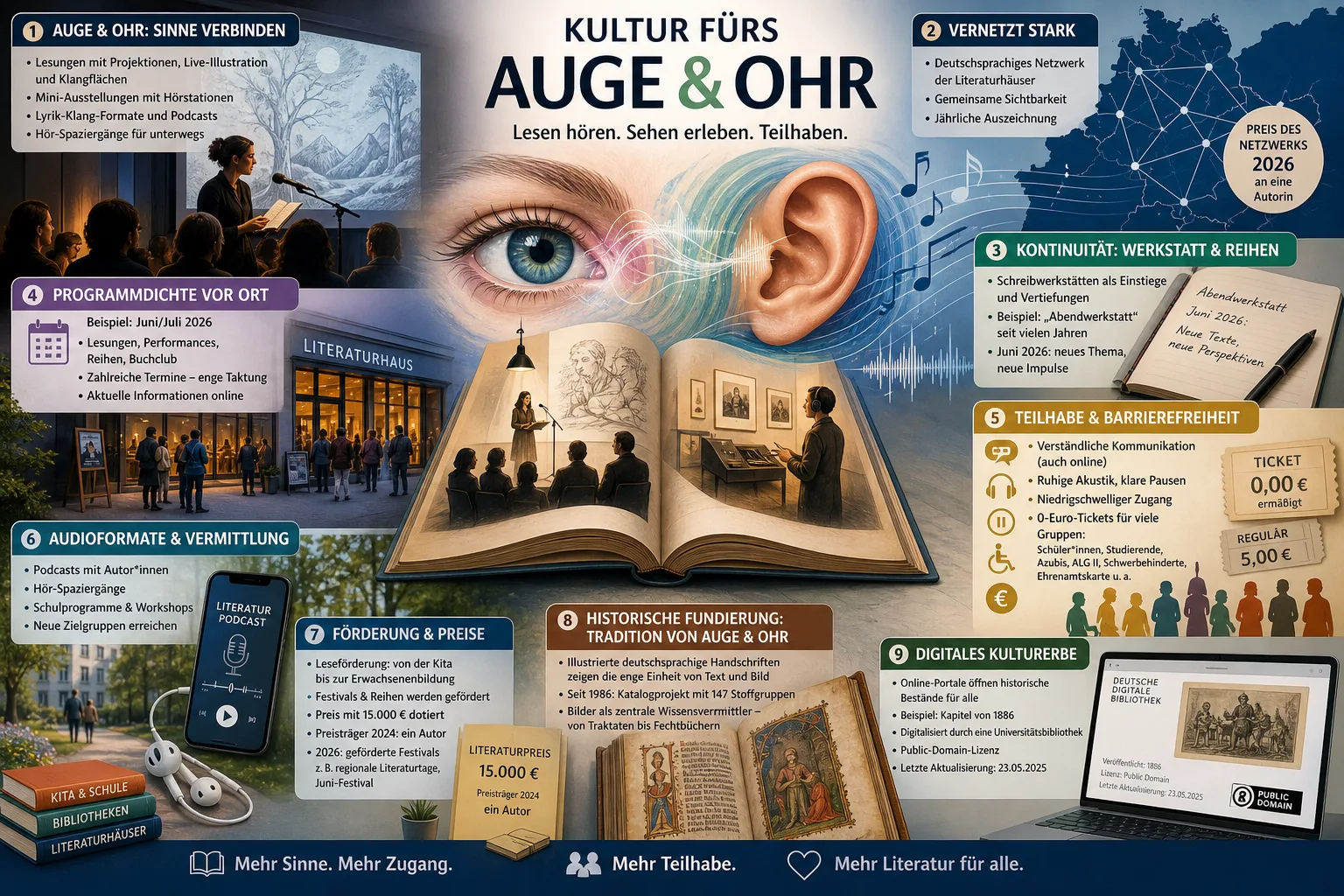
In the coming months, libraries and literary houses in Schwerin can further expand their role as venues for readings, discussions, and media art. This article compiles forward-looking, practical event formats that make "culture for the ear & eye" tangible: with voice, sound, projection, illustration, and low-barrier access.
Future Program Lines: Reading, Audio, Image
1) Reading with Visual Layer (Projection or Live Illustration)
A future-proof format is the combination of reading and visual accompaniment: While reading or moderating, illustrations are created live or text passages are displayed as easily readable projections. This supports attention, orientation, and memory.
- Suitable for: Novel and poetry evenings, family formats, graphic novel focuses.
- Practical: clear lines of sight, glare-free lighting, sufficient contrast in projections.
2) "Listening Station in the Room" as an Accompanying Format for Evening Events
Before or after an event, a small listening station (headphones/loan devices) can offer short audio content: author statements, interview excerpts, introductions to topics, or short audio samples. This creates a deepening parcours that opens up additional access even with limited stage time.
- Suitable for: Theme weeks, small exhibitions, series with changing guests.
- Quality criterion: limit volume, easy-to-understand operation, hygienic loan practice.
3) Live Podcast in Front of an Audience
A live podcast brings together conversational dynamics and participation: A moderated recording with guests (e.g., author, translator, publisher, scientist, local cultural creators) can take place on site in the future and then be published as an audio file.
- Suitable for: Debate formats, city talks, literature & society.
- Transparency: consents, notice of recording, clear rules for audience questions.
4) "Text Meets Music" (Acoustically Restrained, Understandable)
When music is used, it should serve intelligibility in the future: short musical transitions, quiet soundscapes, or pointed inserts between text parts. The focus remains on voice, articulation, and audibility.
- Suitable for: Poetry, staged readings, themed evenings.
- Recommendation: soundcheck with focus on speech intelligibility; test microphones and room acoustics early.
Participation Offers: Workshop, Writing School, Podcast
Future programs gain impact when they not only present but also enable participation. Libraries in particular are predestined for low-threshold learning and production formats.
Writing Workshop (Multi-Part, with Closing Evening)
A multi-part writing workshop can be planned as a course series in the future: with fixed dates, clear group size, and a moderated closing evening (reading, open mic, or zine release). This creates commitment and a visible result.
- Format core: short writing impulses, feedback rules, voluntary reading aloud.
- Binding: respectful conversation culture, data protection for texts, clear usage rights.
Podcast or Audio Workshop (for Youth & Adults)
An audio workshop can teach the basics in the future: voice, interview technique, editing, sound recording, and publishing. Result-oriented mini-productions (e.g., 3–8 minutes) are realistically plannable and motivating.
- Low-barrier: optional written scripts, quiet recording area, break planning.
- Quality: standards for sound levels, clear language, source citation for quotes.
Family Format "Listening & Seeing"
A mix of reading aloud, showing pictures, and participation stations is suitable for upcoming family events. Children can guess sounds, draw small scenes, or record short sentences, which are then listened to together.
- Important: age-appropriate length, clear moderation, quiet retreat options.
- Data protection: no publication of children's voices without explicit consent.
Accessibility & Participation: How Upcoming Events Become Accessible
To ensure that future events in Schwerin reach as many people as possible, consistently low-barrier planning is worthwhile. Established standards and recommendations provide orientation, for example on web accessibility, clear information, and inclusive event organization.
Concrete Measures for Upcoming Readings and Series
- Advance Information: clearly visible details on location, travel, seating, barriers, duration, breaks, volume, and contact options.
- Audibility: consistently use microphones, repeat questions from the audience, minimize background noise.
- Visibility: sufficient lighting, high contrast in projections, no overloaded slides.
- Supporting Formats: live text/subtitles (where possible), handouts, short content overviews.
- Retreat Option: quiet zone or the possibility to briefly leave the room and return.
- Prices & Access: transparent, socially acceptable pricing models (e.g., reduced rates) and simple ticketing options.
Trust Through Clear Rules
Trust in future cultural events also arises from transparent rules: respectful discussion culture, clear photo/audio notices, comprehensible moderation, and a low-threshold contact option for questions or support needs.
Digital Extensions: Archives, Streaming, Media Library
Future cultural mediation can be supplemented by digital components without replacing the on-site character. This allows events to be extended, documented, and made accessible to people who cannot attend.
- Media library after the event: selected audio excerpts, reading samples (with rights), link lists, and book recommendations.
- Accompanying online formats: short introductory clips, moderation guides, digital Q&A sessions.
- Digital research consultation: guidance on using major cultural and library portals, citation methods, source evaluation.
It is important to have a clean rights and data protection practice: publication only with clear agreements, comprehensible labeling, and responsible handling of personal data.
Planning & Quality: Checklist for Upcoming Events
This checklist helps reliably implement future "culture for the ear & eye" formats:
- Goal & Audience: Who should the format reach (families, youth, professional audience, broad city public)?
- Format Decision: Reading, discussion, live podcast, workshop, combination with image/audio.
- Low-barrier Information: understandable announcement, clear notes on accessibility and procedure.
- Technology & Procedure: soundcheck for speech, test projection, schedule including breaks.
- Rights & Data Protection: consents for recording, regulation for photos/audio, labeling on site.
- Quality Assurance: collect feedback (short & anonymous possible), derive improvements for the next edition.
If future literary events are both audible, visible, and well explained, the chance increases that people will return—not just for a title, but for the experience.