Museums in Schwerin: Discover Exhibitions, Castle & More
Museums & Learning Venues in Schwerin: What Awaits You on Your Next Visit
This guide bundles ideas for upcoming exhibition visits, guided tours, family offers, and learning formats in Schwerin – from art and the castle to technology, remembrance culture, and the observatory.
How to Plan Your Museum Day (Stress-Free in the Future)
If you want to visit museums and learning venues in Schwerin soon, planning in three steps is worthwhile: Route, Format, and Target Group. Many stations can be easily combined – especially in the city center and around the lake.
- Set your route: For a day trip, plan two to three stations so there is enough time for exhibitions, breaks, and travel.
- Choose a format: Decide whether you want to visit a classic exhibition, a guided tour, a family format, an educational program, or an evening event.
- Check in advance: Opening hours, ticket models, registration requirements (e.g., for demonstrations), accessible entrances, and current program information are most reliably found on the official websites of the venues.
Note: Programs and time slots change regularly. Always rely on the respective event pages for specific dates and bookings.
Art Museum & Castle: Two Stations, One Cultural Walk
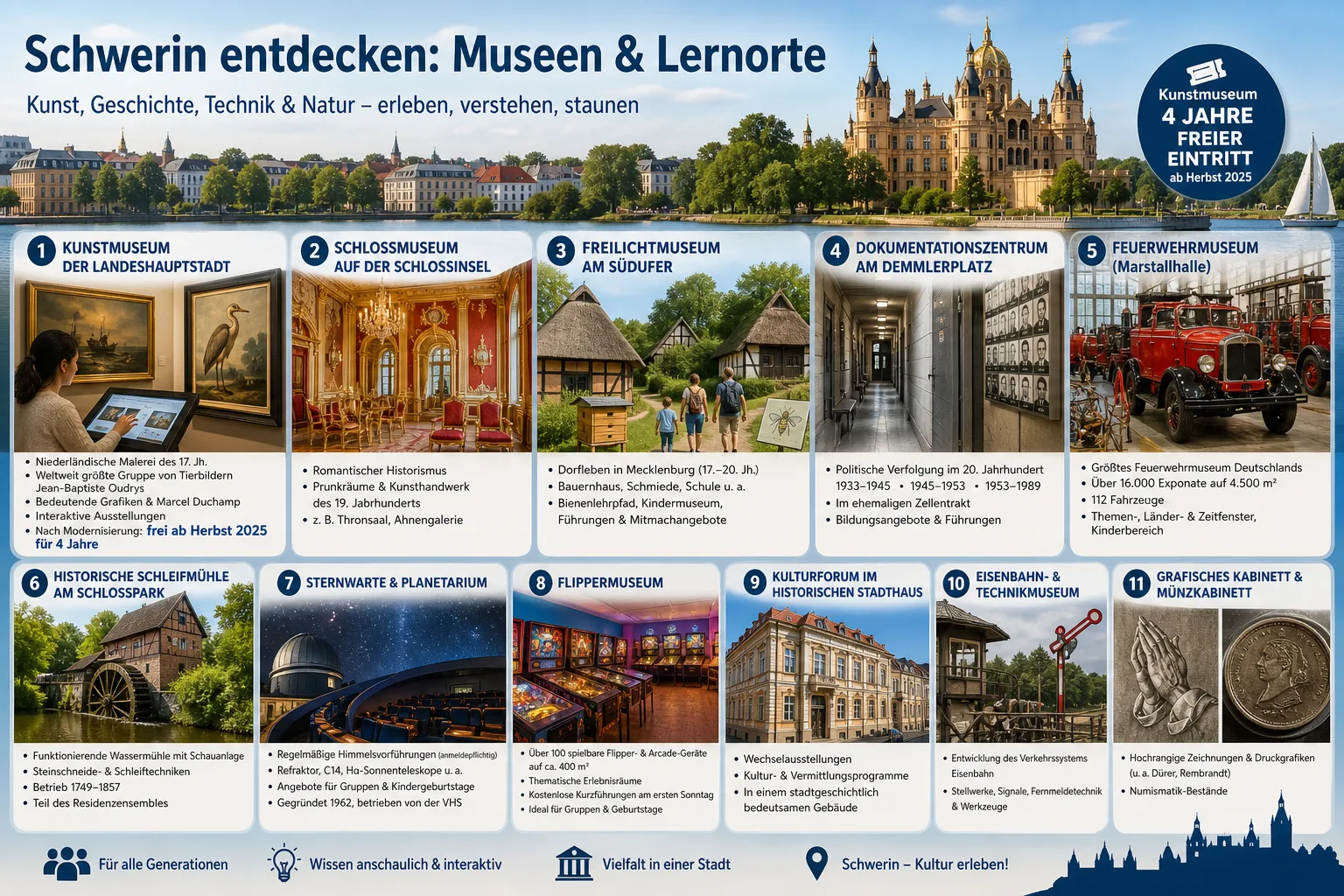
For your next visit, a combination of art and residential culture is a good idea: Start with painting, graphics, or contemporary positions and then move into rooms where representation, craftsmanship, and the everyday organization of a court become tangible.
Art Museum: Exhibitions, Tours, and Mediation
If you go to the art museum soon, you can typically expect a mix of collection presentations and temporary exhibitions. Thematic tours and dialogical formats are particularly helpful for beginners, where you can ask questions and clarify backgrounds directly on site.
- For families: Look out for hands-on stations, child-friendly audio guides, or short tours.
- For art enthusiasts: Allow enough time for graphic or cabinet formats, which are often shown in a concentrated form.
- For school classes: Educational programs can usually be booked in advance and adapted to curriculum topics.
Castle & Castle Museum: Rooms, Rituals, and Changing Perspectives
On your next tour through the castle museum, spatial experience and object culture are usually the focus: How are power, order, and taste made visible? What roles do arts and crafts, building technology, and the organization of everyday life play?
If you come with children, questions that build on observations work particularly well: “What could this room have been used for?”, “What rules can you see in the furnishings?”, “What would be different in our everyday life today?” Such perspectives make the visit an active learning moment instead of just a walkthrough.
Open-Air Museum: Learning with All Senses
For the next season's planning, an open-air museum is particularly suitable if you want to experience everyday culture rather than just read about it. You move through buildings, work areas, and learning stations that vividly illustrate typical processes from household, crafts, and rural life.
On your next visit, it is worthwhile to specifically look for demonstrations, action days, or family formats. Activities are often shown there that are hardly visible in everyday life anymore – an entry point for conversations about sustainability, resources, nutrition, and social roles.
- With children: Plan time for trying things out (e.g., learning paths or hands-on areas).
- As a trip with friends: Combine the visit with a walk by the lake and set a theme (“Living”, “Working”, “School”) as a common thread.
- For learning groups: Clarify group size, age levels, and the desired language for the tour in advance.
Documentation Center: Guided Tours, Discussions, Responsibility
If you are looking for a learning venue in the coming months that focuses on democratic values, human rights, and the rule of law, a visit to the documentation center is a good idea. Such places often rely on a combination of exhibition, original locations (e.g., spatial evidence), and multi-perspective sources.
Accompanied formats are particularly recommended for your next visit: Guided tours or moderated discussions help to classify content, clarify terms, and discuss questions respectfully. This is especially important for school classes and youth groups, because sensitive topics should not be dealt with “on the side”, but should be consciously processed.
Practical tip: Plan time for a short reflection after the visit (e.g., three questions: What was surprising? What remained unclear? What do I take away for the present?).
Technology Venues: Fire Brigade, Railway & Crafts
For your next technology day in Schwerin, you can combine several learning venues that make engineering, safety culture, and working environments tangible. Technology museums work particularly well if you enter with specific questions: “How is safety organized?”, “How is energy transmitted?”, “What roles do maintenance and responsibility play?”
Fire Brigade Museum: Safety Knowledge for Everyday Life and School
On an upcoming visit to a fire brigade museum, vehicles, equipment, and operational logic are usually the focus – supplemented by prevention knowledge. For families, this is a good occasion to talk at home about smoke detectors, escape routes, and emergency call rules in the future (without panic, but with clear routines).
- For children: Look for child-friendly explanation stations (e.g., “How does smoke form?”, “Why is visibility so important?”).
- For adults: Use the exhibition to clarify questions about materials science, protective clothing, and operational coordination.
Railway and Technology Museum: Systems, Signals, and Responsibility
If you visit a railway or technology museum soon, it is worthwhile to pay attention to systemic aspects: signals, interlocking logic, communication, and redundancy. This makes it clear why mobility is not just “trains running”, but a safety and planning network.
For young people interested in STEM topics, such a visit can be a next step: Questions about training, job profiles, and technology ethics can be discussed directly at the objects.
Crafts & Mechanics: Experiencing Technology on a Small Scale
As a balance to large machines and vehicles, a craft-oriented technology venue is also suitable for your next Schwerin visit. There, drive, materials, precision, and process steps are often the focus – ideal for understanding how raw materials become utility and decorative elements.
Unusual Learning Venues: Observatory, Pinball & Cultural Forum
If you are looking for learning venues in the future that feel “light” but convey a lot of knowledge, these stations are particularly suitable: They combine experience with explanation and create quick conversation starters.
Observatory & Planetarium: Demonstrations, Observations, Questions
For your next evening appointment, an observatory or planetarium is a good choice: You can expect moderated demonstrations that make constellations, planetary movements, and current celestial events understandable. Such appointments often require registration and are weather-dependent if real observation is planned.
- For families: Choose a program with an age-appropriate duration and clarify whether a dark phase (for observation) is planned.
- For those interested: Plan to bring a question (e.g., light pollution, seasons, space travel) and discuss it afterwards.
Pinball Museum: Design, Mechanics, and Media Culture
If you visit a pinball museum soon, you can experience learning through play: reaction, mechanics, electronics, graphics, and sound design become immediate. Interactive collections are particularly suitable for groups, because observing and trying things out automatically lead to comparisons and conversations.
For your next visit, it is worthwhile to set a small “observation goal”: Pay attention to how feedback (light/sound), control, and chance combine into a system – and how design decisions affect behavior and concentration.
Cultural Forum: Thematic Exhibitions and City Conversations
A cultural forum with changing exhibitions is ideal for your upcoming stay if you want to see current questions of urban society, art projects, or thematic focus exhibitions. Look out for accompanying programs such as readings or discussion evenings if you not only want to look but also think along.
Accessibility, Families & School Classes: What You Can Pay Attention to in the Future
To ensure your next museum visit in Schwerin is truly successful, these points are particularly practical:
- Accessible planning: Check information on elevators, step-free paths, seating, easy language, and accessible toilets in advance.
- Family friendliness: Look for changing facilities, food rules, cloakrooms, hands-on offers, and the recommended visit duration.
- School classes: Book programs early, clarify learning objectives, and whether working materials are provided in advance. Also plan time for preparation and follow-up.
- Photo rights: If you want to take photos in the future, observe the house rules and notes on loans or personal rights.