How Schwerin is Changing: World Heritage and New Cultural Venues
How Schwerin is Set to Change in the Coming Years: New Cultural Venues, Ideas, and Spaces for Community
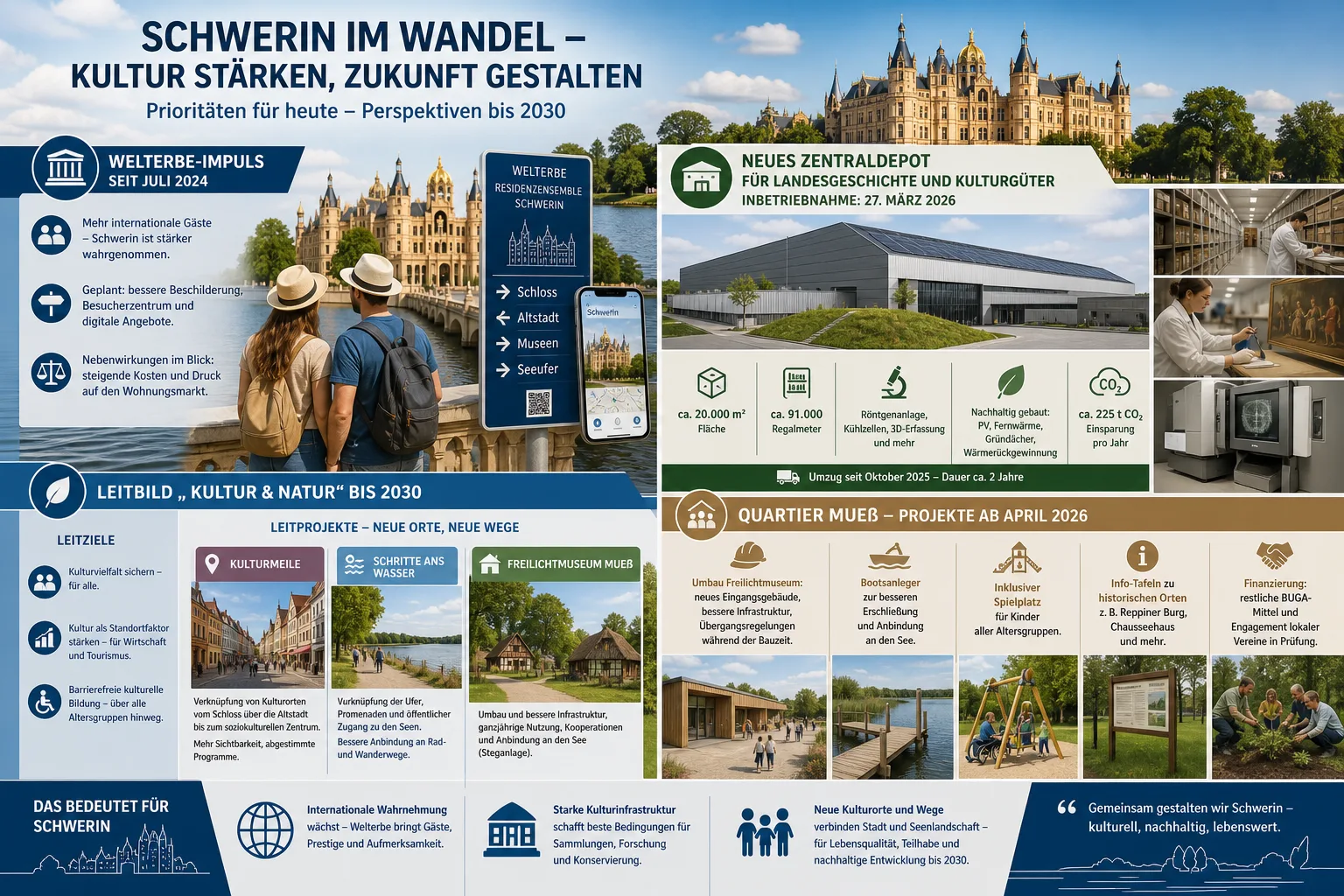
Schwerin is facing a phase in which cultural policy, urban development, and its lake landscape are to be more closely integrated. Planned are new information and mediation offerings around the residential ensemble, a modern site for collections and restoration, as well as renovations and improved access at several cultural and natural locations. This article summarizes the most important announced projects and shows what residents and guests can expect in the future.
World Heritage Outlook: What New Mediation is Supposed to Change
Around the residential ensemble (castle, gardens, historic axes, and waterfronts), additional offerings are to be created in the coming years to make orientation and background knowledge more accessible. Among the topics under discussion are:
- More visible information in public spaces (e.g., guidance systems, steles, map points), so that visitors can better understand the connections between buildings, parks, and waterfronts.
- Multilingual mediation (e.g., audio formats or digital tours) to more specifically address international guests.
- A more networked visitor experience, in which classic sights are linked with new cultural venues and neighborhoods in routes and programs.
For urban development, this approach means: Cultural visibility should increase without losing sight of recreation, nature, and monument protection. In the coming years, the question of how visitor flows can be managed without overloading residential areas and waterfronts is likely to become more important.
Central Depot: More Space, More Protection, Better Research (Planned)
A central depot for collection holdings and archival material is intended to strengthen the cultural infrastructure in Schwerin. The typical aim of such projects is to bring together previously scattered holdings in one place, thereby improving conservation standards, restoration, and research.
What Could Change as a Result
- Better preservation through controlled storage conditions (e.g., climate, security, pollutant protection) and more professional processes.
- More restoration capacity, because workshops, diagnostics, and documentation (e.g., digital recording) can be bundled more efficiently.
- Faster access for research and exhibitions, because loans, preparation, and scholarly processing become more plannable.
If the depot is implemented as announced, it can be expected in the medium term that exhibitions and educational offerings in Schwerin will benefit from better-prepared objects and more stable loan and research processes.
Guiding Principle "Culture & Nature": Cultural Offerings Between Lakes and City (Planned)
Schwerin wants to more closely link cultural development and nature experiences. In practice, this likely means: better pathways, higher quality of stay by the water, and more targeted coordination of programs between established institutions, independent initiatives, and neighborhoods.
What the Next Years Could Lead To
- Networking of cultural venues (close to the city center and in neighborhoods), so that offerings do not appear isolated but can be experienced as a "chain."
- Lower-barrier participation through understandable information, more accessible paths, and formats for different budgets and life situations.
- More use of water as urban space, provided ecological protection needs are taken into account (shore zones, sensitive areas, seasonal stress).
This could create a broader picture for visitors: Schwerin not just as a castle backdrop, but as a city where cultural routes, neighborhoods, and nature access are consciously planned together.
Mueß Neighborhood: Open-Air Museum, Water Access, and Community (Planned)
In the Mueß area, changes to and around the open-air museum are expected in the coming years. Typically, measures are planned to make the location more functional, usable year-round, and more accessible.
Possible Components of Further Development
- Modernized arrival and orientation (e.g., an entrance area with clear visitor guidance and learning opportunities).
- Better connection to the lake, for example through water access or improved land routes, to better integrate Mueß into excursion routes.
- More offerings for families and groups, e.g., low-threshold stations that combine history, everyday life, and nature experiences.
- Cooperation with schools, clubs, and initiatives, so that the museum also functions as a neighborhood place and learning space.
During construction and transition phases, there may be temporarily changed access or restricted areas. Anyone planning a visit should check the official information on opening times, routes, and programs in advance.
What These Projects Could Mean for Schwerin
The planned developments touch on several levels at once:
- Cultural substance: A stronger focus on collection, restoration, and mediation can help keep state and city history visible in the long term.
- Everyday life & participation: If paths, information, and prices are considered socially, not only guests but also residents benefit.
- Tourism & economy: Additional programs and clearer orientation can extend stays and attract new target groups.
- Nature & protection: More use of the water will likely require stricter coordination with ecology, noise protection, and quality of stay in the coming years.
Whether this balance succeeds will depend on how transparently priorities are set, how consistently monument and nature concerns are integrated, and how citizen participation is practically implemented.
Classification: All points mentioned describe announced or discussed development directions. Concrete schedules, budgets, and implementations may change during the planning, tendering, and construction processes.
Practical Tips for Future Visits
- Check the current situation: During construction or remodeling phases, detours and temporary restrictions are possible. Rely on official event and visitor information shortly before your arrival.
- Plan more time for routes by the water: As waterfront areas are upgraded, walks and routes will become a more important part of the visitor experience.
- Consciously include neighborhoods: Those who want to experience Schwerin as a "city of places" should combine classic destinations (residential area) with neighborhood and nature spots (e.g., Mueß).