Zero Waste Events in Schwerin: celebrate sustainably
Zero Waste & Green Events: This is how Schwerin will celebrate sustainably in the future
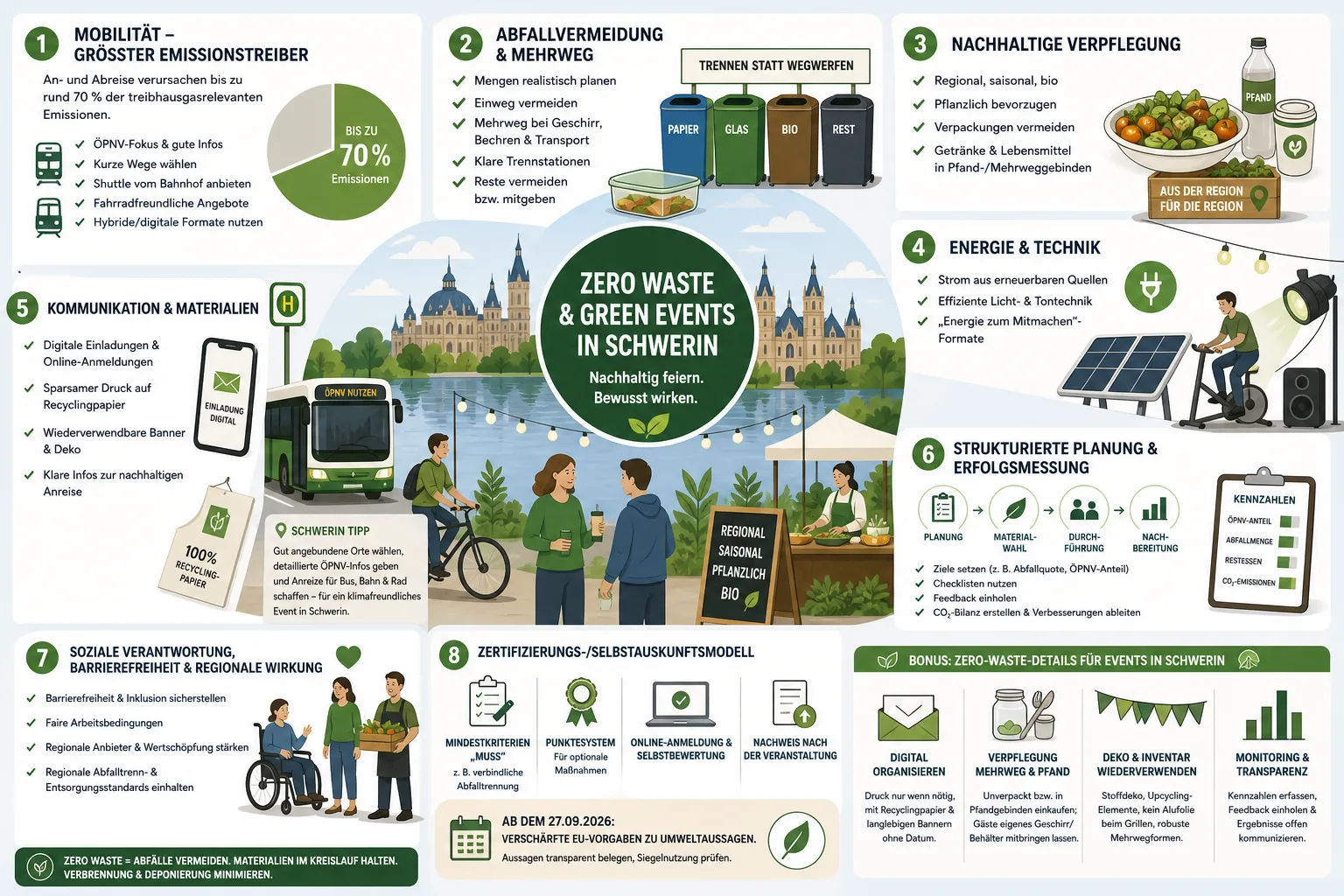
Whether it’s a festival by the water, a street fair in the old town, or a corporate event with guests from the surrounding area: In the coming years, events in Schwerin can become significantly less wasteful and more climate-friendly without losing atmosphere. The biggest levers are often where many underestimate them: in arrival (often the largest source of emissions) and in the consistent use of reusables.
This guide shows how organizers in Schwerin can plan, implement, and transparently evaluate future events according to the Zero Waste principle and as a Green Event—with practical measures for mobility, waste, catering, energy, communication, and success measurement.
What will define a Zero Waste and Green Event in Schwerin in the future
Zero Waste in the event context means: Waste does not arise in the first place or is kept in the cycle as much as possible. Green Events broaden the perspective: In addition to waste, greenhouse gas emissions, energy consumption, procurement, water, noise, light, and social criteria also count.
For future events in Schwerin, a realistic approach is particularly effective: Instead of promising to be “perfectly sustainable,” concrete goals are set, measures are implemented, and results are transparently documented. This increases credibility and reduces the risk of greenwashing.
- Mobility: Specifically reduce arrival emissions (public transport, bicycle, sharing, shuttle, park & ride).
- Resources & Waste: Avoid single-use, standardize reusables, simplify separation, manage leftovers.
- Catering: plant-based, seasonal, regional, minimal packaging, clean water concept.
Mobility: How arrival becomes the strongest lever for climate protection
For future events in Schwerin, a mobility strategy that supports guests from the very beginning—not just on the day of the event—is worthwhile. The goal is to increase the share of arrivals by public transport, bicycle, and on foot, and to reduce car journeys (especially single occupancy).
Concrete measures for planning
- Arrival information in every invitation: Clearly and briefly explain stops, walking routes, bicycle access, barrier-free routes, and parking options.
- Make public transport the “default”: In event communication, mention the public transport option first, then bicycle, then car (instead of the other way around).
- Temporarily expand bicycle infrastructure: Additional, highly visible bicycle racks near the entrance; for evening events with good lighting and clear route guidance.
- Park & Ride & meeting points: Communicate parking options outside core areas for guests from the surrounding area and link them with shuttles or clear public transport connections.
- Initiate carpooling: Link to a ride-sharing platform in the registration or offer group arrival options.
- Hybrid participation options: For program points that are suitable, offer livestream or recording to avoid long-distance travel.
Measurable instead of vague: Mobility KPIs for evaluation
- Share of arrival types (public transport / bicycle / on foot / car / others) via a short survey in registration or follow-up survey.
- Number of bicycle parking spaces provided and their utilization (spot checks).
- Shuttle utilization (passengers per trip) as an efficiency indicator.
Avoiding waste: Zero Waste starts before ordering
Waste does not arise “by accident,” but through decisions in procurement, tendering, and process. For upcoming events in Schwerin, a clear hierarchy is helpful: avoid → reduce → reuse → recycle (and only then dispose).
Reusables & deposit as standard
- Define reusable set: Cups, plates/bowls, cutlery, serving containers, transport boxes—as a uniform standard for all stands.
- Clearly communicate deposit logic: Deposit amount, return points, return times, and instructions for return on tickets/signs/program.
- Washing and logistics concept: Define routes for clean/used items, interim storage, peak times, staff, and hygiene procedures.
Low-waste guest experience instead of “waste education”
- Separation stations instead of single bins: Few, highly visible collection points with clear pictograms and uniform labeling.
- On-site teams at peak times: Short instructions (“Please put organic / packaging / residual here”) significantly improve the quality of separation.
- Single-use bans in stand contracts: Only approved materials and packaging, clear sanctions and alternatives (reusable or defined recyclable solution).
Leftover food: reduce in a planned way
- Realistic quantity planning: Sales forecasts, weather buffer, portion sizes, and post-production instead of overproduction.
- Takeaway in reusables: Give out leftover portions to guests in reusables (with deposit system), instead of single-use boxes.
- Donate only if legally and organizationally sound: If cooperations are planned, cold chain, liability, and handover processes must be clearly regulated in advance.
Sustainable catering: plant-based, seasonal, regional—without loss of enjoyment
Catering strongly influences the climate and resource balance—and at the same time guest satisfaction. For future Green Events in Schwerin, an approach that puts plant-based dishes at the center and uses animal products as a supplement (instead of the other way around) works particularly well.
Procurement & menu design
- Plant-based main dishes as standard: At least one full vegan option per stand/station; vegetarian options as a supplement.
- Seasonal & regional: Align menus with seasonal availability and prefer regional supply chains to reduce transport and cooling effort.
- Organize drinks smartly: Prioritize deposit containers; water stations (tap water where permitted) or large reusable dispenser systems instead of individual bottles.
- Less packaging: Large containers, refill dispensers, and avoid portion sachets where hygienically acceptable.
Transparent labeling
- Clearly display allergens, vegetarian/vegan, regional focus, and reusable/deposit information.
- Use “sustainable” claims only if criteria are explained (e.g., “reusable required at all drink stands” instead of “100% sustainable”).
Energy, materials, and communication: How Green Events become visible to guests
So that sustainability does not only take place backstage, visible, simple signals are needed—as well as technical and material planning that makes reuse the rule.
Energy & technology
- Electricity from renewable sources: For indoor locations, check green electricity tariffs; for temporary setups, calculate energy needs (lighting, sound, cooling) in advance and design efficiently.
- Efficient lighting planning: LED technology, zoned lighting, and time control reduce consumption and unwanted light emissions.
- Load management: Avoid power peaks (e.g., staggered startup of cooling/technology) to reduce generator or grid load.
Materials: reusable, modular, date-neutral
- Date-neutral signage: Banners/signs without year so they can be reused for future events.
- Modular set design: Choose stage and decoration elements so they can be stored, repaired, and rebuilt.
- Prioritize digital communication: Tickets, programs, and site maps digitally; if printing is necessary, use reduced layouts and recycled paper.
Involve guests—without a moralizing finger
- Short, concrete instructions: “Return reusables here,” “Bicycle parking there,” “Water station”—clear, friendly, visible.
- Micro-transparency on site: A small board with 3–5 measures (e.g., reusable quota, arrival info, waste separation) increases trust.
Organization, responsibility, and reliable evidence for future events
A Green Event stands and falls with responsibilities, service provider criteria, and an evaluation that is more than just a gut feeling. For Schwerin, a simple management cycle is recommended: Plan (goals & criteria) → Implement (processes & training) → Measure (data) → Improve (next iteration).
Roles & processes
- Define sustainability responsibility: One person or a small team with decision-making authority for reusables, waste logistics, mobility, and communication.
- Stand and service provider contracts: Clear requirements (reusable obligation, packaging standards, return times, separation rules, delivery logistics).
- Briefing & training: Short, mandatory briefing for stands, security, cleaning, and volunteers (what goes where, how is deposit handled, how to address guests).
What you should measure (and why)
- Residual waste per guest: Central zero-waste indicator (total amount / number of visitors).
- Reusable quota: Share of distribution via reusables vs. single-use (ideally close to 100%).
- Energy consumption: Derive from meter readings, equipment lists, or invoices; document per event day.
- Mobility: Arrival types via survey; with ticketing, optionally supplement with postal code/start point, if data protection compliant.
Important: Terms like “climate neutral,” “CO₂-free,” or “completely sustainable” should only be used for future events if the criteria are clearly defined, data is reliably collected, and statements are verifiably substantiated. In the EU, requirements for environmental advertising and environmental claims are expected to become more specific; transparent, data-based communication protects reputation and budget in the long term.