
Adolf Glaßbrenner
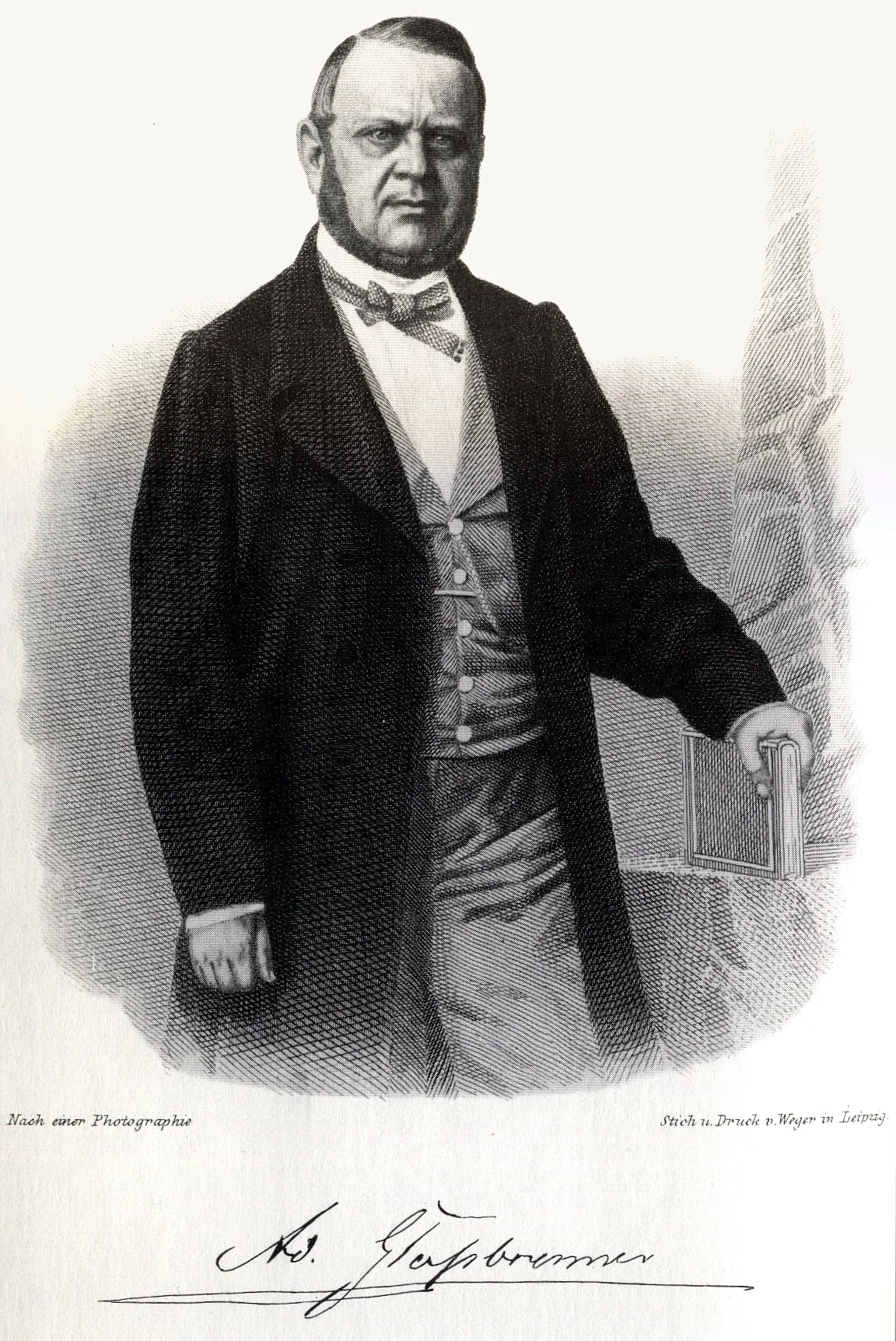
Image from Wikipedia
Image from Wikipedia
Adolf Glaßbrenner: The Sharp-Tongued Chronicler of Berlin Wit
A satirical author who measured Berlin with wit, characters, and fine scorn
Adolf Glaßbrenner, born on March 27, 1810, in Berlin and died there on September 25, 1876, is among the defining humorists and satirists of the 19th century. As a journalist, editor, caricaturist, and writer, he developed a distinctive voice that captured the everyday theater of the Prussian capital with precise observation, Berlin dialect, and political sharpness. The Deutsche Biographie describes him as a precursor to later satirical publications such as Kladderadatsch and Simplicissimus. ([deutsche-biographie.de](https://www.deutsche-biographie.de/sfz21129.html?utm_source=openai))
From Berlin Gymnasium to Journalism of the Vormärz
Glaßbrenner was not an academic scholar but a self-taught individual with a sharp linguistic prowess. After leaving the gymnasium for financial reasons, he initially worked in commerce before his path led him early into the literary public sphere. As a young author, he emerged with satirical texts and found in the Berlin journalism of the Vormärz the milieu where political observation, everyday comedy, and journalistic sharpness ideally connected. ([deutsche-biographie.de](https://www.deutsche-biographie.de/sfz21129.html?utm_source=openai))
His early journalistic attempts repeatedly faced censorship and governmental restrictions, but it was precisely in this resistance that his profile sharpened. Glaßbrenner wrote against the constraints of society and transformed political pressure into a literary form: short, pointed, and often satirically sharpened texts that resonated with the tone of the times. This combination of observational talent, wit, and societal friction made him a prominent figure in Vormärz literature. ([deutsche-biographie.de](https://www.deutsche-biographie.de/sfz21129.html?utm_source=openai))
The Berlin Way of Life as a Literary Stage
His most famous work is the series of writings Berlin wie es ist und – trinkt, published between 1832 and 1850 under the pseudonym "Brennglas." In a total of 32 issues, he designed a panorama of Berlin life that flourished with types, speech patterns, milieus, and social peculiarities. Caricatures by Theodor Hosemann enhanced the impact of this perspective on the metropolis as a humorous and social testing ground. ([de.wikipedia.org](https://de.wikipedia.org/wiki/Adolf_Gla%C3%9Fbrenner?utm_source=openai))
Other works like Leben und Treiben der feinen Welt from 1834, Berliner Volksleben, and Buntes Berlin expanded this tableau. Glaßbrenner did not observe the capital from the outside but from within its linguistic context. His literary rank lies precisely in the fact that he captured Berlin's everyday culture not decoratively, but as a social reality encompassing dialect, gesture, conflict, and comic sharpness. ([deutsche-biographie.de](https://www.deutsche-biographie.de/sfz21129.html?utm_source=openai))
Censorship, Exile, and Journalistic Resilience
Glaßbrenner's career was never smooth but was marked by constant struggles against censorship and political repression. After stops in Neustrelitz, he was expelled for political reasons in 1850, living in Hamburg until 1858. These breaks only enhanced his reputation as a combative publicist who advocated for press and opinion freedom and did not shy away from conflict with authority. ([deutsche-biographie.de](https://www.deutsche-biographie.de/sfz21129.html?utm_source=openai))
Through his humor magazines and satirical endeavors, he worked against state control, often for only short periods but with lasting effects. The Deutsche Biographie emphasizes that he was a gifted talent successful in all popular satirical genres of his time. His work was thus not only literarily significant but also historically crucial in shaping published satire in German-speaking regions. ([deutsche-biographie.de](https://www.deutsche-biographie.de/sfz21129.html?utm_source=openai))
Berlin Volksleben, Type Comedy, and Satirical Character Art
What made Glaßbrenner special was his ability to transform the Berlin archetype into a literary character with recognition value. The "Eckensteher Nante" became a symbol of that quirky, mischievous everyday figure who repeatedly appears in his prose and satire. The Haus der Pressefreiheit describes him as a humorist known for his humorous depictions of such Berliner characters. ([hausderpressefreiheit.de](https://www.hausderpressefreiheit.de/Home/HOF/Journalisten/Gla%C3%9Fbrenner-Adolf.html?utm_source=openai))
His texts thrive on proximity to dialogue, comical precision, and a sense of social role-playing. Glaßbrenner composed language like a stage play: quickly, directly, character-oriented, and with a sharp ear for the registers of urban speech. It is precisely this blend of satire, social study, and pointed observation that makes his texts culturally and historically worthy of reading today. ([deutsche-biographie.de](https://www.deutsche-biographie.de/sfz21129.html?utm_source=openai))
Influence on German Satire and Press Culture
His influence extends beyond his own work. In literary retrospect, Glaßbrenner is considered one of the figures who paved the way for later satirical publications. The Deutsche Biographie identifies him as a precursor of forms and types that were later further developed in Kladderadatsch and Simplicissimus. Thus, he stands at an important intersection between political journalism and modern satire. ([deutsche-biographie.de](https://www.deutsche-biographie.de/sfz21129.html?utm_source=openai))
Contemporary and later appreciation emphasizes his standing as the "educator of Berlin wit." This title refers to more than mere entertainment: Glaßbrenner made humor a method of insight, a social diagnosis, and literary resistance. His texts reveal how closely intertwined wit, public life, and political stance were in the 19th century. ([deutsche-biographie.de](https://www.deutsche-biographie.de/sfz21129.html?utm_source=openai))
Later Years, Return to Berlin, and Lasting Echo
After his time in Hamburg, Glaßbrenner returned to Berlin in 1858 and later took on editorial responsibilities, including at the Berliner Montagszeitung. Until the end, he remained journalistically active and connected to the issues of his time. He found his final resting place in Berlin; the city later honored him with a grave of honor from the State of Berlin. ([de.wikipedia.org](https://de.wikipedia.org/wiki/Adolf_Gla%C3%9Fbrenner?utm_source=openai))
His posthumous fame stems from the rare combination of popular tone and analytical sharpness. Glaßbrenner did not write for an abstract literary ideal but for an urban audience that recognized itself in his scenes. This is where the durability of his work lies: it preserves the sound of a historical Berlin without appearing museum-like. ([deutsche-biographie.de](https://www.deutsche-biographie.de/sfz21129.html?utm_source=openai))
Current Projects and Publications
As a historical author, Adolf Glaßbrenner has no current albums, singles, tours, or new media projects in the contemporary sense. The researched sources mainly list historical works, biographical classifications, and publication-historical notes. There is no verified evidence for a current music or social media profile in the search results. ([deutsche-biographie.de](https://www.deutsche-biographie.de/sfz21129.html?utm_source=openai))
Conclusion: Why Adolf Glaßbrenner Remains Compelling Today
Adolf Glaßbrenner fascinates as a chronicler of a city that he measured with wit, empathy, and satirical precision. His texts connect political stance, linguistic feeling, and urban observation into a work that not only describes Berlin humor but also shapes it literarily. Anyone wanting to understand German satire, press history, and the culture of the Vormärz cannot overlook him. ([deutsche-biographie.de](https://www.deutsche-biographie.de/sfz21129.html?utm_source=openai))
His significance lies in the liveliness of his characters, the sharpness of his puns, and the historical power of his perspective on everyday life and power. Adolf Glaßbrenner is not just a name for the archive but for the tradition of satire that takes society seriously while also unmasking it with a smile. His texts still invite us to rediscover the spirit of old Berlin. ([deutsche-biographie.de](https://www.deutsche-biographie.de/sfz21129.html?utm_source=openai))
Official Channels of Adolf Glaßbrenner:
- Instagram: no official profile found
- Facebook: no official profile found
- YouTube: no official profile found
- Spotify: no official profile found
- TikTok: no official profile found